17.03.2026 by Aileen Sammler
Moisture Matters: Understanding the Decomposition of Potassium Clavulanate Using TGA-FT-IR
Beyond Peaks and Curves: Application Insights by NETZSCH and Bruker
The Monthly Blog Series with Bruker Optics – Part 3: Influence of Humidity on Pharmaceutical Stability | TGA-FT-IR Analysis
Sustainability also depends on the production of safe and effective pharmaceuticals. In this third part of our monthly blog series in cooperation with Bruker Optics, we turn our attention to the pharmaceutical field and demonstrate how thermogravimetric analysis coupled with FT-IR (TGA-FT-IR) helps uncover the critical influence of humidity on drug stability.
Following our previous blogs on battery materials (Part 1) and polymers and consumer products (Part 2), this article highlights the added valued that evolved gas analysis offers for development, quality assurance, and regulatory issued in the pharmaceutical sector.
Why Humidity Is Critical for Pharmaceutical Stability
Many active pharmaceutical ingredients (APIs) are sensitive to moisture. Even small amounts of water can accelerate degradation reactions, alter Decomposition reactionA decomposition reaction is a thermally induced reaction of a chemical compound forming solid and/or gaseous products. decomposition pathways, or lead to the formation of undesirable by-products. Understanding how humidity affects Thermal StabilityA material is thermally stable if it does not decompose under the influence of temperature. One way to determine the thermal stability of a substance is to use a TGA (thermogravimetric analyzer). thermal stability is therefore essential for defining storage conditions, packaging concepts, and shelf life.
Potassium clavulanate is a frequently employed β-lactamase inhibitor, used in combination with antibiotics to treat resistant bacteria, thereby increasing their effectiveness. It is a well-known example of a moisture-sensitive compound.Its thermal Decomposition reactionA decomposition reaction is a thermally induced reaction of a chemical compound forming solid and/or gaseous products. decomposition behavior changes significantly depending on the presence of water — making it an ideal model substance for studying humidity effects using thermal analysis.
Why TGA-FT-IR Makes the Difference
Although conventional thermogravimetric analysis provides precise information on mass loss as a function of temperature, it cannot identify the gases released during Decomposition reactionA decomposition reaction is a thermally induced reaction of a chemical compound forming solid and/or gaseous products. decomposition. This is where Evolved Gas Analysis (EGA) becomes essential.
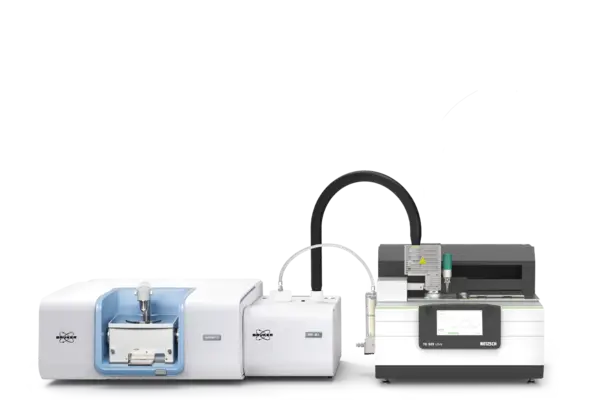
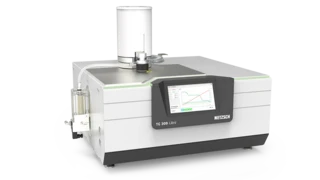
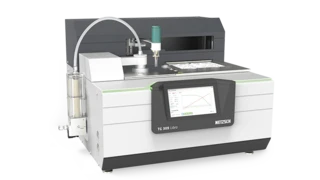
By coupling a Bruker FT-IR spectrometer with a NETZSCH thermogravimetric analyzer, TGA-FT-IR enables simultaneous measurement of mass changes and chemical identification of gases evolved.
This hyphenated approach not only reveals when Decomposition reactionA decomposition reaction is a thermally induced reaction of a chemical compound forming solid and/or gaseous products. decomposition occurs, but also why it occurs — and how environmental factors such as humidity influence reaction pathways.
Key Insights from our Study
In a recent study, we analyzed potassium clavulanate under dry and humid conditions using TGA-FT-IR. The results clearly show that moisture has a decisive impact on the Decomposition reactionA decomposition reaction is a thermally induced reaction of a chemical compound forming solid and/or gaseous products. decomposition process:
- The presence of humidity shifts decomposition temperatures
- Additional gas species are detected under humid conditions
- Decomposition reactionA decomposition reaction is a thermally induced reaction of a chemical compound forming solid and/or gaseous products. Decomposition mechanisms differ significantly compared to dry measurements
By identifying the evolved gases with FT-IR, it becomes possible to distinguish moisture-induced reactions from purely thermal degradation. This level of insight cannot be achieved with thermogravimetry alone.
Learn More in the Full Application Note
Added Value for Pharmaceutical Development and Quality Control
For pharmaceutical scientists, these findings translate directly into practical benefits:
- Improved understanding of humidity-driven degradation mechanisms
- Reliable data for defining storage and handling conditions
- Enhanced support for stability studies and regulatory documentation
- Reduced risk of unexpected degradation during processing or storage
The combination of quantitative mass change data and qualitative gas identification provides a robust analytical foundation for critical formulation and packaging decisions.
NETZSCH & Bruker: A Long-Standing Partnership in Evolved Gas Analysis
The successful application of TGA-FT-IR in pharmaceutical research is built on decades of collaboration. NETZSCH and Bruker Optics have worked together since 1993, continuously advancing hyphenated thermal analysis techniques.
This long-standing partnership combines NETZSCH’s expertise in thermal analysis with Bruker’s leadership in FT-IR spectroscopy, delivering reliable, application-oriented solutions for polymers, battery materials, and pharmaceuticals as well as many more materials and applications.
Review the Blog Series: From Batteries to Polymers to Pharma
This article concludes our monthly blog series on Evolved Gas Analysis with TGA-FT-IR “Beyond Peaks and Curves: Application Insights by NETZSCH and Bruker”
- Part 1:Identification of separator materials in battery applications
- Part 2:Detection of plasticizers in polymers, toys, and sporting goods
- Part 3:Influence of humidity on pharmaceutical decomposition
One message remains constant across all three application areas:
TGA-FT-IR provides answers that conventional thermal analysis alone cannot deliver.
In the next part of our NETZSCH Bruker blog series, we will move from pharmaceutical analysis to fire testing. We will show how coupling the NETZSCH TCC 918 Cone Calorimeter with the Bruker OMEGA FT-IR enables detailed analysis of combustion gases, providing deeper insight into toxic emissions and the fire behavior of materials.


Become an Expert with our Free E-Learning Courses
All NETZSCH E-Learning Basic Courses are free of charge! The content is created by our laboratory method experts, who share their personal experiences with you. Take advantage of flexible online learning, fully adapted to your training needs!