21.04.2026 by Aileen Sammler
More Transparency in Combustion Gas Analysis: OMEGA 5 FT-IR Coupling on the NETZSCH TCC 918 Cone Calorimeter
Beyond Peaks and Curves: Application Insights by NETZSCH and Bruker
The Monthly Blog Series with Bruker Optics – Part 4: Combining cone calorimetry with FT-IR gas analysis
Understanding the fire behavior of materials is essential for safety assessments in industries such as construction, transportation, electronics, and public infrastructure. In these environments, it is not only important to know how intensely a material burns, but also which gases are released during combustion.
More Transparency in Combustion Gas Analysis
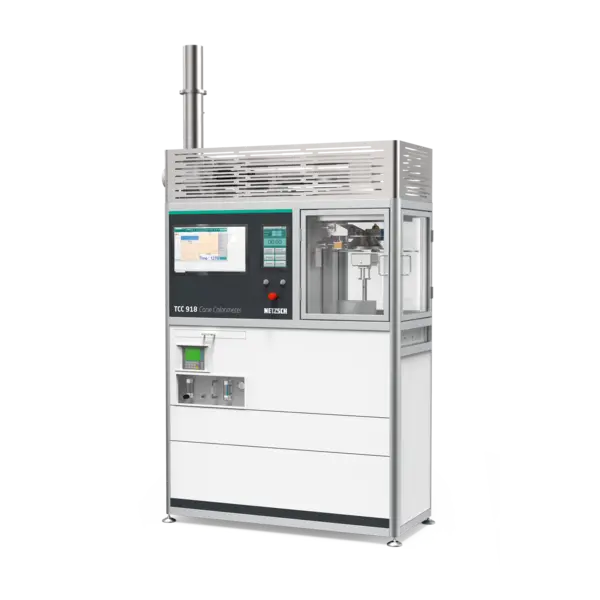
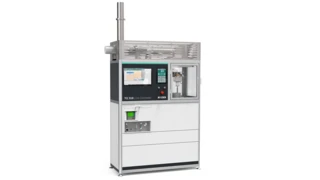
The NETZSCH TCC 918 Cone Calorimeter is a well-established instrument for analyzing fire behavior. By applying the oxygen consumption principle, it provides key fire parameters including oxygen, carbon dioxide and carbon monoxide concentrations, heat release rate (HRR), smoke production rate (SPR), mass loss rate (MLR), time to ignition (TOI), and time to flame out (TOF). Together, these parameters describe the fire performance of a material from ignition to flame extinction and are widely used to model real fire scenarios.
In this fourth article of our NETZSCH Bruker blog series on coupled analytical techniques, we look at how combining cone calorimetry with FT-IR gas analysis provides deeper insights into combustion processes and toxic emissions.
Cone Calorimetry: The Basis for Fire Behavior Analysis
During a cone calorimeter test, a sample is exposed to a defined heat flux from a cone heater, ignited, and allowed to burn under controlled conditions. The resulting flue gases are transported through an exhaust system where they are analyzed to determine key fire parameters.
Standard gas analysis in the TCC 918 focuses on the O₂, CO, and CO₂ concentrations, which are used to calculate the heat release rate according to the oxygen consumption principle. The heat release rate is one of the most important indicators of fire intensity and potential hazard.
Other classic cone calorimeter outputs include:
- Smoke Production Rate (SPR) – indicating visibility impairment and possible toxic exposure
- Mass Loss (ML) – reflecting material degradation and residue formation
- Time to Ignition (TOI) and Time to Flame Out (TOF) – describing the temporal behavior of combustion
These measurements already provide a comprehensive picture of fire behavior. However, they do not fully reveal the specific chemical species present in the combustion gases.
Expanding Fire Testing with FT-IR Gas Analysis
To obtain deeper insight into combustion processes, the NETZSCH TCC 918 Cone Calorimeter can be coupled with the Bruker OMEGA 5 FT-IR gas analyzer.
The connection is realized via a heated transfer line, ensuring rapid gas transport and preventing condensation of Decomposition reactionA decomposition reaction is a thermally induced reaction of a chemical compound forming solid and/or gaseous products. decomposition products. This enables real-time FT-IR analysis of the combustion gases during the experiment.
FT-IR spectroscopy identifies gases based on their characteristic infrared absorption spectra. In contrast to many other coupling techniques that primarily provide qualitative or semi-quantitative information, the OMEGA 5 FT-IR gas analyzer enables the direct and simultaneous quantitative determination of multiple gas species in the combustion stream.
In addition to the standard combustion gases such as CO₂, CO, and H₂O, the system can therefore simultaneously quantify a wide range of additional compounds, including:
- hydrocarbons (e.g., methane, ethene, ethyne)
- halogen compounds such as HCl, HBr, and HF
- nitrogen-containing species like HCN, NH₃, NO, NO₂, and N₂O
- organic compounds including formaldehyde, benzene, and phenol
- sulfur compounds such as SO₂
This capability allows researchers to move beyond classical fire parameters and obtain quantitative, time-resolved information on toxic and fire-relevant gas species, providing a much more comprehensive understanding of combustion processes and emission behavior.
Example: Fire Behavior of Polyamide Materials
To demonstrate the capabilities of this coupled system, a PA6 textile sample was tested in the cone calorimeter under a defined heat flux.
The classic cone calorimeter data revealed the typical fire behavior of the material, including the heat release rate and smoke production rate. At the same time, the FT-IR gas analysis provided detailed information on the composition of the smoke gases generated during combustion.
Among the detected gases were:
- CO₂ as the main combustion product
- H₂O from material and additive Decomposition reactionA decomposition reaction is a thermally induced reaction of a chemical compound forming solid and/or gaseous products. decomposition
- CO, indicating incomplete combustion
- NO and N₂O originating from nitrogen-containing polymer structures
- HCN, a highly toxic gas that can inhibit cellular respiration
The simultaneous detection of these gases allows researchers and engineers to evaluate not only the fire intensity, but also the toxicological risk of combustion products.
A More Complete View of Fire Safety
While the cone calorimeter quantifies the thermal fire behavior of a material, the FT-IR gas analyzer reveals the chemical composition of the resulting smoke gases. Together, they enable comprehensive assessment of materials with regard to fire behavior, toxic emissions, compliance with safety regulations and suitability for safety-critical applications.
Read the full application note here
This article is part four of our blog series highlighting the benefits of combining thermal and spectroscopic analysis through the long-term collaboration between NETZSCH and Bruker.
Stay tuned! Our next article will dive deeper into the investigation of cement raw material by STA-FTIR.
Review the Blog Series:
This article concludes our monthly blog series on Evolved Gas Analysis with TGA-FT-IR “Beyond Peaks and Curves: Application Insights by NETZSCH and Bruker”.
Review the full series:

Learn more about our fire testing products and coupling techniques
Become an Expert with our Free E-Learning Courses
All NETZSCH E-Learning Basic Courses are free of charge! The content is created by our laboratory method experts, who share their personal experiences with you. Take advantage of flexible online learning, fully adapted to your training needs!