Introduction
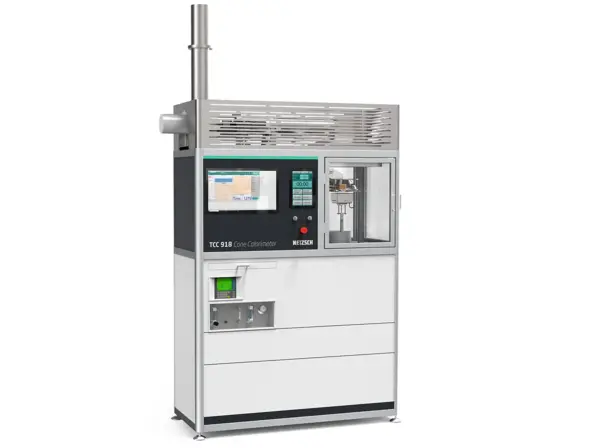
The fire behavior of materials is a crucial factor in safety assessments in areas such as construction, transportation, and electronics. The NETZSCH TCC 918 Cone Calorimeter (figure 1) determines key fire parameters based on the oxygen consumption principle, including:
- O2, CO2 and CO concentrations
- Heat release rate (HRR)
- Average heat release rate (ARHE)
- Smoke production rate (SPR)
- Mass loss rate (MLR)
- Time to ignition (TOI)
- Time to flame out (TOF)
These parameters provide a comprehensive picture of the thermal fire behavior of a material, from ignition to flame extinction, and serve as the basis for modeling and predicting real fire events.
Optional coupling with the Bruker OMEGA FT-IR gas analyzer allows the composition of the resulting smoke gases to be analyzed in detail. The quantitative detection of numerous Decomposition reactionA decomposition reaction is a thermally induced reaction of a chemical compound forming solid and/or gaseous products. decomposition and combustion products enables extensive assessment of toxic emissions and supports the development of safe, sustainable materials.
Measurement Principle
In the TCC 918, the sample is exposed to a defined heat flow using a cone heater, ignited, and burned under controlled conditions. The resulting flue gases are transferred via an exhaust system for further analysis.
As standard, the relevant flue gases, in particular O2, CO, and CO2, are analyzed using a Siemens Oxymat/Ultramat gas analyzer. These variables measured are used to calculate the heat release rate (HRR) according to the oxygen consumption principle.
The optional FT-IR coupling extends this approach and also enables the quantitative detection of further Decomposition reactionA decomposition reaction is a thermally induced reaction of a chemical compound forming solid and/or gaseous products. decomposition and combustion products. This allows for the flue gas composition to be examined in much greater detail, particularly with regard to toxic components.
OMEGA FT-IR Coupling
The coupling (figure 2) is achieved via a heated transfer line, similar to the FT-IR transfer line coupling of other NETZSCH analyzers (e.g., TG-FT-IR). Temperature control prevents condensation, ensures fast gas transport, and enables real-time analysis of the flue gases.
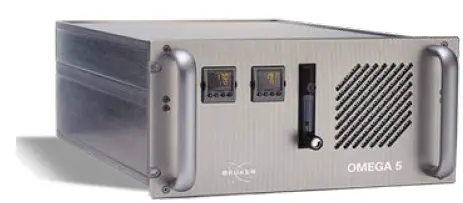
FT-IR spectroscopy simultaneously quantifies various gases based on their characteristic absorption spectra. This allows for numerous combustion and Decomposition reactionA decomposition reaction is a thermally induced reaction of a chemical compound forming solid and/or gaseous products. decomposition products to be detected.
In addition to the typical combustion gases CO2, CO, and H2O, these include hydrocarbons (CH4, ethene, ethyne), halogen compounds (HCl, HBr, HF), nitrogen compounds (HCN, NH3, NO, NO2, N2O), organic substances (acrolein, formaldehyde, benzene, phenol), and sulfur compounds (SO2).
This extended gas analysis provides valuable information about potentially toxic by-products, especially in applications with high fire safety requirements, such as in rail vehicle construction.
Typical examples are polyamides (PA), which are often used in interior trim, seats, cable insulation, and molded parts due to their strength and heat resistance. They are also found in public buildings and households, for example, in floor coverings, furniture, and electrical components. As organic polymers, they can release considerable amounts of smoke and toxic gases in the event of a fire, so detailed investigation of their fire behavior is crucial for safe use.
Measurement Conditions
A PA6 textile measuring 50 x 50 x 7 mm3 (8 layers) and weighing 10.58 g was examined. The test parameters are summarized in table 1.
Table 1: Measurement conditions
| Sample holder | Horizontal |
|---|---|
| Heat flow | 50 kW/m2 |
| Nominal flow rate | 24.0 l/s |
| Distance to the cone heater | 25 mm |
| FT-IR interface temperature | 180°C |
| FT-IR measurement parameters | Transmission mode; resolution: 1 cm-1; averaged scans per spectrum: 10parts |
Classic Cone Calorimeter Measurement Values
The following figures show the most important classic fire parameters that form the basis for assessing fire behavior:
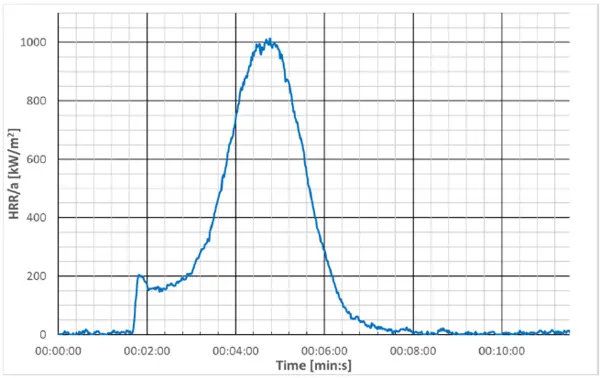
The heat release rate (HRR, figure 3) is a measure of fire intensity and thus a key indicator of potential danger.
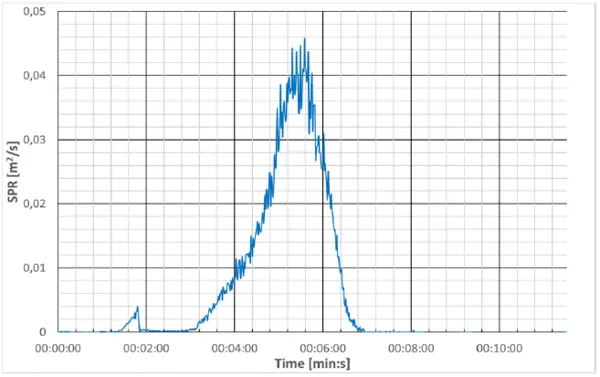
The smoke production rate (SPR, figure 4) provides information on visibility impairment and possible toxic exposure.
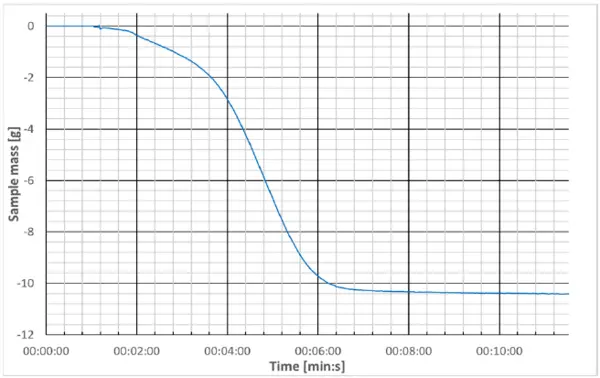
The mass loss (ML, figure 5) correlates directly with material combustion and provides information on stability and residue formation.
Advanced FT-IR Gas Analysis
In addition to these established parameters, supplementary FT-IR analysis now provides new insights into the chemical composition of the flue gases produced.
With the OMEGA FT-IR coupling, the flue gas composition during combustion could be precisely determined (figure 6).
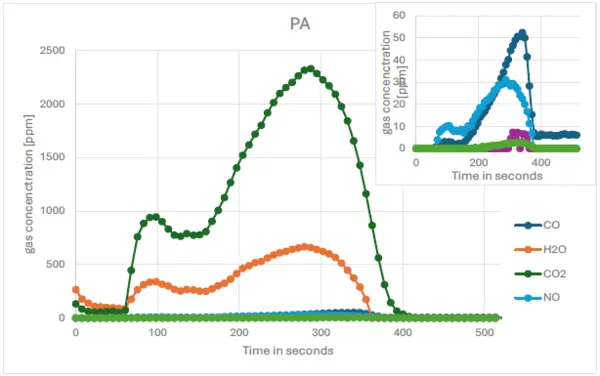
The following components were recorded in particular (see also figure 6):
- CO2 – Main product of combustion, correlates with oxygen consumption
- H2O – Water vapor from material and additive Decomposition reactionA decomposition reaction is a thermally induced reaction of a chemical compound forming solid and/or gaseous products. decomposition
- CO – Indicator of incomplete combustion (colorless and odorless asphxiant)
- NO – Formed from nitrogen compounds in the polyamide
- N2O – Byproduct of nitroxen OxidationOxidation can describe different processes in the context of thermal analysis.oxidation (highly irritating to the respiratory tract)
- HCN – Highly toxic, inhibits cellular respiration
The simultaneous detection of these gases enables comprehensive evaluation of the materials, both in terms of their thermal fire behavior (HRR, SPR, MLR) and their toxicological relevance.
Summary
Coupling of the TCC 918 Cone Calorimeter with the Bruker OMEGA FT-IR gas analyzer expands classic fire gas analysis to include simultaneous detection of numerous toxic and fire-relevant gases. In addition to the standard parameters of the TCC 918, detailed information on the composition of the smoke gas can thus be obtained.
This allows for holistic evaluation of materials in terms of fire behavior, toxic emissions, and safety requirements – a considerable added value for research, product development, and safety assessment.
With this combination of precise calorimetry and modern FT-IR spectroscopy, NETZSCH offers a powerful tool for innovative material analysis and safety assessment in fire testing.