19.05.2026 by Aileen Sammler
Understanding Cement Raw Materials: STA-FT-IR Analysis for Deeper Insight into Thermal Processes
Beyond Peaks and Curves: Application Insights by NETZSCH and Bruker
The Monthly Blog Series with Bruker Optics – Part 5: STA-FTIR Analysis of Cement Raw Materials - Linking Thermal Effects and Gas Evolution
The production of cement involves a complex sequence of physical and chemical transformations that occur during heating and ultimately determine clinker formation and material performance. To fully understand these processes, it is not enough to track mass loss or thermal effects alone. What is needed is a method that directly links thermal behavior with gas evolution.
In this fifth article of our NETZSCH–Bruker blog series, we explore how STA-FT-IR coupling provides exactly this level of insight for inorganic materials, using the example of cement raw materials.
STA-FT-IR: Linking Thermal Effects and Gas Evolution
Thermal analysis of cement raw materials typically involves multiple overlapping processes, including dehydration, Decomposition reactionA decomposition reaction is a thermally induced reaction of a chemical compound forming solid and/or gaseous products. decomposition, and Phase TransitionsThe term phase transition (or phase change) is most commonly used to describe transitions between the solid, liquid and gaseous states.phase transitions.
Using simultaneous thermal analysis (STA), mass changes (TGA) and heat flow (DSC) are recorded in a single measurement. When combined with FT-IR gas analysis, these thermal events can be directly correlated with the composition of the gases released during heating.
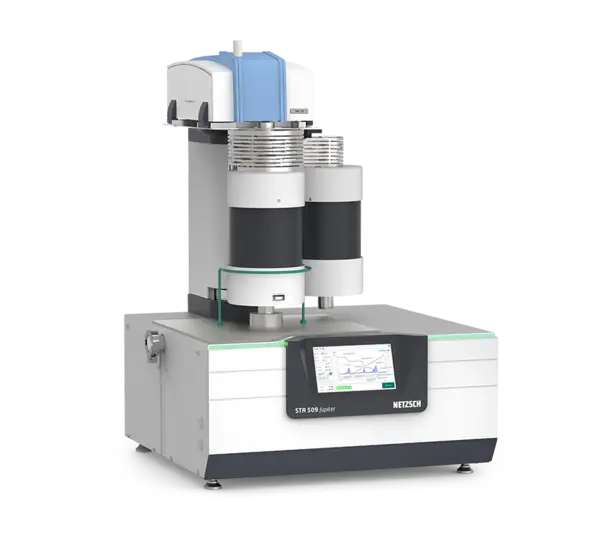
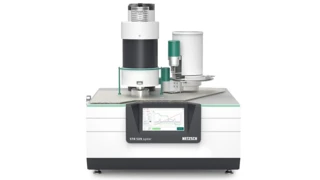
A key advantage of the NETZSCH STA Jupiter® coupled with Bruker ALPHA II FT-IR via the PERSEUS® concept is the direct integration of the spectrometer into the furnace. This results in:
- avery short, heated gas path
- minimal dead volume
- excellent synchronization between thermal and spectroscopic signals
This setup is particularly beneficial for analyzing complex inorganic systems such as cement raw materials.
Typical Thermal Processes in Cement Raw Materials
STA-FT-IR analysis reveals a sequence of characteristic processes over a wide temperature range up to approx. 1450°C.
Key steps include:
- 100–200°C: Release of physically bound water and dehydration of calcium sulfate phases
- 400–600°C: Dehydroxylation of calcium hydroxide
- Approx 575°C: a à b phase transformation of quartz (SiO₂)
- 700–850°C: Decarbonation of calcium carbonate with the release of CO₂
- >1200°C: Formation of silicate phases and start of high-temperature reactions
- >1250°C: Decomposition reactionA decomposition reaction is a thermally induced reaction of a chemical compound forming solid and/or gaseous products. Decomposition of sulfates with release of SO₂ and beginning of melting processes
These processes are typical for cement and clinker-related systems and define the material’s behavior during production.
Direct Identification of the Gases Evolved
The real strength of STA-FT-IR lies in the direct correlation between mass loss and gas evolution.
In our latest study, we clearly identified and assigned the following gases to specific reaction steps:
- H₂O → released during dehydration and dehydroxylation
- CO₂ → released during carbonate Decomposition reactionA decomposition reaction is a thermally induced reaction of a chemical compound forming solid and/or gaseous products. decomposition
- SO₂ → released during sulfate Decomposition reactionA decomposition reaction is a thermally induced reaction of a chemical compound forming solid and/or gaseous products. decomposition
By combining thermal signals with FT-IR data, it becomes possible to unambiguously assign individual reaction steps, even in complex and overlapping processes.
Why This Matters for Cement and Inorganic Materials
Cement raw materials are multi-component systems with interdependent reactions. Without gas analysis, interpreting overlapping thermal effects can be ambiguous.
STA-FT-IR solves this challenge by providing:
- clear identification of reaction mechanisms
- direct correlation of thermal effects and gas release
- reliable interpretation of complex transformation processes
This makes the method a powerful tool for:
- optimizing raw material composition
- improving clinker formation processes
- supporting process development and quality control
A Powerful Tool for Inorganic Material Analysis
By combining TGA, DSC, and FT-IR, STA-FT-IR allows for comprehensive understanding of thermal processes in inorganic materials.
The ability to simultaneously track mass changes, thermal effects, and gas composition significantly reduces ambiguity and provides a much clearer picture of the material behavior during heating.
👉 Read the Full Application Note
Learn More
This article is part five of our blog series highlighting the benefits of combining thermal analysis with spectroscopic techniques in cooperation with Bruker.
Stay tuned! Our next article will provide more insights into the advanced characterization of pharmaceutical materials using the new STA 319 Jupiter®!
Missed former blog articles of this series? See here:



Become an Expert with our Free E-Learning Courses
All NETZSCH E-Learning Basic Courses are free of charge! The content is created by our laboratory method experts, who share their personal experiences with you. Take advantage of flexible online learning, fully adapted to your training needs!