
Open-Source Rheology Solutions by NETZSCH
Transform Soft Material Testing with Rheodialysis for NETZSCH Kinexus Rheometer
Rheodialysis technology: A new tool for real-time characterization and testing of soft materials.
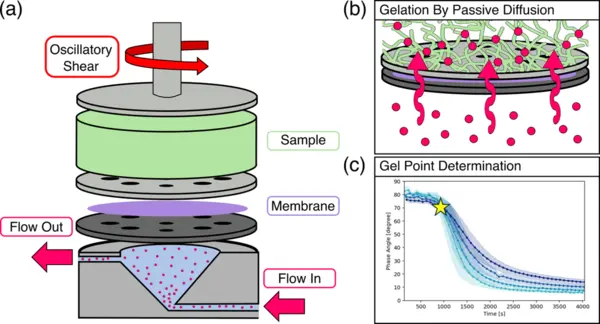
Rheodialysis allows for real time changes of a sample´s chemistry by applying ions via a membrane into the sample on a rotational rheometer.
Explore the innovative rheodialysis developed by the University of Liverpool (Dr. Anders Aufderhorst-Roberts, Lecturer in Sustainable & Biological Materials at the School of Engineering) and Durham University (Prof. John Girkin, Professor of Biophysics at the Department of Physics) in collaboration with NETZSCH, offering an unprecedented capability to probe the interplay between chemical environments and mechanical forces in soft materials.

“More often than not, when a material encounters a change in shear environment, this coincides directly with change in chemical environment. But commercial rheometers cannot control shear and chemistry simultaneously and this represents an obvious blindspot when understanding the processing of soft structured materials and their end use applications. It’s also integral to many biological processes.
Rheodialysis is a new device that represents our shared vision to address this blindspot. It’s a joint endeavour between my team, our collaborators at Durham University and our colleagues at NETZSCH. Rather than commercialising this device, we’re making it fully and freely available to all interested users. If you believe this might help you answer new research questions, we’d like to hear from you. Please get in touch below.”
WHY RHEODIALYSIS?

Why Choose Rheodialysis for NETZSCH Kinexus?
Almost all soft materials ‒ biological or industrial ‒ are highly sensitive to mechanical StressStress is defined as a level of force applied on a sample with a well-defined cross section. (Stress = force/area). Samples having a circular or rectangular cross section can be compressed or stretched. Elastic materials like rubber can be stretched up to 5 to 10 times their original length.stress and their chemical surroundings. This rheology system uniquely enables you to:
- Simultaneously control chemical environment and mechanical forces in your shear rheometer tests
- Monitor real-time changes in rheological properties, including viscosity and shear StressStress is defined as a level of force applied on a sample with a well-defined cross section. (Stress = force/area). Samples having a circular or rectangular cross section can be compressed or stretched. Elastic materials like rubber can be stretched up to 5 to 10 times their original length.stress during dynamic chemical changes
- Understand synergy between chemical and mechanical stimuli for soft solids, gels, and dispersions
- Model realistic processes such as digestion, drug release, and blood clotting kinetics with automated chemical diffusion control
Take a look at our white paper if you would like to learn more about the Rheodialysis Approach:


Join us in advancing open-source Rheodialysis!
Key Benefits of Rheodialysis
- Dynamic chemical environment control: Precisely adjust buffers, solvents, acids, or enzymes within the integrated flow cell of your Kinexus rotational rheometer
- Advanced viscosity and mechanical property measurement: Track how polymers, hydrogels, pharmaceuticals, food products, and personal care formulations respond under chemical and mechanical StressStress is defined as a level of force applied on a sample with a well-defined cross section. (Stress = force/area). Samples having a circular or rectangular cross section can be compressed or stretched. Elastic materials like rubber can be stretched up to 5 to 10 times their original length.stress
- Seamless integration: Designed exclusively for the modular NETZSCH Kinexus rheometer with easy plug-and-play cartridge swapping for multi-user labs
- Automation-ready testing: Enable automated multi-condition rheology testing, such as variable pH environments, saving time and boosting test accuracy
- Versatile for life sciences and industrial applications: From healthcare and pharmaceutical controlled reagent release to food digestion simulation and adhesive wear analysis
Rheodialysis: An Experimental Platform for Changing a Sample’s Chemical Environment during Rheological Testing
Cutting-Edge Applications for Rheodialysis Technology
- Monitoring the gelation kinetics of polymers under chemical initiators.
- Simulation of digestion and enzyme exposure on structured food materials
- Monitoring the controlled release of reagents in pharmaceuticals under shear StressStress is defined as a level of force applied on a sample with a well-defined cross section. (Stress = force/area). Samples having a circular or rectangular cross section can be compressed or stretched. Elastic materials like rubber can be stretched up to 5 to 10 times their original length.stress.
- Rheological response of creams and cosmetics to salinity and enzyme interaction
- Adhesive property changes under combined chemical and mechanical wear
- Blood clotting kinetics and soft biological material rheology

Why should you decide for a NETZSCH Kinexus Shear Rheometer?
| Feature | Benefit |
|---|---|
| Modular, open design with easy sample access | Effortless cartridge swapping with dedicated rheology accessory ensures quick transitions between tests |
| Optimized rheology accessory fit for Kinexus only | Eliminates adaptation challenges, guaranteeing precise chemical-mechanical coupling measurements |
| Proprietary rSpace software controls automation | Synchronizes chemical environment changes and rheological measurements for streamlined experiments |
| High sensitivity and dual-action shear and axial testing | Enables comprehensive investigation of complex fluids, soft solids, and dispersions |
Contact Us to Learn More
Discover how rheodialysis technology for your NETZSCH Kinexus rheometer can revolutionize your rheological testing of chemically sensitive soft materials. Discuss custom applications for pharmaceutical, healthcare, food, and material science innovations with our experts!
Join us in advancing open-source Rheodialysis!
FAQs about the NETZSCH Rheometer Service