Time Domain Thermoreflectance Analyzer
For determining the Thermal DiffusivityThermal diffusivity (a with the unit mm2/s) is a material-specific property for characterizing unsteady heat conduction. This value describes how quickly a material reacts to a change in temperature.thermal diffusivity and Thermal ConductivityThermal conductivity (λ with the unit W/(m•K)) describes the transport of energy – in the form of heat – through a body of mass as the result of a temperature gradient (see fig. 1). According to the second law of thermodynamics, heat always flows in the direction of the lower temperature.thermal conductivity of thin films with thicknesses in the nanometer range
The LFA method can typically be used on samples with a thickness of between 0.1 mm and 6 mm. However, with ever-advancing designs in electronic instruments and the associated demand for efficient thermal management, it is more important than ever to achieve precise measurements of Thermal DiffusivityThermal diffusivity (a with the unit mm2/s) is a material-specific property for characterizing unsteady heat conduction. This value describes how quickly a material reacts to a change in temperature.thermal diffusivity, Thermal ConductivityThermal conductivity (λ with the unit W/(m•K)) describes the transport of energy – in the form of heat – through a body of mass as the result of a temperature gradient (see fig. 1). According to the second law of thermodynamics, heat always flows in the direction of the lower temperature.thermal conductivity and transition Contact ResistanceAccording to the second law of thermodynamics, heat transfer between two systems always moves in the direction from higher to lower temperatures. The amount of thermal energy transferred by heat conduction, e.g., through a wall of a building, is influenced by the thermal resistances of the concrete wall and the insulation layer.contact resistance into the nanometer range. In this application area, materials range in thickness from 10 nm to 20 µm. They may take the form of phase change storage (PCM), thermoelectric thin films, light-emitting diodes (LED), dielectric interface layers or even transparent conductive films (TCF).
Our Time Domain Thermoreflectance Analyzers
Explore the range of NETZSCH TDTR instruments
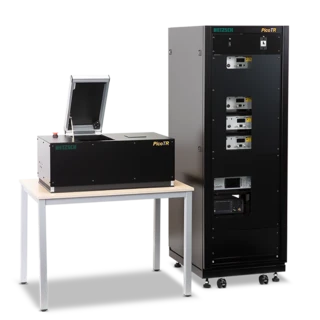
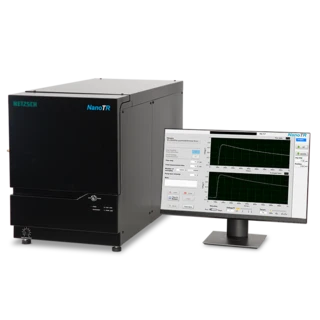
Benefits of NETZSCH TDTR instruments
NETZSCH Time DomainA time domain analysis is based on changes in physical signals related to time. A time-domain graph shows how a signal changes over time. In the case of thermoreflectance or the laser flash method, the detector signal (voltage change) is recorded – at a minimum – over the time range between the energy input and the signal maximum (e.g., RF mode) or as a function of the expected heat diffusion time (e.g., FF mode).Time Domain ThermoreflectanceThermoreflectance is a method for determining the thermal diffusivity and thermal conductivity of thin films with thicknesses in the nanometer range.Thermoreflectance (TDTR) analyzers allow for precise, non-destructive thermal characterization of ultra-thin films and interfaces ranging from a few nanometers to tens of micrometers thick. Using ultrafast laser pulses, these analyzers deliver accurate data on Thermal DiffusivityThermal diffusivity (a with the unit mm2/s) is a material-specific property for characterizing unsteady heat conduction. This value describes how quickly a material reacts to a change in temperature.thermal diffusivity, thermal conductivity, and interfacial thermal resistance in minutes — even for delicate or patterned samples.
- Ultra-thin film measurement
Accurate Thermal DiffusivityThermal diffusivity (a with the unit mm2/s) is a material-specific property for characterizing unsteady heat conduction. This value describes how quickly a material reacts to a change in temperature.thermal diffusivity/thermal conductivity results for layers from a few nanometers to tens of micrometers thick. - Non-contact & non-destructive
Ultrafast laser heating/detection preserves delicate surfaces. - RF and FF configurations
NanoTR and PicoTR can be configured for both RF (rear heating/front detection) and FF (front heating/front detection) measurements. - Versatile
Works with opaque and transparent samples via front or rear heating / front detection modes. - Fast & comprehensive
Determines thermal diffusivity, thermal conductivity, and interfacial thermal resistance in minutes. - Standardized & reliable
Complies with JIS R 1689/1690 for traceable results. - Widest thickness range: In combination with our LFA instruments, we are able to offer solutions for everything from thin films in the nanometer range to bulk materials in the millimeter range.
Long Instrument Life
Always There for You
Proven Excellence in Service
Principle of the TDTR Method
Thermoreflectance by Pulsed Light Heating
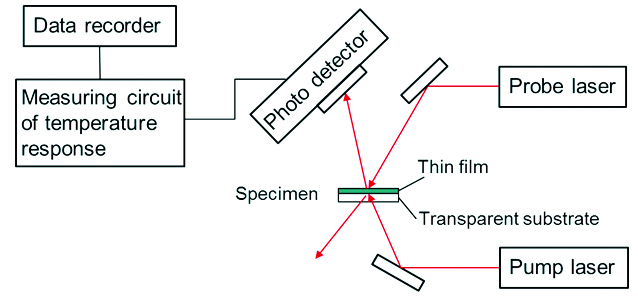
In contrast with the conventional laser flash method, there is no infrared detector used to measure the temperature increase in the sample following a short laser pulse. Instead, the temperature-dependent reflectivity of a surface is used to generate the measurement signal (voltage change).
The thin film is heated by a short laser pulse (pump laser). At the same time, an additional laser (probe laser) is left on continuously. The laser light of the probe laser is reflected by the film surface to the detector. The absolute value of voltage change in the detector is proportional to the temperature change of the film’s surface. A model calculation on the basis of the voltage change yields the heat diffusion time and thermal diffusivity of thin films.
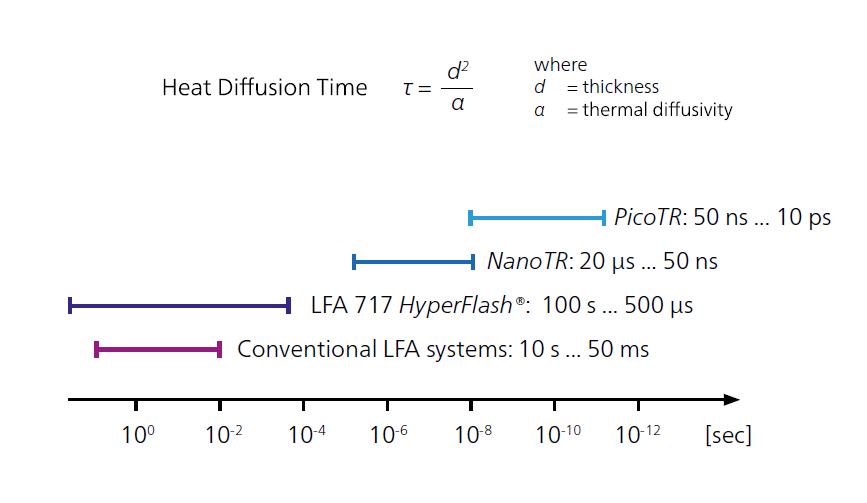
The heat diffusion time (t) is dependent on the thickness (d) and thermal diffusivity (a). The possible heat diffusion time ranges can be seen in figure 1. The lower limit for the LFA 467, for example, is ~500 µs which is comparable to a copper plate with a thickness of 200 µm. In contrast with this, the PicoTR (pico-second ThermoreflectanceThermoreflectance is a method for determining the thermal diffusivity and thermal conductivity of thin films with thicknesses in the nanometer range.thermoreflectance apparatus) is able to measure a molybdenum film with a thickness of 100 nm. For applications in the range between the LFA and PicoTR, the more cost-effective NanoTR (nano-second ThermoreflectanceThermoreflectance is a method for determining the thermal diffusivity and thermal conductivity of thin films with thicknesses in the nanometer range.thermoreflectance apparatus) is available.
Thermal Management of Thin Films
The National Institute of Advanced Industrial Science and Technology (AIST), Japan, already responded to industrial requirements with the development of a “pulsed light heating ThermoreflectanceThermoreflectance is a method for determining the thermal diffusivity and thermal conductivity of thin films with thicknesses in the nanometer range.thermoreflectance method” in the early 90’s. PicoTherm Corporation was established in 2008 with the launch of a nano-second ThermoreflectanceThermoreflectance is a method for determining the thermal diffusivity and thermal conductivity of thin films with thicknesses in the nanometer range.thermoreflectance apparatus “NanoTR” and a pico-second ThermoreflectanceThermoreflectance is a method for determining the thermal diffusivity and thermal conductivity of thin films with thicknesses in the nanometer range.thermoreflectance apparatus, “PicoTR”, which allows for absolute measurements of the thermal diffusivity of thin films in a thickness range of several tens of micrometers down into the nanometer range.
In October 2020, PicoTherm joined the NETZSCH Group as a subsidiary of NETZSCH Japan. In combination with our LFA systems, PicoTherm’s product line allows NETZSCH to now offer solutions for everything from thin films in the nanometer range to bulk materials in the millimeter range.
Frequently Asked Questions

Applications for Thermoreflectance
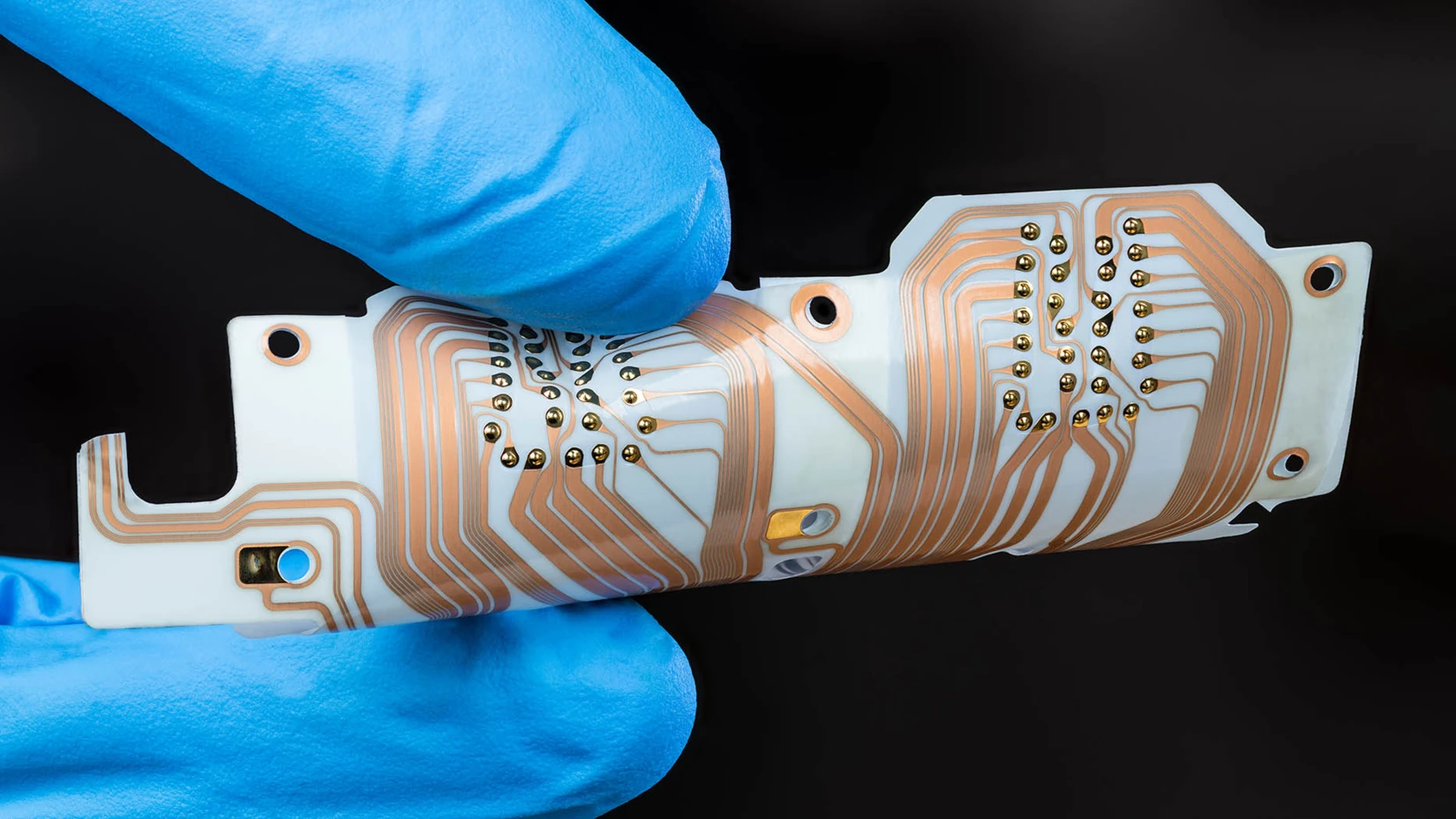
Managing heat flow in modern devices starts with understanding how thin films and interfaces behave. NETZSCH NanoTR and PicoTR analyzers use Time DomainA time domain analysis is based on changes in physical signals related to time. A time-domain graph shows how a signal changes over time. In the case of thermoreflectance or the laser flash method, the detector signal (voltage change) is recorded – at a minimum – over the time range between the energy input and the signal maximum (e.g., RF mode) or as a function of the expected heat diffusion time (e.g., FF mode).Time Domain ThermoreflectanceThermoreflectance is a method for determining the thermal diffusivity and thermal conductivity of thin films with thicknesses in the nanometer range.Thermoreflectance (TDTR) to deliver precise, non-contact measurements of thermal diffusivity, Thermal ConductivityThermal conductivity (λ with the unit W/(m•K)) describes the transport of energy – in the form of heat – through a body of mass as the result of a temperature gradient (see fig. 1). According to the second law of thermodynamics, heat always flows in the direction of the lower temperature.thermal conductivity, and interfacial thermal resistance in films from a few nanometers to several micrometers thick. Whether you are developing next-generation microelectronics, improving LED efficiency, or optimizing battery materials, these instruments provide the data you need to design materials and systems with superior thermal performance.
Typical applications include:
- LED & Laser Devices
- Measuring thermal conductivity of epitaxial layers and substrates
- Interface resistance analysis for heat-spreading layers
- Thin-Film Coatings
- Thermal behavior of optical coatings, hard coatings, and protective layers
- Layer uniformity verification on wafers or substrates
- Thermoelectric Materials
- Evaluation of thin-film thermoelectric elements for efficiency optimization
- Data Storage & Photonics
- Heat management in magnetic storage layers and photonic components
- Battery & Energy Materials
- Thermal properties of thin electrode coatings, separators, and solid electrolyte layers
- Research & Development
- Material screening for nanotechnology, advanced composites, and novel functional films
- Interfacial thermal resistance (Kapitza resistance) studies in multilayer systems

Media and Training


Application Literature
Our latest blog articles


Videos about the Time Domain Thermoreflectance Method

Consultancy & Sales
Do you have further questions about the instrument or the method? Would you like to speak to a sales represenative?
Service & Support
Do you already have an instrument and need technical support or spare parts?
FAQs about NETZSCH Service