
Customer SUCCESS STORY
Rheology, Innovation and Regional Collaboration: Driving the Future of Bioplastics and Recycled Materials
How can research, education, industry and advanced material characterization work together to accelerate the development of more sustainable polymers? In the Auvergne-Rhône-Alpes region of France, Green Business and Consulting Company, Jean Zay Technical High School, Clermont Auvergne INP and NETZSCH have joined forces to create a collaborative platform focused on bioplastics, recycled materials and plastics processing. At the center of this cooperation is rheology – connecting fundamental material understanding with real industrial processing conditions.
In this Customer Success Story, Laurent Massacrier, President of Green Business and Consulting Company, explains how complementary expertise and advanced rotational and capillary rheometry are supporting the development of next-generation sustainable polymers.

“Thanks to the advanced RH7 capillary rheometer from NETZSCH, we are able to generate accurate rheological data for simulation software and support mold development to study biopolymer injection under real processing conditions, helping to anticipate and prevent industrial challenges.”
Addressing Sustainability Challenges Through Material Science
In a rapidly evolving industrial and regulatory landscape, a deep understanding of polymer materials has become a key driver of innovation. As industries strive to meet ambitious sustainability, circularity, and performance targets, advanced material characterization is playing an increasingly strategic role.
With this objective in mind, Green Business and Consulting Company,a company dedicated to the development of eco-responsible solutions including biomaterials and bioplastics (biobased and/or biodegradables), but also recycled plastics, has launched a unique technical and scientific collaboration within the Auvergne-Rhône-Alpes region of France.
This initiative brings together four partners whose complementary expertise creates a powerful innovation ecosystem:
- Green Business and Consulting Company, specialist in bioplastics and bioplastics development, with a strong expertise in Ecodesign and LCA
- Jean Zay Technical High School (in Thiers), a recognized center of excellence in plastics processing education and technical training;
- Clermont Auvergne INP, a leading engineering institute combining world-class research with industrial innovation transfer;
- NETZSCH, a global leader in advanced rheological testing technologies.
At the heart of this collaboration lies rheology, the science of material flow and deformation. Rheology serves as the essential link between academic research and industrial application, providing critical insights into the behavior of complex polymer systems.
This expertise is particularly important for emerging materials such as bioplastics and recycled polymers, whose physical and chemical properties can vary significantly depending on composition, microstructure, and processing conditions.
The importance of advanced characterization is further amplified by the forthcoming requirements of the European Packaging and Packaging Waste Regulation (PPWR), which entered into application in August 2026, introduced stricter obligations regarding the use of recycled and sustainable materials in packaging in the coming years.
To address these challenges, the partners combined their strengths in education, research, materials innovation, and metrology, creating a collaborative platform capable of accelerating the development of next-generation sustainable polymers.
Advanced Instrumentation: Enabling Knowledge and Performance
NETZSCH Kinexus Prime Pro+ Rotational Rheometer
The scientific expertise in rotational rheometry, driven by the research staff of the Institut Pascal’s GePEB research group, is leveraged through the Gen’Mat technology transfer platform at Polytech Clermont (Clermont Auvergne INP), managed by Fabrice Audonnet. Acquired through the AMI CMA “Académie des Mobilités” funding program to support engineering education, these instruments are utilized for advanced material characterization, serving both the education of CA INP engineering students and academic research.
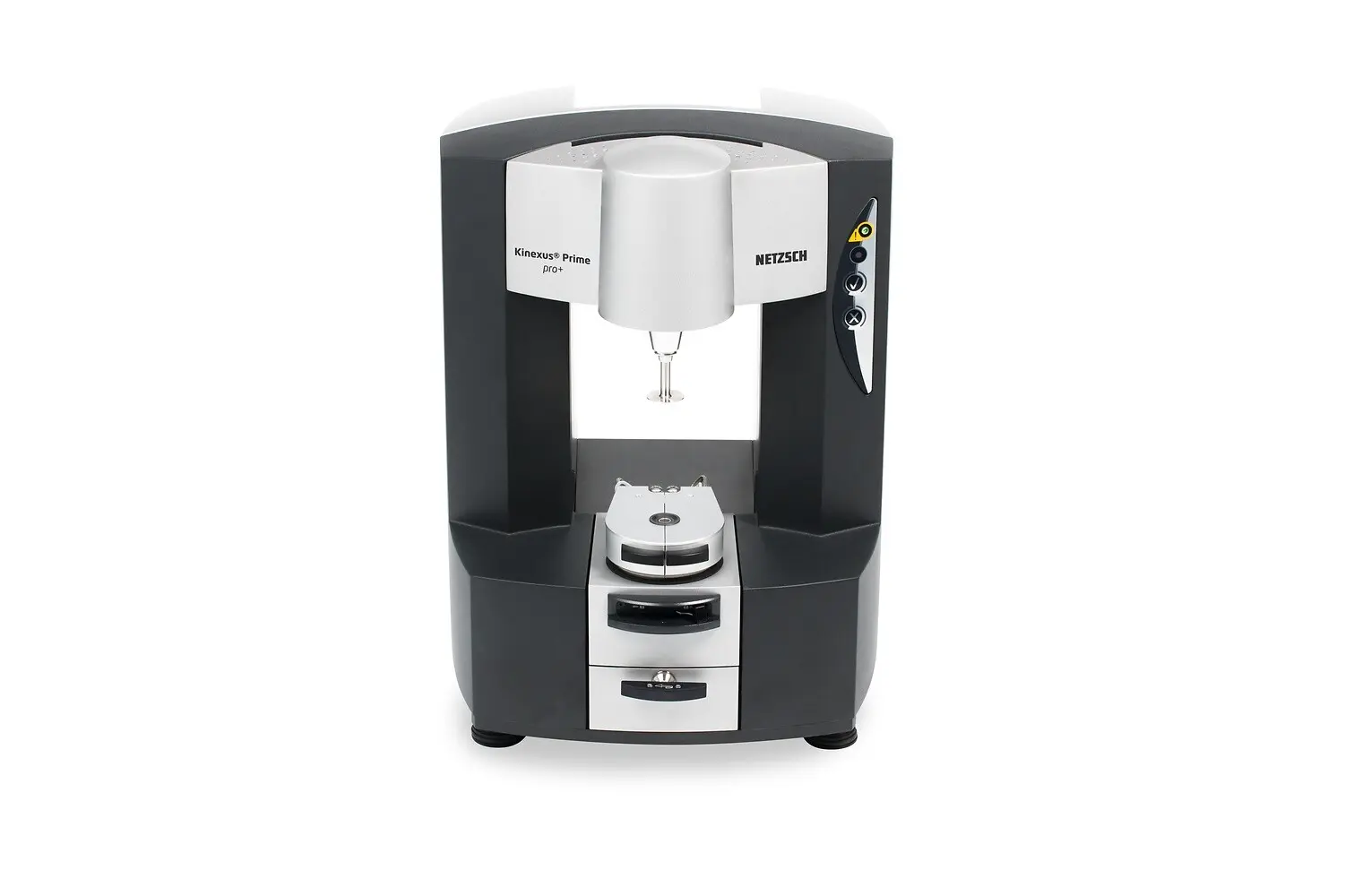
Equipped with a HTC Prime furnace, the NETZSCH Kinexus Prime Pro+ rotational rheometer provides fundamental insights into material structure and behavior under low shear conditions. The system enables precise measurement of critical properties such as:
- Dynamic viscosity;
- Viscoelastic moduli;
- Physical transitions including flow behavior and elasticity.
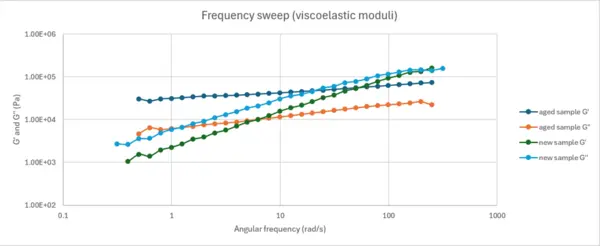
As an established tool for rheological analysis, it supports the understanding and development of advanced polymer formulations (Cf. Figure 1 about properties with aging).
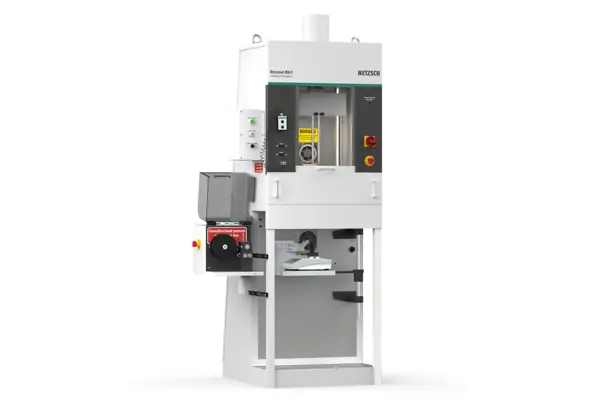
NETZSCH Rosand RH7 Capillary Rheometer: A Major Technological Leap
The acquisition of the NETZSCH Rosand RH7 capillary rheometer (Cf. Figure 2), with technical support from Frédéric Fraisse, represents a significant step forward toward reproducing real industrial processing conditions such as extrusion and injection molding.
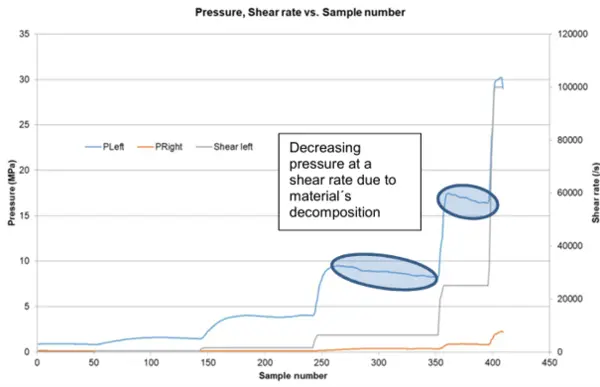
The instrument enables the characterization of key melt-state properties including:
- Shear and extensional viscosity under high-pressure conditions;
- Elastic behavior and flow profiles across a broad range of shear rates (Cf. Figure 3);
- pVT (Pressure-Volume-Temperature) properties, essential for modeling material compressibility and thermal expansion.
These measurements provide highly accurate data for process simulation, tool design, and part manufacturing, ultimately enhancing product quality and reducing development time.
“The integration of the Kinexus Prime Pro+ and the Rosand RH7 within the Gen'Mat platform bridges our fundamental research at the Institut Pascal (GePEB) with industrial application. It gives our engineering students at Polytech Clermont and our industrial partners access to cutting-edge characterization, which is essential for driving the transition towards sustainable polymers.”
Complementary Technologies Delivering Comprehensive Material Understanding
The combination of rotational and capillary rheometry provides a broad and complementary analytical capability.
Rotational rheometry is particularly valuable for studying material response under low deformation rates and determining viscoelastic properties.
Capillary rheometry, by contrast, provides critical information under the demanding conditions encountered during industrial processing, where materials are exposed to high shear rates and elevated temperatures.
Together, these technologies enable comprehensive rheological characterization by linking fundamental material properties such as viscosity, elasticity, and solid-to-liquid transitions with key process parameters including pressure, temperature, volume, and flow velocity.
For complex materials such as biopolymers and recycled blends, whose properties can vary significantly, this integrated approach provides a major scientific advantage. It facilitates formulation optimization, improves process predictability, and supports the successful transfer of innovations from laboratory development to large-scale industrial production.
Building Skills and Fostering Knowledge Transfer
A cornerstone of this partnership is the mutual exchange of expertise.
NETZSCH delivers advanced practical training to academic and research staff from both the Institut Pascal and Clermont Auvergne INP, as well as to the technical teams of Green Business and Consulting Company. Developing these competencies is essential to fully leverage the analytical power of the Rosand RH7 and generate high-quality data for the development of future generations of sustainable polymers.
At the same time, Jean Zay Technical High School, under the leadership of David Bonnet, has made an important contribution through its plastics processing programs and technical facilities, particularly within the framework of the EuroPlastics & Composites BTS program.
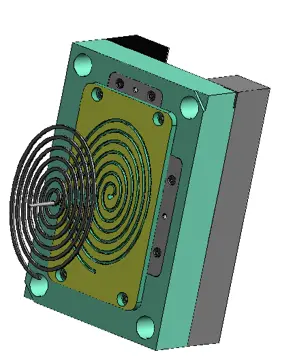
The school designed and manufactured a spiral flow mold (Cf. Figure 4), which will be installed on an ENGEL 60-ton electric injection molding machine. This educational and scientific tool will enable students and researchers to visualize the direct relationship between material rheology and industrial processing performance.
Its integration into practical workshops strengthens the connection between academic learning and industrial reality while encouraging future technicians to engage with sustainable materials and technological innovation.
A Model of Regional Excellence
This collaboration perfectly illustrates a holistic innovation model that spans the entire value chain, from fundamental research to industrial application, supported by high-level technical education.
By aligning the research capabilities of Clermont Auvergne INP, the educational expertise of Jean Zay Technical High School, the state-of-the-art technologies of NETZSCH, and the market-driven innovation strategy of Green Business and Consulting Company, the Auvergne-Rhône-Alpes region is establishing itself as a benchmark for successful regional cooperation.
Together, these partners are helping shape the future of plastics processing: more circular, more technical, and more sustainable.
Thank You for the Successful Collaboration
We would like to sincerely thank Laurent Massacrier, Green Business and Consulting Company, Fabrice Audonnet, Institut Pascal's GePEB research group and Gen’Mat platform (Polytech Clermont, Clermont Auvergne INP), David Bonnet, Jean Zay Technical High School, as well as everyone involved in this collaboration for their trust, expertise and commitment.
We are pleased to be part of this strong regional partnership and look forward to seeing how the combined expertise in rheology, materials development, research and education will continue to contribute to the development of more sustainable polymer solutions.