23.07.2026 von Aileen Sammler
Rheodialysis: Controlling Chemistry and Shear Simultaneously with the NETZSCH Kinexus Rheometer
How do materials respond when chemistry and shear change simultaneously? Discover Rheodialysis with the NETZSCH Kinexus Rheometer!
Explore the new Rheodialysis Solution
Soft materials rarely experience mechanical forces in isolation.
In real processes, shear and chemistry change at the same time.
Until now, commercial rotational rheometers could control mechanical stress and strain – but not the chemical environment dynamically during the test. This created a blind spot in understanding gels, biopolymers, pharmaceuticals, food systems and biological materials.
With the new Rheodialysis solution for the NETZSCH Kinexus rotational rheometer, this gap has been closed.
Why Is This Important?
Consider an alginate hydrogel used to encapsulate an active pharmaceutical ingredient.
As soon as the material comes into contact with calcium ions, it begins to transform from a liquid into a gel. At the same time, diffusion processes occur, the structure changes, and its mechanical properties evolve continuously.
Until now, researchers could typically monitor either the chemical changes or the rheological response. Studying both simultaneously under realistic conditions remained extremely challenging.
Rheodialysis changes this. It enables researchers to observe how a material responds mechanically while its chemical environment evolves in real time – bringing laboratory measurements much closer to real-world conditions.
A Collaborative Innovation: Universities of Liverpool and Durham and NETZSCH
Rheodialysis was developed by the University of Liverpool (Dr. Anders Aufderhorst-Roberts) and Durham University (Prof. John Girkin and Dr. Lai Zhang) in close collaboration with NETZSCH Analyzing & Testing.
The objective was clear: Enable simultaneous control of chemical environment and mechanical forces during rheological testing. Rather than commercializing, it as a closed system, the partners chose an open-source approach – making the concept accessible to the research community.
The rheodialysis technique addresses a fundamental challenge: Chemical and mechanical stimuli rarely act independently. In biological and industrial systems, they occur in synergy.

What Is Rheodialysis?
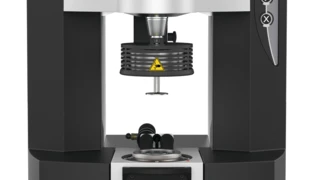
Rheodialysis integrates a custom-designed flow cell with a porous membrane into the base of a NETZSCH Kinexus rotational rheometer.
Through this membrane buffers, solvents, acids, enzymes and Ionic are introduced into the sample by passive diffusion.
At the same time, standard rheological tests – oscillatory, shear, stress-controlled – are performed.
The result:
Real-time monitoring of rheological properties while the chemical environment changes dynamically.
No sample damage from direct flow. No interruption of the measurement.
Why Is It Called Rheodialysis?
Why Is It Called Rheodialysis?
The term combines two concepts:
- Kriechen (Rheologie)Creep is one of the earliest “controlled stress” rheometer tests that quite literally “creeps” the material, i.e. we measure over a relatively prolonged period the small movement (the creep defined as creep compliance, J) of the sample by applying a small constant stress.Rheology – the study of how materials flow and deform
- Dialysis – the controlled transport of molecules through a membrane
Just as dialysis allows substances to pass through a membrane while keeping others separated, Rheodialysis enables controlled chemical exchange with a sample during a rheological measurement.
This makes it possible to mimic processes such as ion diffusion, solvent exchange, enzyme exposure, pH changes, or nutrient transport while continuously monitoring material behavior.
Why This Matters for Soft Materials
Almost all soft materials are sensitive to:
- Mechanical stress
- Chemical surroundings
- Time-dependent diffusion processes
Examples include:
- Blood clot formation and degradation
- Alginate gelation
- Food digestion under gastric conditions
- Drug release under physiological shear
- Creams and cosmetics exposed to salinity or enzymes
Bringing Real-World Processes into the Rheometer
Many soft materials are designed to respond to their environment.
For example:
Alginate Hydrogels
Alginate, derived from seaweed, is widely used in drug delivery, tissue engineering and cell encapsulation. During exposure to calcium ions, the material gels through Ionic crosslinking. Rheodialysis allows researchers to monitor this gelation process in real time while measuring the evolving viscoelastic properties.
Food Digestion Studies
Food structures do not only experience mechanical deformation during consumption. They are simultaneously exposed to changing pH values, salts and digestive enzymes. Rheodialysis enables researchers to study how food texture and structure change under conditions that more closely resemble digestion.
Pharmaceutical Formulations
Drug delivery systems often rely on diffusion-controlled processes. With Rheodialysis, researchers can investigate how buffer solutions, ions or other reagents influence material structure and release behavior while mechanical forces are applied.
These examples demonstrate why controlling chemistry and shear simultaneously can provide insights that conventional rheological measurements cannot capture.
With Rheodialysis, researchers can:
✔ Control chemical diffusion rates via pump settings and concentration
✔ Identify precise gelation points during Ionic exchange
✔ Model real-world processing conditions more accurately
As shown in the new white paper, the convergence of oscillatory phase angles at different frequencies can pinpoint the exact gel point during in-situ Ionic exchange.
Download the whitepaper here:
Key Advantages of the NETZSCH Kinexus Rheometer
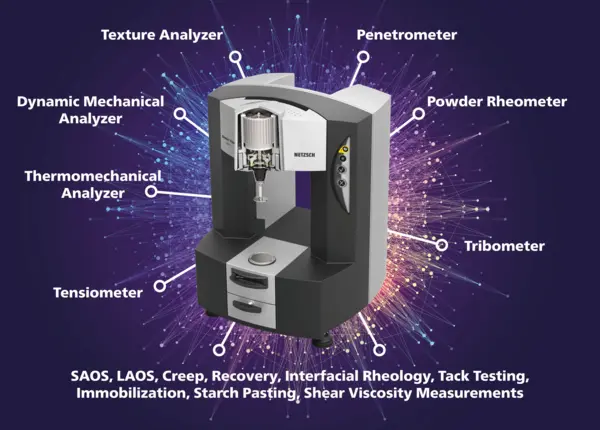
Rheodialysis is designed exclusively for the modular Kinexus platform:
- Seamless integration into existing systems
- High sensitivity for shear and axial measurements
- Plug-and-play cartridge concept for multi-user labs
It transforms a standard rheometer into a dynamic chemical-rheological testing platform.
Thus, rheodialysis opens new possibilities for:
- Monitoring polymer gelation kinetics
- Simulating digestion of structured foods
- Investigating pharmaceutical release mechanisms
- Studying adhesive degradation under combined chemical and mechanical load
- Exploring biological material response under controlled environments
It enables a new experimental dimension: Testing materials the way they are actually used.
Learn More in the White Paper
The full technical background, experimental setup, and application examples are described in the new White Paper:
Customize, Integrate, Innovate
One size does not fit all when it comes to rheological testing. That is why the NETZSCH Kinexus rotational rheometer is built as an open platform designed for maximum flexibility:
✔️ Integrate third-party tools.
✔️ Attach custom accessories.
✔️ Co-develop new software solutions together with our NETZSCH experts.
Rheodialysis is just one example of what becomes possible through close collaboration between research teams and industry If you would like your application to be the next innovation case study, get in contact with us!