Accelerating Rate Calorimetry
Accelerating Rate Calorimeter (Accelerating Rate Calorimetry (ARC)The method describing isothermal and adiabatic test procedures used to detect thermally exothermic decomposition reactions.ARC®) Technology by NETZSCH
Accelerating Rate Calorimetry (ARC)The method describing isothermal and adiabatic test procedures used to detect thermally exothermic decomposition reactions.Accelerating Rate Calorimetry (Accelerating Rate Calorimetry (ARC)The method describing isothermal and adiabatic test procedures used to detect thermally exothermic decomposition reactions.ARC®) is the gold standard for process safety testing, Thermal runawayA thermal runaway is the situation where a chemical reactor is out of control with respect to temperature and/or pressure production caused by the chemical reaction itself. Simulation of a thermal runaway is usually carried out using a calorimeter device according to accelerated rate calorimetry (ARC).thermal runaway analysis, and reaction hazard evaluation. The method, describing IsothermalTests at controlled and constant temperature are called isothermal.isothermal and AdiabaticAdiabatic describes a system or measurement mode without any heat exchange with the surroundings. This mode can be realized using a calorimeter device according to the method of accelerating rate calorimetry (ARC). The main purpose of such a device is to study scenarios and thermal runaway reactions. A short description of the adiabatic mode is “no heat in – no heat out”.adiabatic test procedures, is used to detect Thermally induced reactionA thermally induced reaction is a decomposition reaction exclusively started through heat treatment. thermally induced ExothermicA sample transition or a reaction is exothermic if heat is generated.exothermic Decomposition reactionA decomposition reaction is a thermally induced reaction of a chemical compound forming solid and/or gaseous products. decomposition reactions. The standard procedure is Heat-Wait-Search (HWS)Heat-Wait-Search is a measurement mode used in calorimeter devices according to accelerating rate calorimetry (ARC).Heat-Wait-Search (Heat-Wait-Search (HWS)Heat-Wait-Search is a measurement mode used in calorimeter devices according to accelerating rate calorimetry (ARC).HWS).
Our Accelerating Rate Calorimeters
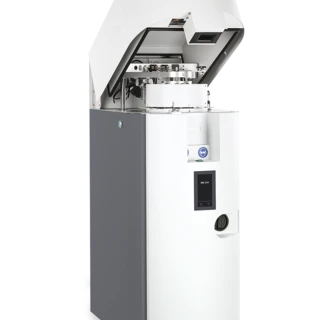
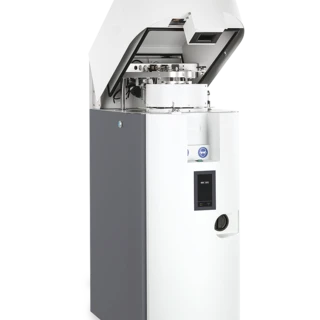
Explore the range of NETZSCH Accelerating Rate Calorimetry (ARC)The method describing isothermal and adiabatic test procedures used to detect thermally exothermic decomposition reactions.ARC® instruments
About the Method
Accelerating Rate Calorimetry – The gold standard for process safety testing, thermal runaway analysis, and reaction hazard evaluation
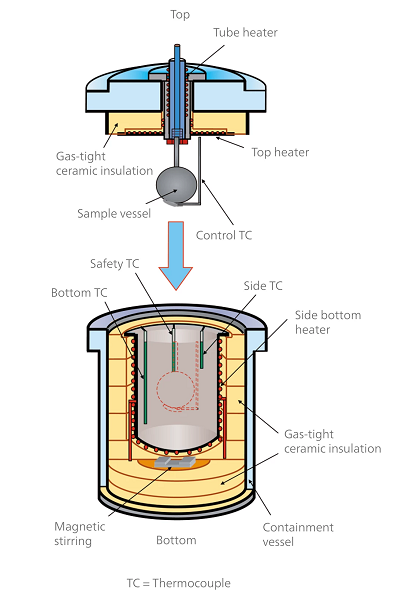
ARC® – Principle of Operation
The method describing IsothermalTests at controlled and constant temperature are called isothermal.isothermal and AdiabaticAdiabatic describes a system or measurement mode without any heat exchange with the surroundings. This mode can be realized using a calorimeter device according to the method of accelerating rate calorimetry (ARC). The main purpose of such a device is to study scenarios and thermal runaway reactions. A short description of the adiabatic mode is “no heat in – no heat out”.adiabatic test procedures is used to detect Thermally induced reactionA thermally induced reaction is a decomposition reaction exclusively started through heat treatment. thermally induced ExothermicA sample transition or a reaction is exothermic if heat is generated.exothermic Decomposition reactionA decomposition reaction is a thermally induced reaction of a chemical compound forming solid and/or gaseous products. decomposition reactions. The standard procedure is Heat-Wait-Search (HWS)Heat-Wait-Search is a measurement mode used in calorimeter devices according to accelerating rate calorimetry (ARC).Heat-Wait-Search (Heat-Wait-Search (HWS)Heat-Wait-Search is a measurement mode used in calorimeter devices according to accelerating rate calorimetry (ARC).HWS).
It operates under AdiabaticAdiabatic describes a system or measurement mode without any heat exchange with the surroundings. This mode can be realized using a calorimeter device according to the method of accelerating rate calorimetry (ARC). The main purpose of such a device is to study scenarios
and thermal runaway reactions. A short description of the adiabatic mode is “no heat in – no heat out”.adiabatic conditions — “no heat in, no heat out” — to investigate the Worst-Case ScenarioRelated to a chemical reactor, a worst-case scenario is the situation where temperature and/or pressure production caused by the reaction runs out of control.worst-case scenario on chemicals and reaction mixtures.
Using the Heat-Wait-Search (HWS)Heat-Wait-Search is a measurement mode used in calorimeter devices according to accelerating rate calorimetry (ARC).Heat-Wait-Search (Heat-Wait-Search (HWS)Heat-Wait-Search is a measurement mode used in calorimeter devices according to accelerating rate calorimetry (ARC).HWS) method, Accelerating Rate Calorimetry (ARC)The method describing isothermal and adiabatic test procedures used to detect thermally exothermic decomposition reactions.ARC® accurately detects the onset of self-heating, measures the AdiabaticAdiabatic describes a system or measurement mode without any heat exchange with the surroundings. This mode can be realized using a calorimeter device according to the method of accelerating rate calorimetry (ARC). The main purpose of such a device is to study scenarios
and thermal runaway reactions. A short description of the adiabatic mode is “no heat in – no heat out”.adiabatic temperature and pressure rise, and allows for the calculation of the key safety parameters such as temperature and pressure increase rate, time-to-maximum rate (TMR) and reaction enthalpy.
The patented VariPhi option compensates for heat losses and enables low Phi testing, making results more representative of large-scale conditions.
What Makes NETZSCH ARC® Instruments Unique?
- Safe investigation of Thermal runawayA thermal runaway is the situation where a chemical reactor is out of control with respect to temperature and/or pressure production caused by the chemical reaction itself. Simulation of a thermal runaway is usually carried out using a calorimeter device according to accelerated rate calorimetry (ARC).thermal runaway testing or Worst-Case ScenarioRelated to a chemical reactor, a worst-case scenario is the situation where temperature and/or pressure production caused by the reaction runs out of control.worst-case scenario testing in accordance with ASTM E1981.
- Wide measurement range: Temperature: RT to 500°C I Pressure: up to 150 bar I Tracking rate: up to 200 K/min
- Robust, explosion-proof design for testing high-energetic materials and reactive chemicals.
- Flexible operation modes: Heat-Wait-Search (HWS)Heat-Wait-Search is a measurement mode used in calorimeter devices according to accelerating rate calorimetry (ARC).Heat-Wait-Search, Iso-Fixed, Iso-Track, ramp screening, fire exposure, and true IsothermalTests at controlled and constant temperature are called isothermal.isothermal.
- Multiple vessel types: Spherical and tube designs in stainless steel, Hastelloy, or titanium; volumes from 1 ml to 130 ml.
- Patented VariPhi: Enables low Phi testing, detection of EndothermicA sample transition or a reaction is endothermic if heat is needed for the conversion.endothermic effects, faster scanning, and accurate enthalpy determination.
- Integrated Proteus® software for data acquisition and evaluation, kinetic analysis, and easy data export.
Long Instrument Life
Always There for You
Proven Excellence in Service
Frequently Asked Questions
Your Benefits
over 60
up to 150
over 50
NETZSCH ARC® Application Fields
Accelerating Rate Calorimeters (ARC®) by NETZSCH help industry operate safely and profitably. Key application areas include:
- Chemical process safety: determination of Decomposition reactionA decomposition reaction is a thermally induced reaction of a chemical compound forming solid and/or gaseous products. decomposition onset, TMR, SADT (Self-Accelerating Decomposition reactionA decomposition reaction is a thermally induced reaction of a chemical compound forming solid and/or gaseous products. Decomposition Temperature), and kinetic parameters
- Energetic materials: propellants, explosives, airbags
- IsothermalTests at controlled and constant temperature are called isothermal.Isothermal Battery testing: heat signature of charging and discharging
- Storage and transportation studies: behavior under real-world thermal environment
- Autocatalytic reaction studies: Iso-Track and Iso-Fixed modes for long-term stability tests
Thermal Risk Assessment in Chemical Processes
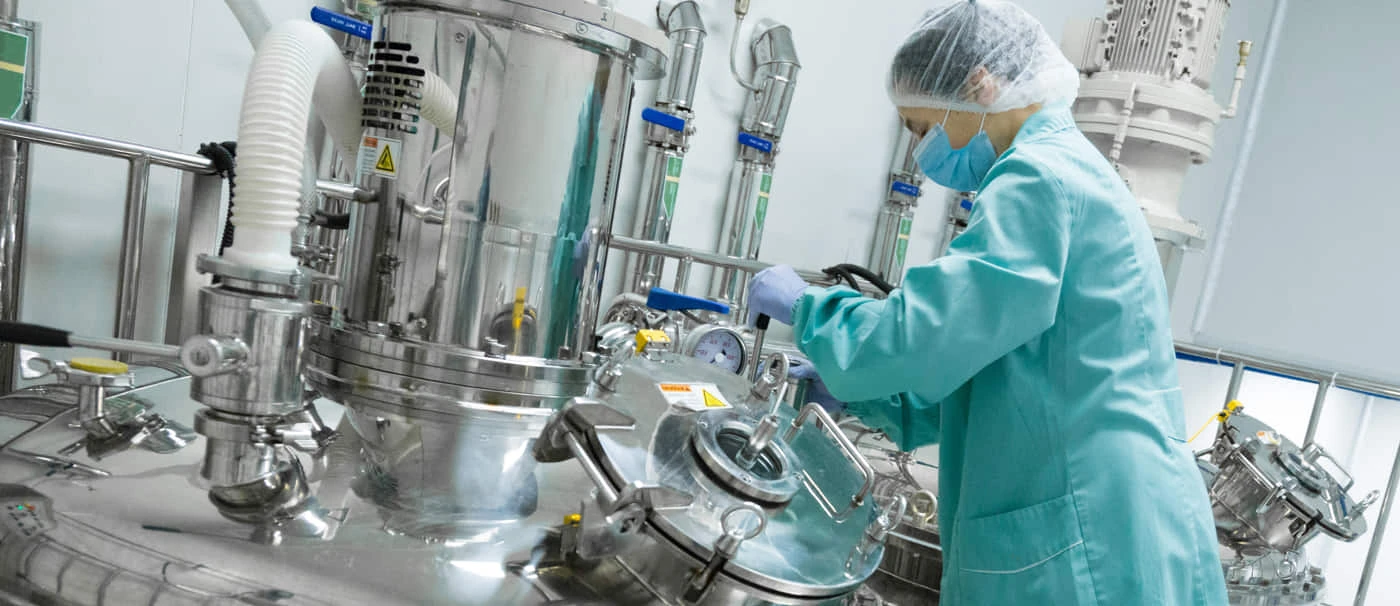
Chemical industrial processes based on ExothermicA sample transition or a reaction is exothermic if heat is generated.exothermal reactions can be dangerous. To ensure safety, it is necessary to determine beforehand whether the temperature increase is harmless or indicates the beginning of Thermal runawayA thermal runaway is the situation where a chemical reactor is out of control with respect to temperature and/or pressure production caused by the chemical reaction itself. Simulation of a thermal runaway is usually carried out using a calorimeter device according to accelerated rate calorimetry (ARC).thermal runaway.
Media and Training


Application Literature about ARC®
Blog articles about NETZSCH Accelerating Rate Calorimetry


Videos that may be of interest to you

Consultancy & Sales
Do you have further questions about our instruments or the method? Would you like to speak to a sales representative?
Service & Support
Do you already have an instrument and need technical support or spare parts?
FAQs about NETZSCH Service