Dielectric Analysis
For investigation of the Curing (Crosslinking Reactions)Literally translated, the term “crosslinking“ means “cross networking”. In the chemical context, it is used for reactions in which molecules are linked together by introducing covalent bonds and forming three-dimensional networks.curing behavior of thermosetting resin systems, composite materials, adhesives and paints, Dielectric Analysis (DEA) / Dielectric Thermal Analysis (DETA) in accordance with ASTM E2038 or E2039 has stood the test of time.
Dielectric Analysis (DEA), also known as Dielectric Thermal Analysis (DETA), is a technique for monitoring changes in viscosity and the cure state of thermosetting resins, adhesives, paints, composites and other kinds of polymers or organic substances by measuring variations in their dielectric properties.
NETZSCH offers single- and multiple-channel DEA systems for measuring ion conductivity, which is calculated from the dielectric loss factor or its reciprocal, the Ion ViscosityIon viscosity is the reciprocal value of the ion conductivity, which is calculated from the dielectric loss factor.ion viscosity. These systems operate in various measurement and frequency ranges with different types of sensors, depending on the application.
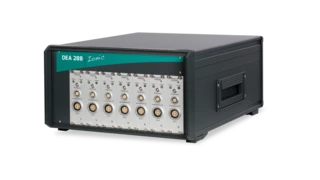
Our Dielectric Analyzer
Explore the NETZSCH DEA analysis instrument
Explore our DEA Webinar Series

Product Versions: Ionic & Rack
The DEA 288 Ionic is available in two versions to meet different application needs:
- Ionic Version (Portable)
With up to 7 channels in the standard configuration, the portable Ionic version offers maximum flexibility for laboratory use.
With the Ionic Extension, the system can be expanded to up to 14 channels, enabling parallel measurements and efficient material screening. - Rack Version (Industrial Integration)
The Rack version is designed for control-cabinet installation and optimized for industrial process environments.
It supports 8 channels, expandable to up to 16 channels using additional rack modules. This makes it ideal for automated production lines and in-line process control.
About the Method
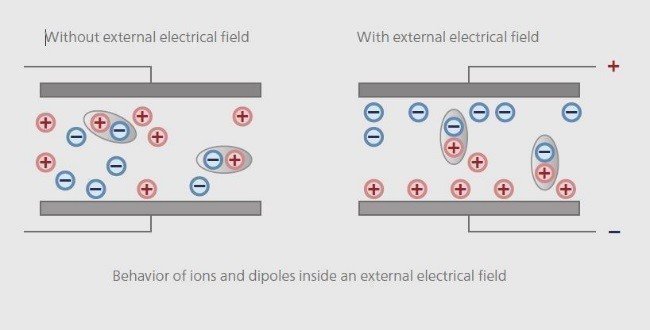
Dielectric Analysis is based on impedance measurement. A sample is placed between two electrodes (the dielectric sensor) and subjected to an alternating sinusoidal voltage. The applied electric field forces ions and dipoles within the material to move, creating a current with a measurable phase shift.
As Curing (Crosslinking Reactions)Literally translated, the term “crosslinking“ means “cross networking”. In the chemical context, it is used for reactions in which molecules are linked together by introducing covalent bonds and forming three-dimensional networks.curing progresses, viscosity increases and ion mobility decreases, leading to characteristic changes in the dielectric response. These signals provide information on:
- Flow behavior and reactivity
- Viscosity and gel point
- Degree of CureThe degree of curing describes the conversion achieved during crosslinking reactions (curing). Degree of cure and cure kinetics
- Glass transition and vitrification
- Diffusion and Decomposition reactionA decomposition reaction is a thermally induced reaction of a chemical compound forming solid and/or gaseous products. decomposition effects
This makes DEA an ideal method for monitoring both fast and slow Curing (Crosslinking Reactions)Literally translated, the term “crosslinking“ means “cross networking”. In the chemical context, it is used for reactions in which molecules are linked together by introducing covalent bonds and forming three-dimensional networks.curing systems, including thermal, UV, and dual-cure processes.
Frequently Asked Questions
Your Benefits
Over 60
up to 16
over 50
What Makes NETZSCH DEA Instruments Unique?
- Versatile instrumentation: Portable lab version or industrial rack version, supporting up to 16 channels.
- Fast data acquisition: <5 ms minimum acquisition time for real-time monitoring of even rapid UV curing systems.
- Wide frequency range: 1 mHz to 1 MHz, covering all relevant processes.
- Smart sensors: Disposable, reusable, and in-mold sensors tailored for coatings, adhesives, prepregs, composites, or bulk materials.
- Process transferability: Parameters developed in the lab can easily be applied to production monitoring.
- No special sample preparation: Sensors can be easily integrated into real applications — from coatings to in-mold cure monitoring.
- Software integration: The NETZSCH Proteus® software allows for intuitive setup, advanced evaluation, and seamless accessory control (UV lamp, furnace, press).
- Coupling options: Simultaneous DEA-DMA or DEA-Rheology measurements expand analytical insight into flow, gelation, and vitrification.
Long Instrument Life
Always There for You
Proven Excellence in Service
NETZSCH DEA Application Fields
DEA is applied across industries wherever thermosets and curing reactions define performance:
- Resins, adhesives & coatings: Monitoring viscosity, gelation, and curing behavior in epoxies, polyesters, polyurethanes, paints, and varnishes.
- Composites: Cure monitoring in Sheet Molding Compounds (SMC), Bulk Molding Compounds (BMC), prepregs, and Resin Transfer Molding (RTM).
- UV curing systems: Real-time evaluation of light-induced curing of inks, adhesives, and protective coatings.
- Process optimization: Direct in-mold measurements for automotive, aerospace, wind energy, shipbuilding, and electronics manufacturing.
- Quality assurance: Ensuring consistent production and reliable component performance.
- Research & development: Development of optimized formulations, investigation of additives, fillers, and curing agents.
DEA bridges laboratory analysis and industrial process control, making it indispensable for modern polymer and composite processing.

Real-Time Insights into Curing Processes
Dielectric Analysis is the key method for monitoring the curing of thermosets and composites.
It provides direct measurement of viscosity, gel point, and cure kinetics, allowing researchers and engineers to optimize materials and transfer parameters from lab to production with confidence.
Media and Training


Application Literature about DEA
Blog articles about NETZSCH Dielectric Analyzers

Videos that may be of interest to you

Consultancy & Sales
Do you have further questions about our instruments or the method? Would you like to speak to a sales representative?
Service & Support
Do you already have an instrument and need technical support or spare parts?
FAQs about NETZSCH Service