Dynamic Mechanical Analyzers
For measuring the viscoelastic properties of materials
Dynamic Mechanical Analysis (DMA) is a technique used to evaluate the viscoelastic properties of materials, particularly polymers, by applying an oscillating load. StressStress is defined as a level of force applied on a sample with a well-defined cross section. (Stress = force/area). Samples having a circular or rectangular cross section can be compressed or stretched. Elastic materials like rubber can be stretched up to 5 to 10 times their original length.Stress and StrainStrain describes a deformation of a material, which is loaded mechanically by an external force or stress. Rubber compounds show creep properties, if a static load is applied.strain at the sample are measured to determine properties such as modulus and damping behavior under varying temperature and frequency conditions.
The main advantage of Dynamic Mechanical Analysis (DMA) is its ability to provide detailed insight into the viscoelastic properties of materials, enabling accurate characterization of their mechanical behavior, which is critical for applications in materials development and quality control.
Our Dynamic Mechanical Analyzers
Explore the range of NETZSCH DMA instruments

Dynamic Mechanical Analysis: A Five-Part Webinar Series
Learn the fundamentals and advanced applications of Dynamic Mechanical Analysis (DMA) to confidently characterize viscoelastic material behavior, accurately interpret mechanical properties, and optimize material development and processing performance.
Principle of the DMA Method

Storage Modulus E’, Loss Modulus E’’ and tan δ
Certain materials, particularly polymers, exhibit viscoelastic behavior, i.e., they possess both elastic properties (similar to an ideal spring) and viscous properties (similar to an ideal damper).
The Storage modulus (E') indicates the ability of the material to store elastic energy.
The Dynamic Viscous modulusThe complex modulus (viscous component), loss modulus, or G’’, is the “imaginary” part of the samples the overall complex modulus. This viscous component indicates the liquid like, or out of phase, response of the sample being measurement. loss modulus (E'') reflects the energy dissipated as heat, highlighting the viscous behavior of the material.
The phase shift and dissipation factor (tan δ) provides insight into the relationship between the elastic and viscous responses.
DMA is particularly sensitive to the Glass Transition TemperatureThe glass transition is one of the most important properties of amorphous and semi-crystalline materials, e.g., inorganic glasses, amorphous metals, polymers, pharmaceuticals and food ingredients, etc., and describes the temperature region where the mechanical properties of the materials change from hard and brittle to more soft, deformable or rubbery.glass transition temperature. As the temperature increases, the storage modulus (E') shows a sharp decrease, while both the dynamic Viscous modulusThe complex modulus (viscous component), loss modulus, or G’’, is the “imaginary” part of the samples the overall complex modulus. This viscous component indicates the liquid like, or out of phase, response of the sample being measurement. loss modulus (E'') and the loss factor (tan δ) show distinct maxima, indicating significant changes in material behavior within this critical temperature range.
Frequently Asked Questions
Dynamic Mechanical Analysis (DMA) is a technique used to measure the viscoelastic properties of materials, particularly polymers, by applying an oscillating load and recording StressStress is defined as a level of force applied on a sample with a well-defined cross section. (Stress = force/area). Samples having a circular or rectangular cross section can be compressed or stretched. Elastic materials like rubber can be stretched up to 5 to 10 times their original length.stress and StrainStrain describes a deformation of a material, which is loaded mechanically by an external force or stress. Rubber compounds show creep properties, if a static load is applied.strain at the sample. This method allows the determination of key material properties such as elasticity, viscosity and Glass Transition TemperatureThe glass transition is one of the most important properties of amorphous and semi-crystalline materials, e.g., inorganic glasses, amorphous metals, polymers, pharmaceuticals and food ingredients, etc., and describes the temperature region where the mechanical properties of the materials change from hard and brittle to more soft, deformable or rubbery.glass transition temperature, providing valuable insight into how materials behave under different conditions.
The main differences between the NETZSCH tabletop DMA 303 Eplexor® and the stand alone high force DMA 503 and 523 Eplexor® systems are in their design capabilities and intended applications:
Force range: The NETZSCH tabletop DMA, such as the DMA 303 Eplexor®, is designed for precise measurements on a variety of specimens, including very stiff specimens, with a controlled force range of up to 50 N. In contrast, high force DMA systems can handle higher forces up to a dynamic force of 4000 N and are specifically designed for testing high-modulus materials, making them suitable for applications requiring greater mechanical StressStress is defined as a level of force applied on a sample with a well-defined cross section. (Stress = force/area). Samples having a circular or rectangular cross section can be compressed or stretched. Elastic materials like rubber can be stretched up to 5 to 10 times their original length.stress.
Temperature range and applications: The tabletop DMA offers a wide temperature range from -170°C to 800°C, suitable for a diverse array of materials, including polymers, elastomers and metals. The high force DMA 503 Eplexor® HT is capable of operating in high temperatures up to 1500°C, but is optimized for materials that require higher force applications, such as metals or composites, providing enhanced performance in demanding test scenarios.
These differences make each type of NETZSCH DMA suitable for different materials testing needs, with the tabletop model ideal for general applications and the high force model for more specialized needs.
The Complex ModulusThe complex modulus consists of two components, the storage and the loss moduli. The storage modulus (or Young’s modulus) describes the stiffness and the loss modulus describes the damping (or viscoelastic) behavior of the corresponding sample using the method of Dynamic Mechanical Analysis (DMA). complex modulus describes the stiffness and the damping of a sample. The real part E' of the Complex ModulusThe complex modulus consists of two components, the storage and the loss moduli. The storage modulus (or Young’s modulus) describes the stiffness and the loss modulus describes the damping (or viscoelastic) behavior of the corresponding sample using the method of Dynamic Mechanical Analysis (DMA). complex modulus describes the elastic material behavior while the imaginary part E'' characterizes the viscous component.
Dynamic Mechanical Analysis (DMA) is widely used in various industries and applications due to its ability to characterize the mechanical properties of materials. Here are some typical applications of DMA:
- Polymer characterization: DMA is primarily used to analyze the viscoelastic properties of polymers, including their stiffness, damping characteristics, and temperature-dependent behavior, which is critical for material development and quality control.
- Glass transition detection: One of the key applications of DMA is the determination of the Glass Transition TemperatureThe glass transition is one of the most important properties of amorphous and semi-crystalline materials, e.g., inorganic glasses, amorphous metals, polymers, pharmaceuticals and food ingredients, etc., and describes the temperature region where the mechanical properties of the materials change from hard and brittle to more soft, deformable or rubbery.glass transition temperature (Tg) of materials, which is essential for understanding how polymers transition from a brittle state to a more rubbery state.
- Curing studies: DMA is used to study the Curing (Crosslinking Reactions)Literally translated, the term “crosslinking“ means “cross networking”. In the chemical context, it is used for reactions in which molecules are linked together by introducing covalent bonds and forming three-dimensional networks.curing kinetics of thermoset materials, helping to determine the extent of cross-linking and the point of gelation.
- Phase transition analysis: The technique can identify various Phase TransitionsThe term phase transition (or phase change) is most commonly used to describe transitions between the solid, liquid and gaseous states.phase transitions in materials, such as melting points and CrystallizationCrystallization is the physical process of hardening during the formation and growth of crystals. During this process, heat of crystallization is released.crystallization temperatures, providing insight into Thermal StabilityA material is thermally stable if it does not decompose under the influence of temperature. One way to determine the thermal stability of a substance is to use a TGA (thermogravimetric analyzer). thermal stability and performance.
- Composite evaluation: DMA is used to study the mechanical properties of composites and the interactions between their constituents, aiding in the design and optimization of advanced materials.
- Materials development and validation: DMA supports the material development process by providing data to inform decisions on material selection and processing conditions, ensuring that materials meet specific performance criteria.
The cost of a NETZSCH Dynamic Mechanical Analyzer (DMA) can vary significantly depending on the model, features, and any additional accessories you may require.
To get an accurate and up-to-date price for your individual NETZSCH DMA instrument, please contact your local NETZSCH representative or one of our authorized distributors. We will provide a quote tailored to your specific requirements, including any necessary training, installation, or additional features.
Our delivery is depending on demand and on the specific configuration of the DMA. For more complex customizations or during periods of high demand, the delivery time may extend beyond this range.
For the most up-to-date information, we encourage you to contact us directly with a specific request. This will ensure that we can provide you with an accurate timeline tailored to your specific needs.
Some NETZSCH DMA instruments are no longer in our NETZSCH portfolio. However, accessories and spare parts are still available for you. Information on our legacy products can be found at the following link - see below.
To ask for service and support for your instrument, please contact your local service partner. We're here to assist you with any service needs or queries about your instrument!
Key Benefits of NETZSCH DMA instruments
The DMA Eplexor® series is an essential tool for analysis of viscoelastic properties in a variety of applications.
- Comprehensive material analysis: NETZSCH DMAs provide detailed insight into the viscoelastic properties of various materials, including polymers and elastomers allowing precise characterization of mechanical behavior under various conditions.
- Wide temperature range: The instruments can operate over a wide temperature range, allowing analysis of materials from -170°C to 1500°C, which is critical for studying Phase TransitionsThe term phase transition (or phase change) is most commonly used to describe transitions between the solid, liquid and gaseous states.phase transitions such as Glass Transition TemperatureThe glass transition is one of the most important properties of amorphous and semi-crystalline materials, e.g., inorganic glasses, amorphous metals, polymers, pharmaceuticals and food ingredients, etc., and describes the temperature region where the mechanical properties of the materials change from hard and brittle to more soft, deformable or rubbery.glass transition temperatures.
- Versatile measurement technique: Multiple measurement modes such as tension, compression, 3-point bending and shear allow customers to analyze a wide range of sample types and geometries, increasing the versatility of materials testing.
- High sensitivity: DMA is highly sensitive to changes in material properties, making it an ideal choice for detecting subtle transitions that other methods may miss.
- Advanced data interpretation: The ability to derive key parameters such as storage modulus, Viscous modulusThe complex modulus (viscous component), loss modulus, or G’’, is the “imaginary” part of the samples the overall complex modulus. This viscous component indicates the liquid like, or out of phase, response of the sample being measurement. loss modulus, and loss factor provides customers with valuable information for material development and quality control.
- Advanced calculation models: Equipped with the latest models and a variety of sample holders for precise measurements on a wide range of materials.
- User-friendly software: NETZSCH DMA systems are designed with intuitive software that simplifies data acquisition and analysis, improving ease of use and efficiency in research and development environments.
Different Types of NETZSCH Dynamic Mechanical Analyzers (DMA)
NETZSCH DMAs enhance material testing accuracy through e.g.:
- High sensitivity to Phase TransitionsThe term phase transition (or phase change) is most commonly used to describe transitions between the solid, liquid and gaseous states.Phase Transitions
- Detailed information on both storage modulus (E') and Viscous modulusThe complex modulus (viscous component), loss modulus, or G’’, is the “imaginary” part of the samples the overall complex modulus. This viscous component indicates the liquid like, or out of phase, response of the sample being measurement. loss modulus (E''), as well as the loss factor (tan δ).
- making sure that even very stiff samples can be accurately analyzed by combining high force capabilities with precise measurement techniques.
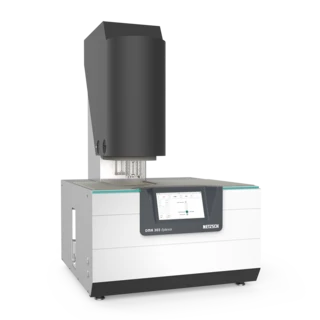
Table-Top DMA up to 50N

The DMA 303 Eplexor® table-top instrument is specifically designed for applications where precise forces up to 50 N are required for dynamic and static measurements.
Applications:
- DMA of linear materials, Universal Tests, CreepCreep describes a time and temperature dependent plastic deformation under a constant force. When a constant force is applied to a rubber compound, the initial deformation obtained due to the application of the force is not fixed. The deformation will increase with time.Creep and Relax
- Polymeric materials: Thermoplastics, thermosets, elastomers
- Metals and ceramics
- Biological materials: Biological tissues and membranes, hair
- Food products
- Adhesives and coatings
- Composites
Temperature Range:
-170°C to 800°C
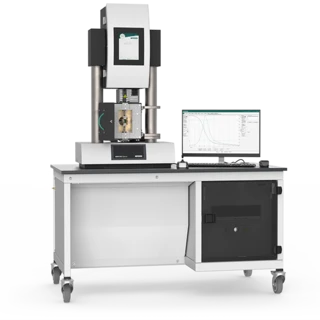
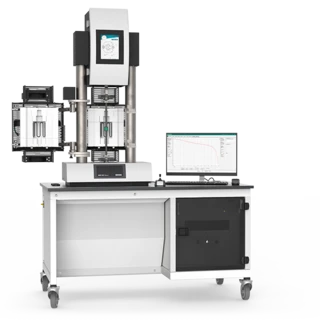
High force DMA up to 500N

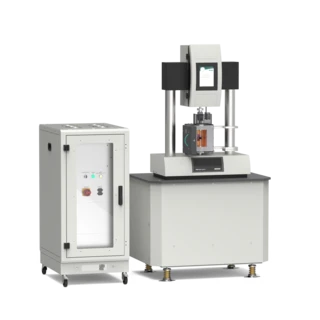
The high force DMA 503 Eplexor® and 503 Eplexor® HT instruments are engineered to characterize viscoelastic properties from -160°C up to 1500°C. This can be used to analyze polymers, metals and ceramics.
Applications:
- DMA of nonlinear materials and larger samples, Universal Tests, CreepCreep describes a time and temperature dependent plastic deformation under a constant force. When a constant force is applied to a rubber compound, the initial deformation obtained due to the application of the force is not fixed. The deformation will increase with time.Creep and Relax
- Polymeric materials: Thermoplastics, thermosets, elastomers
- Metals and ceramics
- Biological materials: Biological tissues and membranes, hair
- Food products
- Adhesives and coatings
- Composites
Temperature Range:
-160°C to 1500°C (2 furnaces needed to cover the complete temperature range)
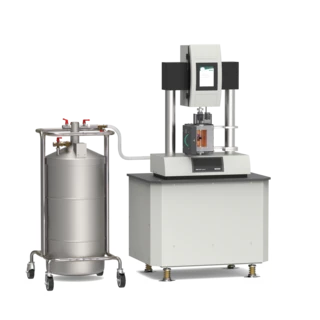
High force DMA up to 4000N

The ultra high force DMA 523 Eplexor® and HBU 523 Gabometer instruments are engineered to characterize viscoelastic properties from -160°C up to 500°C. This can be used to analyze polymers, metals and ceramics.
Applications:
- Fatigue and HBU
- Polymeric materials: Thermoplastics, thermosets, elastomers
- Metals and ceramics
- Biological materials: Biological tissues and membranes, hair
- Food products
- Adhesives and coatings
- Composites
Temperature Range:
-160°C to 500°C
Applications for Dynamic Mechanical Analysis
- Dynamic Mechanical Analysis (DMA) is widely used in various industries and applications due to its ability to characterize the mechanical properties of materials. Here are a few typical applications of DMA
- Viscoelastic material properties: storage and Viscous modulusThe complex modulus (viscous component), loss modulus, or G’’, is the “imaginary” part of the samples the overall complex modulus. This viscous component indicates the liquid like, or out of phase, response of the sample being measurement. loss modulus, loss factor, tan δ
- Stiffness and damping properties under a variety of conditions:
- depending on temperature and frequency
- at different levels of StressStress is defined as a level of force applied on a sample with a well-defined cross section. (Stress = force/area). Samples having a circular or rectangular cross section can be compressed or stretched. Elastic materials like rubber can be stretched up to 5 to 10 times their original length.stress and StrainStrain describes a deformation of a material, which is loaded mechanically by an external force or stress. Rubber compounds show creep properties, if a static load is applied.strain
- under defined gas atmosphere and in liquid environments
- Identification of material reactions and Phase TransitionsThe term phase transition (or phase change) is most commonly used to describe transitions between the solid, liquid and gaseous states.phase transitions
- Glass transition temperature of highly cross-linked polymers and composites
- Compatibility of polymer blends in reference to composition and structure
- Influence of filler and additive contents
- Curing and post-Curing (Crosslinking Reactions)Literally translated, the term “crosslinking“ means “cross networking”. In the chemical context, it is used for reactions in which molecules are linked together by introducing covalent bonds and forming three-dimensional networks.curing of resins
- Analysis of aging influences
- Prediction of material behavior using Time-Temperature-Superposition (TTS)
- CreepCreep describes a time and temperature dependent plastic deformation under a constant force. When a constant force is applied to a rubber compound, the initial deformation obtained due to the application of the force is not fixed. The deformation will increase with time.Creep and RelaxationWhen a constant strain is applied to a rubber compound, the force necessary to maintain that strain is not constant but decreases with time; this behavior is known as stress relaxation. The process responsible for stress relaxation can be physical or chemical, and under normal conditions, both will occur at the same time. relaxation processes
Here's what our customers say about using the NETZSCH DMA
"We use high force NETZSCH Eplexors for compound development and tire testing to characterize the different properties of a wide variety of tire compounds."
"We use the tabletop DMA in combination with a NETZSCH rheometer to optimize the stability of polymer materials employed in semiconductor devices."
"We are very satisfied with the instrument quality and especially the technical and application support. Otherwise we would not have so many DMAs in use."
E-Learning
Media
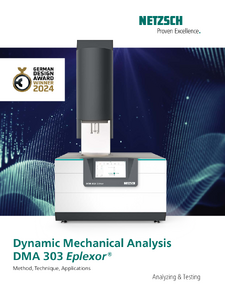
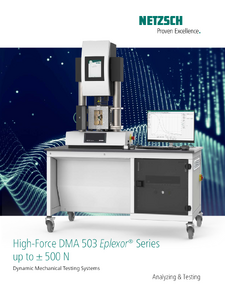
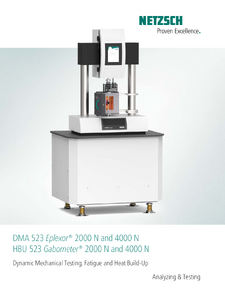
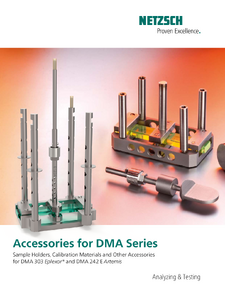
Application Literature about Dynamic Mechanical Analysis
Our latest blog articles about Dynamic Mechanical Analysis
- 26.05.2026
When Tenderness Becomes Measurable: Dynamic Mechanical Analysis of Food

- 14.01.2026
Learn, Apply, Achieve: NETZSCH Launches Free E-Learning Courses on Thermoanalytical Methods

- 19.12.2025
Frost Under the Christmas Tree: Why Material Testing Below 0°C Is Important

- 09.12.2025
How High-Force Dynamic Mechanical Analysis Helps Understand Real Material Behavior

- 22.04.2025
Dynamic Mechanical Analysis: The NETZSCH DMA 303 Eplexor® Comes with New Features

- 25.02.2025
Kinetic Analysis of Storage Modulus Using the NETZSCH DMA 303 Eplexor®

Videos about Dynamic Mechanical Analysis

FAQs about NETZSCH DMA Service
Our NETZSCH Applications Laboratory provides contract testing services for a wide range of industries and research centers. It is equipped with state-of-the-art DMA testing instruments, allowing for a variety of thermal analysis measurements to be carried out.
Consult with the experts in our applications labs to choose the best-suited measuring method for your specific needs.
Benefit from our free e-learning basic courses:
Our basic e-learning courses are available free of charge on our website, designed to support you exactly where learning really happens: in everyday lab work. Whether you’re new to thermal analysis, rheology, or fire testing or simply want to refresh your knowledge: Our expert-led video courses help you:
✔ start measurements with confidence
✔ understand results correctly
✔ reduce operator errors
✔ save time searching for solutions
All courses are created by NETZSCH experts with decades of hands-on experience, sharing real knowledge you can directly apply in the lab.
👉 Start learning for free:netzs.ch/e-learning
Moreover, we offer
- online training via our NETZSCH Online Academy NOA,
- 1:1 remote training and
- on-site training at your location or our training centers.
Simply contact your sales representative or go to Know-How - NETZSCH Analyzing & Testing
We offer:
- Installation and commissioning
- Relocation of your instrument
- Maintenance and inspection
- Calibration
- Repair
- Comprehensive training, from basic to advanced use of the instrument – on-site or online.
Please note that our service may vary from region to region.
Our Remote Service is available worldwide.
Inspection of the pressure of LN2 containers can either be carried out at your site (if you are in Germany, Austria or Switzerland), or at our factory in Selb.
Yes, we offer maintenance contracts for your instruments according to the different regional and individual customer requirements. Please feel free to contact our Service Department or take a closer look at our website section Service-Level Agreement - NETZSCH Analyzing & Testing.