Introduction
Understanding the viscoelastic properties of polymers is critical for their use in many applications including sporting goods. High performance polymer and polymer composites have revolutionized the sports industry by providing users with durable, comfortable, precise, and long-lasting equipment [1]). Polymer and polymer composites are the foundation for a day of activity: they comprise the flooring material used in indoor and outdoor sporting facilities, the soles of shoes, the meshing of nets, the strings of rackets, etc. Being able to evaluate the thermal properties and physical performance of these materials is critical in their design, manufacturing, and final use.
Dynamic Mechanical Analysis (DMA) is primarily used to analyze the viscoelastic properties of polymeric materials but is also used to measure metals, ceramics, or simulate specific mechanical conditions. The NETZSCH DMA 303 Eplexor® is a versatile desktop device capable of measuring over a temperature range from -170°C to 800°C (-274°F to 1472°F), applying forces ranging from 1 mN to 50 N, and operating at frequencies of 0.001 to 150 Hz. In this study, three different high performance badminton strings were tested using dynamic mechanical analysis (DMA). The modern design of badminton strings comprises several materials, layers, and coatings [2]. All three samples tested have the same basic structure: a nylon multifilament core surrounded by braided nylon fibers. Sample 1 has a titanium hydride coating while samples 2 and 3 have a compound cup-stack carbon nanotube coating. From a performance standpoint, the manufacturer grades the different strings, the summary of which is shown in Table 1.
Table 1: Reported properties of the three badminton strings from the manufacturer.
| Variable | Sample 1 (Score out of 10) | Sample 2 (Score out of 10) | Sample 3 (Score out of 10) |
|---|---|---|---|
| Repulsion power | 7 | 8 | 9 |
| Durability | 7 | 10 | 7 |
| Hitting sound | 7 | 7 | 8 |
| Shock absorption | 6 | 6 | 8 |
| Control | 6 | 6 | 10 |
The primary objective of this study is to relate the viscoelastic properties measured by the DMA to the performance criteria reported by the manufacturer in Table 1). The storage modulus (E’) describes the materials’ ability to store and release energy (like a spring), which can be directly related to the reported repulsion power. The Viscous modulusThe complex modulus (viscous component), loss modulus, or G’’, is the “imaginary” part of the samples the overall complex modulus. This viscous component indicates the liquid like, or out of phase, response of the sample being measurement. loss modulus (E”) describes the materials dissipation of energy (typically through internal friction), and finally the damping factor (tan δ) is the ratio of E” to E’ (describing how much a material will dampen an applied force). Therefore, both hitting sound and shock absorption are directly tied to the properties of E” and tan δ. Additionally, parameters such as durability can be explored by testing as a function of increasing force rather than temperature.
DMA Testing for Viscoelastic Properties and Application Simulation
For determination of the viscoelastic properties of the three badminton strings, a standard temperature sweep was performed on each sample in tension (visual representation in Figure 1), with the NETZSCH DMA 303 Eplexor® from -150 to 150ºC.
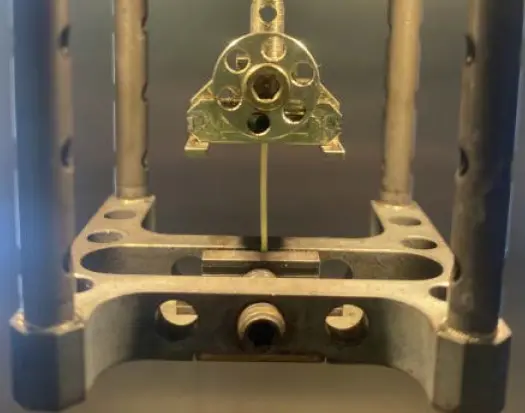
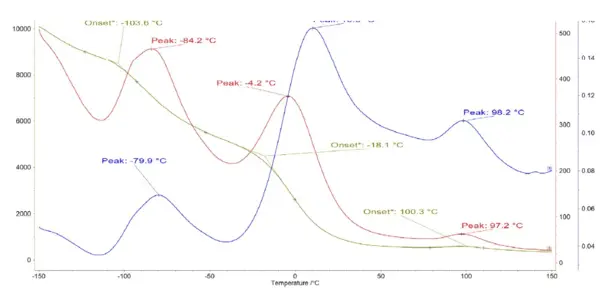
Table 2 summarizes the different transition regions of each sample. The viscoelastic profile of sample 1 as a function of temperature is shown in Figure 2, sample 2 in Figure 3, and sample 3 in Figure 4, all samples were measured in tension. From Figures 2 to 4, both samples 2 and 3 have very similar profiles and transition zones, unlike sample 1 (that has the different coating) which is significantly different. Nylon is an aliphatic polyamide commonly classified by numerical grades (6, 66, 11, 12), all of which have a Glass Transition TemperatureThe glass transition is one of the most important properties of amorphous and semi-crystalline materials, e.g., inorganic glasses, amorphous metals, polymers, pharmaceuticals and food ingredients, etc., and describes the temperature region where the mechanical properties of the materials change from hard and brittle to more soft, deformable or rubbery.glass transition occurring between 40 and 95°C. It is therefore very interesting to consider the other transitions which are observed at subambient temperatures.
Table 2: Thermal transitions of samples 1, 2, and 3, reported for E’, E”, and tan δ. All samples were measured in tension using a dynamic deformation of 10 μm, a proportional factor of 1.3, and a heating rate of 2 ºC/min..
| Transition | E' Onset | E" Peak | Tan δ |
|---|---|---|---|
Sample 1 | |||
| 1 | -103.6°C 8382 MPa | -84.2°C 467 MPa | -79.9°C 0.067 |
| 2 | -18.1°C 4242 MPa | -4.2°C 363 MPa | 10.3°C 0.156 |
| 3 | 100.3°C 580 MPa | 97.2°C 62 MPa | 98.2°C 0.1ß6 |
Sample 2 | |||
| 1 | -90.7°C 7001 MPa | -74.1°C 381 MPa | -71.9°C 0.061 |
| 2 | 22.0°C 3813 MPa | 49.4°C 220 MPa | 65.1°C 0.136 |
Sample 3 | |||
| 1 | -87.5°C 5722 MPa | -71.9°C 309 MPa | -70.7°C 0.060 |
| 2 | 26.2°C 3018 MPa | 51.7°C 187 MPa | 68.1°C 0.138 |
From Figures 2 to 4, it is also important to consider the effect of temperature on the viscoelastic performance of the strings. Badminton is typically an indoor sport, but what about playing outside?
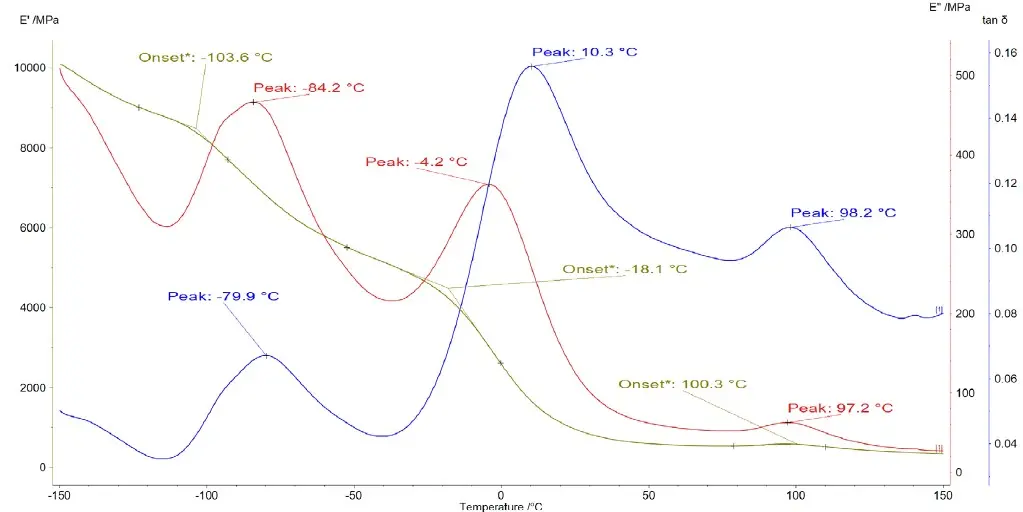
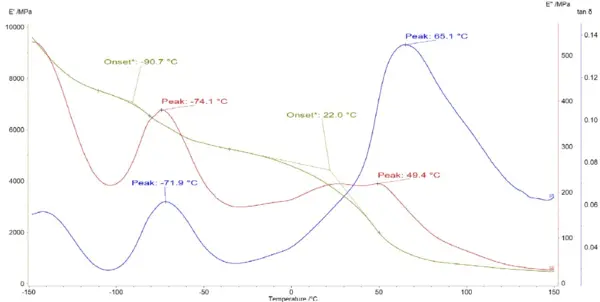
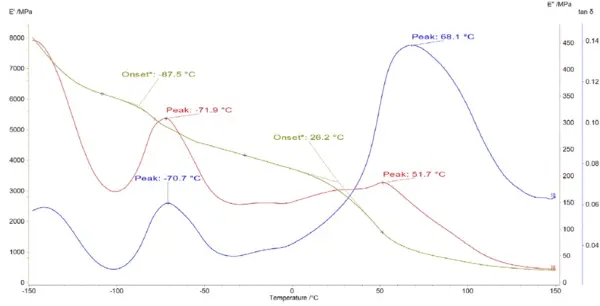
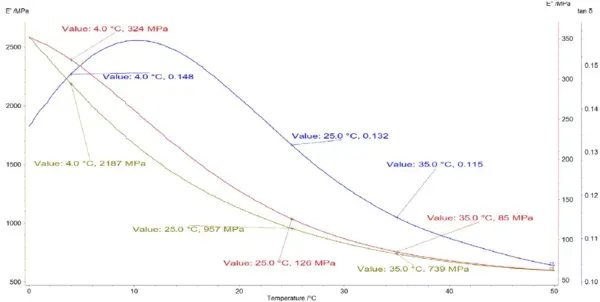
Figure 5 shows the thermal profile of sample 1 from 0 to 50°C. On a cool 4°C autumn day the strings would be 2.3x stiffer than at room temperature (25°C) or 3.0x stiffer than a 35°C hot summers day. However, the damping factor does not follow the exact same trend, being only 1.1x higher at 4°C compared to 25°C and 1.3x at 4°C compared to 35°C. Therefore, even though the strings would be stiffer and display less give when striking the birdie, the amount of energy absorbed by the strings, and not transitioned into the strike, would remain similar.
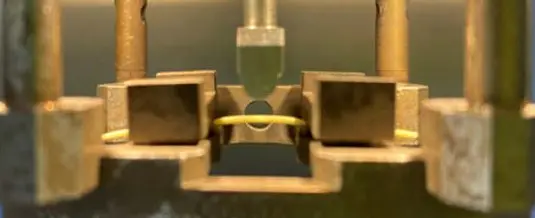
A key consideration of this testing is to understand how the badminton strings would behave in their intended application. Therefore, the same three samples were tested in three-point bend to understand their flexural properties (bending distance of 20 mm to analyze one finite section of the overall racket grid pattern), simulating how they would behave when strung on the racket and used to strike the birdie. The test setup with the string pulled taut in flexure is shown in Figure 6.
To test the performance in three-point bend, two different load sweeps were conducted at room temperature to measure the properties. Figure 7 shows the effect of increasing dynamic deformation (remained under 0.7 N).
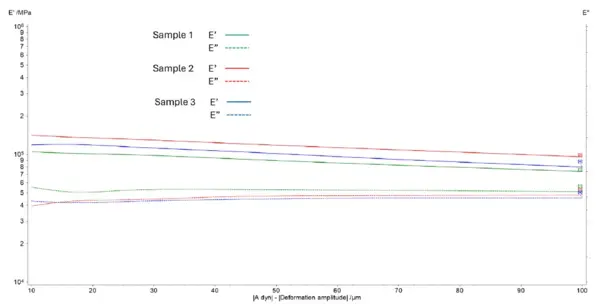
Figure 8 shows the change in length of the samples as a function of increasing force.
From Figure 7, it is observed that at room temperature there is a clear separation in the mechanical properties of the three strings. At an illustrative amplitude of 50 μm sample 1 is has the lowest modulus values (E’ = 89.6 GPa, E” = 12.2 GPa), sample 2 has the highest (E’ = 118.1 GPa, E” = 10.3 GPa), and sample 3 is in between (E’ = 101.6 GPa, E” = 9.5 GPa). Considering that the damping factor is the ratio of the Viscous modulusThe complex modulus (viscous component), loss modulus, or G’’, is the “imaginary” part of the samples the overall complex modulus. This viscous component indicates the liquid like, or out of phase, response of the sample being measurement. loss modulus to the storage modulus, that means sample 1 has the highest damping properties (0.14), followed by sample 3 (0.09), and sample 2 (0.09). These values do not directly correspond with those reported by the manufacturer in Table 1, but it is very important to consider how all three viscoelastic parameters affect performance, and how important the temperature at which they were tested is, as shown by Figure 5.
Finally, from Figure 8, the change in sample length with increasing dynamic force is observed. This is an important consideration for how much force a single string element can withstand without significant deformation. Sample 3 shows the greatest amount of deformation implying it is likely the least durable of the three because of its tendency to deform (this result aligns with Table 1). It is important to note that for these samples loaded in three-point bend, they were pulled taut by hand which may increase variation between the absolute measurements.
Summary
The development of high-performance polymer and polymer composites have revolutionized the world of sporting goods. Herein, we demonstrated how the NETZSCH DMA 303 Eplexor® could be used to evaluate, contrast, and simulate the performance of three different badminton strings across a range of parameters. Temperature ramps were completed to determine the transition temperatures of the three samples as well as to evaluate their performance at various temperatures they may be exposed to outside. Load sweeps were performed to evaluate the mechanical properties of the strings at room temperature and also to understand their performance to an applied load in the direction strings would strike a birdie.