Introduction
Thermosetting epoxy systems are widely employed in adhesives, coatings, composites, and electronic encapsulation applications. During Curing (Crosslinking Reactions)Literally translated, the term “crosslinking“ means “cross networking”. In the chemical context, it is used for reactions in which molecules are linked together by introducing covalent bonds and forming three-dimensional networks.curing, the initially low-viscosity resin transforms into a highly crosslinked network, resulting in substantial changes in both mechanical and electrical properties.
Understanding the progression of cure is essential for process optimization, quality control, and prediction of the final material’s performance. Rheological techniques provide insight into viscosity evolution and gelation behavior, whereas dielectric analysis (DEA) monitors Ionic mobility and molecular dynamics associated with the Curing (Crosslinking Reactions)Literally translated, the term “crosslinking“ means “cross networking”. In the chemical context, it is used for reactions in which molecules are linked together by introducing covalent bonds and forming three-dimensional networks.curing reaction.
Combining both techniques in a single experiment offers a comprehensive view of the Curing (Crosslinking Reactions)Literally translated, the term “crosslinking“ means “cross networking”. In the chemical context, it is used for reactions in which molecules are linked together by introducing covalent bonds and forming three-dimensional networks.curing process by simultaneously tracking macroscopic mechanical changes and microscopic molecular mobility.
This study demonstrates the simultaneous measurement on an amine-cured two-component epoxy resin using a Kinexus Prime rotational rheometer coupled with a DEA 288 Ionic dielectric analyzer.
Experimental
Material
A two-component epoxy system consisting of an epoxy resin and an amine hardener was investigated. The components were mixed immediately before the measurement according to the manufacturer's recommended mixing ratio.
Methods
Measurements were performend using:
- the Kinexus Prime rotational rheometer,
- the DEA 288 Ionic dielectric analyzer and,
- the integrated rheology-dielectric measurement setup, depicted in figure 1.
Immediately after mixing, the reactive formulation was deposited onto the lower rheometer plate, which simultaneously served as the dielectric sensor electrode of the DEA 288 Ionic. The system was maintained at 50°C.
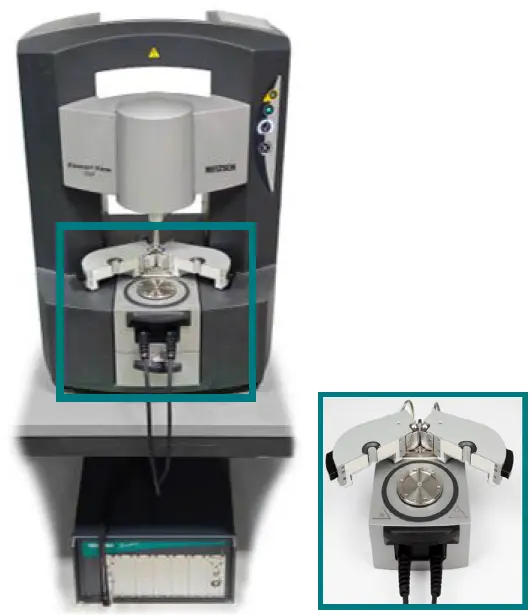
After positioning the upper measuring plate (8 mm in diameter) and setting the measurement gap to 1 mm, rheological and dielectric data were acquired simultaneously throughout the Curing (Crosslinking Reactions)Literally translated, the term “crosslinking“ means “cross networking”. In the chemical context, it is used for reactions in which molecules are linked together by introducing covalent bonds and forming three-dimensional networks.curing process. Table 1 summarizes the measurement conditions.
Kinexus Rotational Rheometer: Monitoring Molecular Network Formation
The rheological response reflects changes in the material's flow and deformation behavior as the polymer network develops.
At the beginning of the cure, the uncured resin exhibits predominantly liquid-like behavior, and the polymer chains can move relatively freely. As crosslinking advances, the growing polymer network increasingly restricts molecular motion, leading to a significant increase in viscosity and elasticity.
This behavior is reflected in the rheological parameters measured by rotational rheometry. The rheological signal therefore provides a highly sensitive indication of the progression cure and structural development, particularly around gelation and vitrification, where significant changes in the viscoelastic properties occur.
DEA 288 Ionic: Monitoring Molecular Mobility
The dielectric response reflects the mobility of Ionic species and dipoles within the material.
At the beginning of the cure, Ionic charge carriers can move relatively freely through the liquid resin. As crosslinking advances, the growing polymer network increasingly restricts molecular motion, resulting in a significant reduction in Ionic mobility.
This behavior is reflected by the increase in Ion ViscosityIon viscosity is the reciprocal value of the ion conductivity, which is calculated from the dielectric loss factor.ion viscosity measured by the DEA 288 Ionic system. The dielectric signal therefore provides a highly sensitive indication of the progressing cure, particularly during the early stages when rheological changes may still be relatively small.
Table 1: Test conditions
Kinexus Rotational Rheometer | |
| Geometry | Disposable plate with a diameter of 8 mm |
| Measurement gap | 1 mm |
| Shear StrainStrain describes a deformation of a material, which is loaded mechanically by an external force or stress. Rubber compounds show creep properties, if a static load is applied.strain | 0.1% |
| Frequency | 1 Hz |
| Temperature | 50°C |
DEA 288 Ionic | |
| Sensor | Tool-mounted |
| Frequency | 1 Hz to 10 kHz |
| Temperature | 50°C |
Results and Discussion
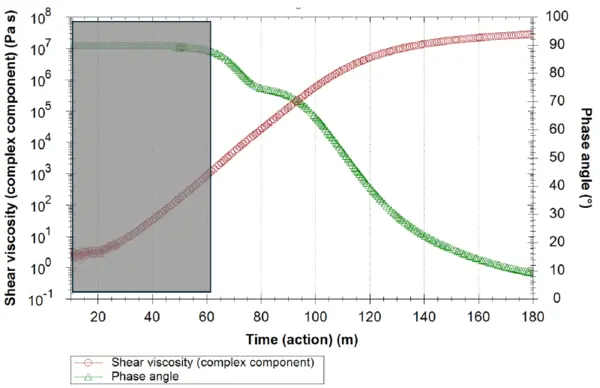
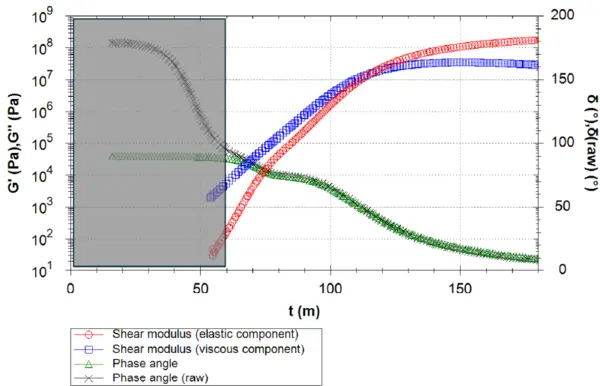
Figure 2 depicts the curves of the complex shear viscosity and the phase angle during the test, while Figure 3 shows the curves of the elastic shear modulus (G´), the viscous shear modulus (G´´), the phase angle and the raw phase angle.
Behavior during the Initial Stages of Curing
Immediately after loading the freshly mixed epoxy formulation, the material exhibits low complex shear viscosity. Under these conditions, the rheological response may be influenced by instrument inertia effects, which are visible in the raw phase angle data.
Using the raw phase angle available in rSpace software, the influence of inertia can be identified by comparing the phase angle and the raw phase angle. At the beginning of the measurement, the raw phase angle exceeds the physically meaningful phase angle, indicating that the rheological signal is affected by inertial contributions rather than solely reflecting the material response.
Consequently, the rheological parameters obtained during this initial period should be interpreted with caution and are not suitable for evaluating the earliest stages of cure. For this reason, rheological curves for which the uncorrected phase angle exceeds the corrected phase angle are not shown.
A possibility would be to minimize the inertia effects by reducing the measurement gap, decreasing the plate diameter, and/or lowering the test frequency.
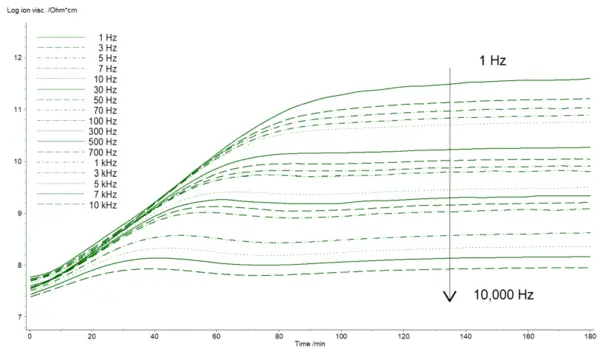
However, if the test is performed in combination with the DEA 288 Ionic, it is not necessary to repeat the measurement for a complete characterization of the curing process. Since dielectric data are acquired simultaneously, the onset of curing can be monitored directly through the evolution of Ion ViscosityIon viscosity is the reciprocal value of the ion conductivity, which is calculated from the dielectric loss factor.ion viscosity. Unlike rheological measurements, dielectric measurements are not affected by rheometer inertia and therefore provide reliable information on the reduction in Ionic mobility from the very beginning of the experiment.
Figure 4 shows the evolution of the Ion ViscosityIon viscosity is the reciprocal value of the ion conductivity, which is calculated from the dielectric loss factor.ion viscosity determined by means of dielectric analysis. The increase in Ion ViscosityIon viscosity is the reciprocal value of the ion conductivity, which is calculated from the dielectric loss factor.ion viscosity immediately after the measurement start for all frequencies is related to the beginning of the curing reaction.
Gelation
As the curing reaction progressed, the molecular weight increased through the formation of covalent bonds between the epoxy and amine functionalities. Consequently, the complex viscosity increased continuously.
The transition from a predominantly viscous liquid to an elastic network was observed through the evolution of the viscoelastic moduli. The gel point can be identified by the crossover of the elastic shear modulus (G´) and viscous shear modulus (G´´) detected at 116 min, indicating the formation of an infinite three-dimensional network.
Conclusion: Simultaneous Detection of Cure Initiation Despite Rheological Inertia Effects
As curing progresses and viscosity increases, the influence of inertia rapidly diminishes. The rheological data then become fully representative of the material response, allowing the subsequent determination of viscosity build-up, viscoelastic evolution, and gelation behavior.
The combination of rheometric and dielectric analysis therefore ensures continuous monitoring of the curing process over the entire measurement range. DEA captures the earliest stages of network formation, while rheometry provides detailed information on the development of mechanical properties once sufficient structural strength has been established.