Introduction
Poly(vinyl alcohol) (PVA) hydrogels have attracted considerable interest in biomedical applications such as cartilage replacement, tissue engineering, and soft biomaterials due to their biocompatibility, high water content, and tunable mechanical properties. A widely used approach for hydrogel preparation is the freeze-thaw technique, as it creates physical crosslinks without the need for chemical crosslinking agents. During freezing, water CrystallizationCrystallization is the physical process of hardening during the formation and growth of crystals. During this process, heat of crystallization is released.crystallization concentrates the polymer chains in the unfrozen regions, promoting the formation of PVA crystallites that act as junction points within the hydrogel network. Repeated freeze-thaw cycles further strengthen the network structure and enhance the mechanical stability of the hydrogel.
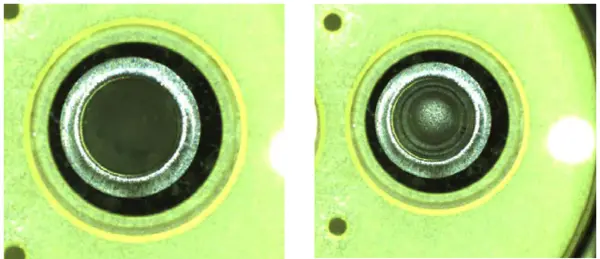
Although differential scanning calorimetry (DSC) is commonly used to investigate thermal transitions during freeze-thaw processing, conventional DSC provides only limited information regarding the visual evolution of the sample. An integrated DSC camera combines calorimetric data with synchronized optical imaging, enabling direct observation of CrystallizationCrystallization is the physical process of hardening during the formation and growth of crystals. During this process, heat of crystallization is released.crystallization and melting phenomena while simultaneously quantifying thermal events.
In this study, video DSC was employed to investigate the freeze-thaw behavior of two aqueous PVA solutions containing 8 wt% and 15 wt% polymer, respectively. The objective was to correlate the visual appearance of the samples with thermal transitions and to evaluate the influence of PVA concentration and repeated thermal cycling on the CrystallizationCrystallization is the physical process of hardening during the formation and growth of crystals. During this process, heat of crystallization is released.crystallization behavior.
Materials and Methods
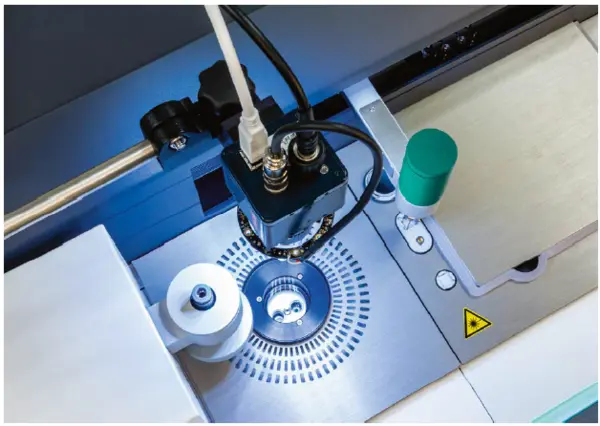
Two aqueous PVA solutions with concentrations of 8 wt% and 15 wt% were prepared and analyzed using the DSC 300 Caliris® equipped with an integrated camera system (see Figure 1).
The samples were subjected to repeated cooling and heating cycles between 40°C and -25°C at a constant rate of 1 K min-1. During each cycle, the DSC signal and synchronized video images were simultaneously recorded.
The thermal behavior was evaluated by analyzing the CrystallizationCrystallization is the physical process of hardening during the formation and growth of crystals. During this process, heat of crystallization is released.crystallization peaks observed during cooling. The integrated optical system allowed direct visualization of the structural changes occurring during CrystallizationCrystallization is the physical process of hardening during the formation and growth of crystals. During this process, heat of crystallization is released.crystallization and melting, which provided additional information to the calorimetric data.
Results and Discussion
CrystallizationCrystallization is the physical process of hardening during the formation and growth of crystals. During this process, heat of crystallization is released.Crystallization Behavior During Cooling
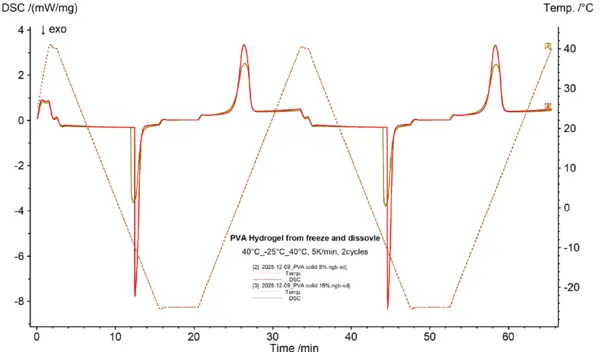
Figure 2 depicts the DSC curves of both hydrogels during two cool-and-heat cycles. Both PVA hydrogels exhibited a pronounced ExothermicA sample transition or a reaction is exothermic if heat is generated.exothermic peak near -10°C during cooling, indicating a CrystallizationCrystallization is the physical process of hardening during the formation and growth of crystals. During this process, heat of crystallization is released. crystallization process occurring within the sample. This temperature indicates the CrystallizationCrystallization is the physical process of hardening during the formation and growth of crystals. During this process, heat of crystallization is released. crystallization of water contained within the PVA hydrogel.
Influence of PVA Concentration
Figure 3 shows a comparison of the DSC curves for both samples. A significant difference was observed between the two formulations. The 8 wt% PVA sample exhibited a larger CrystallizationCrystallization is the physical process of hardening during the formation and growth of crystals. During this process, heat of crystallization is released. crystallization enthalpy than the 15 wt% sample.
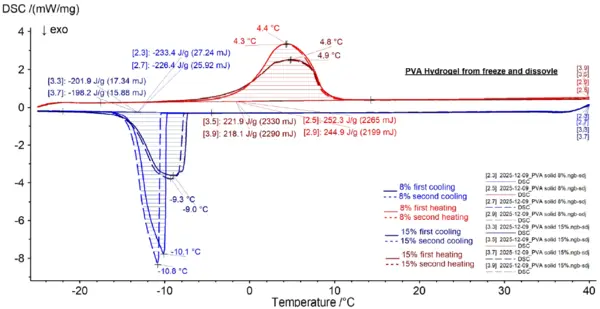
This behavior can be explained by the different fractions of freezable water present in the systems. At a lower polymer concentration, the network formed during freeze-thaw processing is less dense and a larger proportion of the water remains mobile. Consequently, a greater amount of water participates in ice CrystallizationCrystallization is the physical process of hardening during the formation and growth of crystals. During this process, heat of crystallization is released. crystallization and contributes to the enthalpy measured.
In contrast, the higher polymer concentration in the 15 wt% sample results in stronger interactions between the water molecules and the hydroxyl groups of PVA. A larger proportion of water becomes bound or confined within the polymer-rich regions and does therefore not readily crystallize. As a result, the amount of freezable water decreases and a lower CrystallizationCrystallization is the physical process of hardening during the formation and growth of crystals. During this process, heat of crystallization is released. crystallization enthalpy is observed. Similar concentration-dependent effects have been reported for PVA hydrogels, where lower polymer concentrations exhibit larger melting and crystallization peak areas due to the higher content of freezable water.
Effect of Repeated Freeze-Thaw Cycling
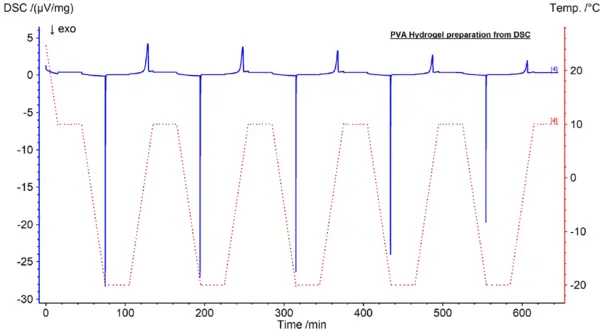
Figure 4 displays the temperature and DSC curves of the 8 wt% PVA for five heat/cool cycles. The crystallization enthalpy gradually decreased with increasing cycle number.
The reduction in crystallization enthalpy indicates the material’s progressive structural evolution during freeze-thaw processing. During the initial freezing cycle, water crystallization induces phase separation and locally concentrates the PVA chains. Upon thawing, these chains can reorganize and form crystalline domains that act as physical crosslinks within the developing hydrogel network.
With each additional freeze-thaw cycle, the extent of physical crosslinking increases. The growing number of PVA crystallites restricts water mobility and converts an increasing proportion of free water into bound or confined water. Consequently, less water is available for crystallization during the subsequent cooling steps, resulting in a gradual decrease in crystallization enthalpy.
Correlation Between Thermal and Visual Information
A major advantage of DSC with integrated camera is the ability to correlate thermal events with observable structural changes. The ExothermicA sample transition or a reaction is exothermic if heat is generated.exothermic crystallization peaks could be directly linked to ice nucleation and growth within the samples, confirming the nature of the thermal transition. Simultaneous video recordings (→Link) revealed the appearance and growth of crystalline regions at temperatures corresponding to the ExothermicA sample transition or a reaction is exothermic if heat is generated.exothermic DSC signal (Figure 4).
The simultaneous decrease in crystallization enthalpy and visible crystal formation over successive cycles provides strong evidence that the freeze-thaw process promotes hydrogel formation through progressive physical crosslinking. Thus, the combination of a video camera and the DSC 300 Caliris® provides unparalleled insight into both the thermodynamic and morphological evolution of PVA systems during hydrogel preparation.
Conclusion
The combination of calorimetric and optical information demonstrates that DSC with integrated camera (see Figure 5) is a powerful tool for studying hydrogel formation and provides valuable insight into the relationship between thermal transitions, water crystallization, and network development in PVA-based systems.