80% Shorter Measurement Time While Extending the Angular Frequency Range from 2 to Nearly 4 Decades
Introduction
Frequency-dependent rheological measurements provide a characteristic viscoelastic fingerprint of a polymer. The storage modulus, G', describes the elastic response, while the Viscous modulusThe complex modulus (viscous component), loss modulus, or G’’, is the “imaginary” part of the samples the overall complex modulus. This viscous component indicates the liquid like, or out of phase, response of the sample being measurement. loss modulus, G'', describes the viscous response. The phase angle, δ, indicates their relative contributions.
Conventional oscillatory frequency sweeps measure the response at individual frequencies sequentially. This can require substantial measurement time, particularly when low frequencies are included. Chirps measurements offer a rapid alternative: the oscillation frequency changes continuously during the excitation, and analysis of the measured signals provides the frequency-dependent viscoelastic response.
This Application Note compares conventional and chirps measurements of linear low-DensityThe mass density is defined as the ratio between mass and volume. density polyethylene (LLDPE) using a Kinexus rotational rheometer. The measurements demonstrate the principal benefit: a substantially broader frequency range acquired in approximately one-fifth of the time.
Measurement Conditions
Two measurements were performed on LLDPE using the Kinexus. The test conditions are detailed in Table 1.
Table 1: Measurement conditions
| Parameter | Conventional Frequency Sweep | Chirps Measurement |
|---|---|---|
| Angular frequency range | 0.62 to 62 rad/s | 0.02 to 150 rad/s |
| Frequency coverage | 2 decades | Almost 4 decades |
| Reported measurement duration | Approximately 25 minutes | Approximately 5 minutes |
| Geometry | Plate-Plate 20 mm | |
| Gap | 1 mm | |
| Temperature | 130°C | |
Results and Discussion
Conventional Frequency Sweep
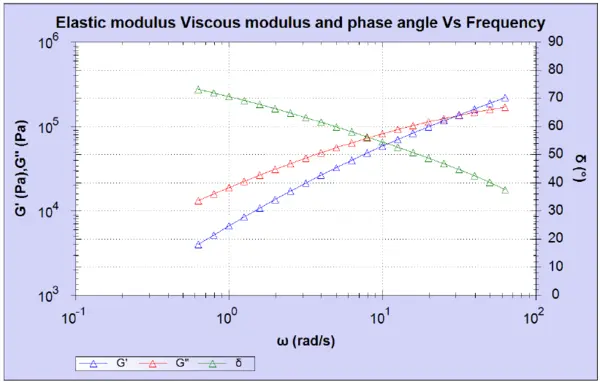
Figure 1 depicts the curves resulting from the conventional frequency sweep. At the lower end of the measured range, G'' exceeds G', indicating a predominantly viscous response. Both moduli increase with rising angular frequency, with G' increasing more strongly. The crossover is detected at 30 rad/s. At higher frequencies, G' exceeds G'', indicating a predominantly elastic response.
The phase angle decreases with increasing frequency, which is consistent with this transition. The conventional sweep therefore captures the transition from viscous-dominated to elastic-dominated behavior within the selected range.
Chirps Measurement
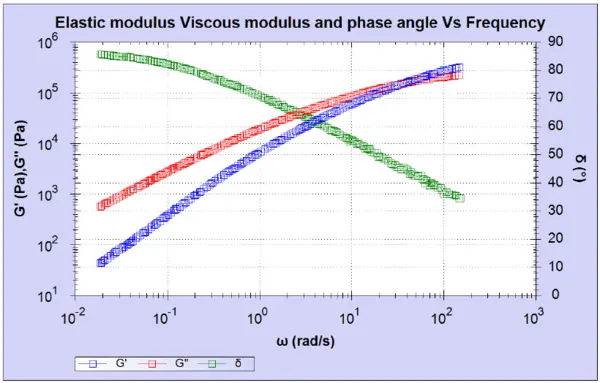
As shown in Figure 2, the chirps measurement extends the spectrum toward both lower and higher angular frequencies.
At low frequencies, G'' is substantially higher than G' and the phase angle approaches 90°, indicating a strongly viscous-dominated response. With increasing frequency, the separation between the moduli decreases. At higher frequencies, G' exceeds G'' and the phase angle falls below 45°.
The extended low-frequency range provides additional information about the sample’s response over longer observation timescales. Due to time considerations, this information is not captured by the conventional sweep shown in Figure 1.
Comparison of the Two Methods
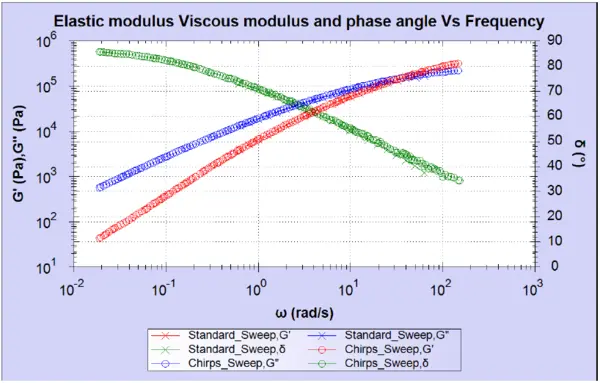
The overlay displayed in Figure 3 shows close visual agreement over the common frequency range, supporting the use of the chirps measurement to characterize this LLDPE sample. The chirps data additionally extend the measured spectrum beyond the typical range of the conventional sweep.
Conclusion: Advantage of Chirps Measurements with the Kinexus
The LLDPE measurements demonstrate a clear practical advantage of chirps testing with the Kinexus rotational rheometer. The chirps measurement covers 0.02 to 150 rad/s in approximately 5 minutes, while the conventional frequency sweep covers 0.62 to 62 rad/s in approximately 25 minutes. The results show close visual agreement within their overlapping range.
Kinexus chirps measurements deliver a broader viscoelastic spectrum with approximately 80% less measurement time, supporting efficient polymer characterization and material comparison.