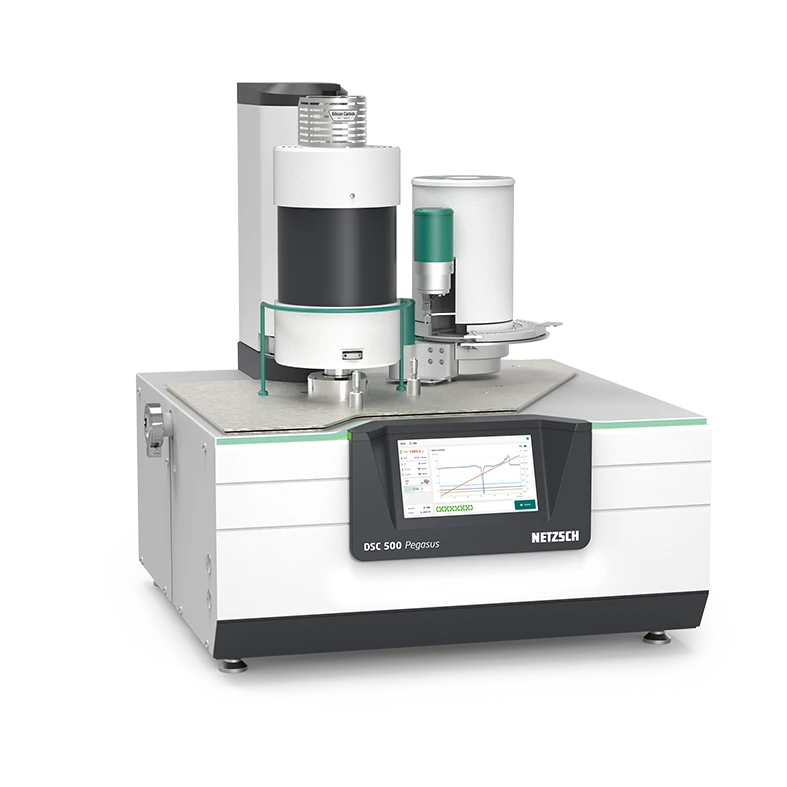
Proteus®
Always One Step Ahead!
The NETZSCH Proteus® software runs on the Windows® user interface (Windows® 10/11 64-bit Professional/Enterprise) and includes, even in its basic version, all of the necessary functions for carrying out and evaluating measurements.
User-friendly menus combined with automated routines make this software very easy to use while still providing sophisticated analysis.
The NETZSCH Proteus® software is licensed to the computer of the corresponding instrument, but can also be installed on additional analysis computers. For in-depth measurement and evaluation methods such as for purity or DensityThe mass density is defined as the ratio between mass and volume. Density Determination, a variety of additional software packages – some of which are instrument-specific – are optionally available.

Universal Measurement Methods
Proteus® software uses across-the-board measurement methods which can be employed on different instruments of the same type (e.g., on any DSC instrument). This enables users ‒ with the appropriate instrument configuration ‒ to carry out measurements with multiple instruments under exactly the same conditions. If needed, the curve evaluation can even be integrated into the respective measurement method so that the evaluated curve is automatically available immediately after completion of the experiment.

SmartMode
The intuitive SmartMode user interface (for DSC, TGA, GHP and HFM systems) allows for the quick and straightforward start of a measurement by using wizards (quick-start routines), user-defined measurement methods or pre-defined measurement methods.
ExpertMode
ExpertMode is designed for any user preferring complete access to the entire range of commands of the Proteus® software, operated via toolbar buttons. SmartMode and ExpertMode are part of the standard configuration of the Proteus® software and can always be found next to each other.
AutoEvaluation
AutoEvaluation is a unique evaluation routine that autonomously finds and evaluates all effects in DSC, TGA, DIL, TMA and DMA curves by means of intelligent algorithms. It allows for different persons to always obtain the same, clear result. Experienced users can utilize the automatic evaluation result as a second opinion or employ this exceptional function to arrive at a result much faster.



KIMW Database
In cooperation with the Kunststoff-Institut Lüdenscheid, NETZSCH-Gerätebau offers a polymer database for DSC analysis with Identify including measurements of 1.250 different commercially available polymers (174 different polymer types).
DSC-BeFlat® compensates for all influences on DSC baselines which can be related to thermal asymmetries of the DSC sensor. This results in a minimal amount of curvature in the baseline in the μW range. TGA-BeFlat® automatically corrects instrument and buoyancy effects and thus eliminates the need for buoyancy correction measurements.
The “specific heat” software package allows for the fast and accurate determination of the Specific Heat Capacity (cp)Heat capacity is a material-specific physical quantity, determined by the amount of heat supplied to specimen, divided by the resulting temperature increase. The specific heat capacity is related to a unit mass of the specimen.specific heat capacity cp (at constant pressure) on solids, powders and liquids in accordance with standardized techniques (e.g., DIN 51007, ASTM E1269, ISO 11357) using DSC or STA instruments. In addition, this software can also be employed to carry out heat-flow calibrations with, for example, sapphire as the standard material.
This software option for conducting measurements with rate-controlled temperature management (mass-change-controlled TGA, i.e., RCM; and shrinkage-rate-controlled dilatometry, i.e., Rate-Controlled Sintering (RCS)The properties of sintered products, such as density or particle size distribution, are determined by the sintering conditions (temperature, atmosphere, etc.) and especially by the sintering rates. RCS) is well suited for increasing the resolution of superimposed effects and enhancing sample compaction for SinteringSintering is a production process for forming a mechanically strong body out of a ceramic or metallic powder. sintering processes.
Provided that the sample thermocouple is in close proximity to the sample (as is the case with NETZSCH thermobalances and dilatometers), a DTA signal can be calculated and recorded from the difference between the temperature of the sample and the temperature of the program. This allows for additional information on ExothermicA sample transition or a reaction is exothermic if heat is generated.exothermal or endothermal processes to be gathered during the course of TGA or DIL measurements. Moreover, the c-DTA® software can also be employed for the temperature calibration of thermobalances or dilatometers.
When applying temperature modulation, the linear heating rate is superimposed by a sinusoidal temperature change. This makes it possible to deconstruct the signals into reversing and non-reversing parts (DSC, DIL, TMA) and thereby separate overlapping effects ‒ for example, Glass Transition TemperatureThe glass transition is one of the most important properties of amorphous and semi-crystalline materials, e.g., inorganic glasses, amorphous metals, polymers, pharmaceuticals and food ingredients, etc., and describes the temperature region where the mechanical properties of the materials change from hard and brittle to more soft, deformable or rubbery.glass transitions and RelaxationWhen a constant strain is applied to a rubber compound, the force necessary to maintain that strain is not constant but decreases with time; this behavior is known as stress relaxation. The process responsible for stress relaxation can be physical or chemical, and under normal conditions, both will occur at the same time. relaxation peaks (DSC) or thermal expansions and SinteringSintering is a production process for forming a mechanically strong body out of a ceramic or metallic powder. sintering steps (DIL, TMA) ‒ and to calculate activation energy(ies) from a measurement (TGA).
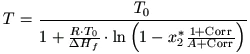
For crystalline substances with known molar mass, Purity Determination serves to determine the percentage of eutectic impurities on the basis of the Van ’t Hoff equation. The DSC melting peak is evaluated for each substance.
Purity Determination is a program for determining the purity of a material through analysis of the DSC melting peak.
The following features set this program apart from the known solutions and from ASTM E 928:
- Purity determination using the VAN'T HOFF equation without mathematical approximation. Thus, the range of application can be extended beyond the impurity of 5 mol%. The estimated upper boundary could be 10 mol%
The names and the molar masses of the substances used are stored in a table and are available after every start. ASCII-Files serve as the general interface for the transfer of data. The data can be corrected using three different baselines:
- linear,
- horizontal area-proportional and
- tangential area-proportional.
The non-linear regression automatically links with the baseline determination. The required initial parameters are prepared in a starting calculation.
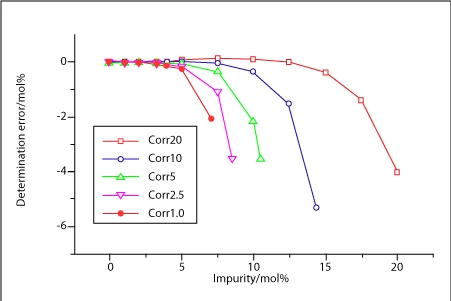
To increase reliability, the results of several measurements can be averaged, with the mean and standard deviation printed out.
These errors are avoided in NETZSCH Purity Determination by using a non-linear regression routine.
The following are listed in the results:
| Name of Parameter | Result |
|---|---|
| Impurity/mol% | concentration of the impurity(ies) |
| Purity/mol% | purity, |
| To/°C | Melting Temperatures and EnthalpiesThe enthalpy of fusion of a substance, also known as latent heat, is a measure of the energy input, typically heat, which is necessary to convert a substance from solid to liquid state. The melting point of a substance is the temperature at which it changes state from solid (crystalline) to liquid (isotropic melt).melting temperature of the pure substance, extrapolated temperature for 1/Partial Area => 0. |
| TempClear/°C | temperature is obtained through extrapolation of 1/Partial Area ->1. |
| TempBegin/°C | temperature for which the Partial Area = 0.1, |
| Correction/% | correction of the peak area |
| Enthalpy/(kJ/mol) | melting enthalpy of the substance (measured from the DSC peak). |
The results can be printed out with the graph.
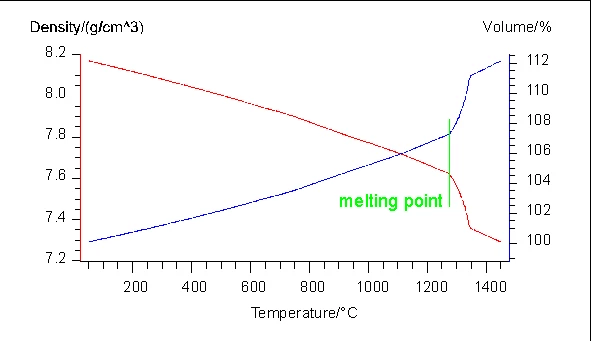
This extra package allows for the calculation of the DensityThe mass density is defined as the ratio between mass and volume. density change in a material (with the initial DensityThe mass density is defined as the ratio between mass and volume. density as a reference value) during a DIL or TMA investigation. Even measurements that finish in a molten state (in a container of sapphire, graphite or quartz) can be evaluated this way. Below the Melting Temperatures and EnthalpiesThe enthalpy of fusion of a substance, also known as latent heat, is a measure of the energy input, typically heat, which is necessary to convert a substance from solid to liquid state. The melting point of a substance is the temperature at which it changes state from solid (crystalline) to liquid (isotropic melt).melting temperature, the DensityThe mass density is defined as the ratio between mass and volume. density can be calculated based on an isotropic material; above the Melting Temperatures and EnthalpiesThe enthalpy of fusion of a substance, also known as latent heat, is a measure of the energy input, typically heat, which is necessary to convert a substance from solid to liquid state. The melting point of a substance is the temperature at which it changes state from solid (crystalline) to liquid (isotropic melt).melting temperature, all influences of the container and sample preparation are taken into consideration.
The DensityThe mass density is defined as the ratio between mass and volume. Density Determination program serves for the determination of the temperature-dependent DensityThe mass density is defined as the ratio between mass and volume. density of solid samples beyond the Melting Temperatures and EnthalpiesThe enthalpy of fusion of a substance, also known as latent heat, is a measure of the energy input, typically heat, which is necessary to convert a substance from solid to liquid state. The melting point of a substance is the temperature at which it changes state from solid (crystalline) to liquid (isotropic melt).melting temperature. The calculations are based on dilatometer measurements carried out in a container temperature-stable (sapphire, graphite, quartz glass, etc.). During melting, the sample completely fills the container. Therefore, with correct sample preparation, there is a monotonic transition of the dL/L0 curve into the liquidus range.
This software is of interest for all researchers who require a more accurate determination of Phase TransitionsThe term phase transition (or phase change) is most commonly used to describe transitions between the solid, liquid and gaseous states.phase transitions. The data should also be of interest for designers who work in the area of casting technology. It is absolutely critical for analyses in which the DensityThe mass density is defined as the ratio between mass and volume. density is required beyond the Melting Temperatures and EnthalpiesThe enthalpy of fusion of a substance, also known as latent heat, is a measure of the energy input, typically heat, which is necessary to convert a substance from solid to liquid state. The melting point of a substance is the temperature at which it changes state from solid (crystalline) to liquid (isotropic melt).melting point (e.g., determination of the Thermal DiffusivityThermal diffusivity (a with the unit mm2/s) is a material-specific property for characterizing unsteady heat conduction. This value describes how quickly a material reacts to a change in temperature.thermal diffusivity by means of laser flash analysis).
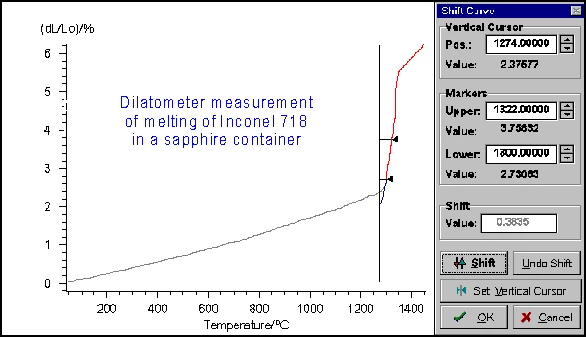
However, if the sample diameter is smaller than the inside diameter of the container, the slope of the dL/L0 curve decreases with the start of melting. If the sample diameter is considerably smaller, a drop in the curve can even be seen. For technical reasons, it is often impossible or too costly to prepare perfect samples. In order to obtain correct results for such samples as well, the almost linear segment of the liquidus curve (red), indicated by the two markers (<), is approximated by a polynomial and this area is extended to the vertical cursor, which characterizes the start of the melting process.
The approximated curve, together with the red part of the liquidus curve that follows, is shifted such that it begins at the point of intersection of the vertical cursor with the solidus curve (pink). Thus, errors which result from the limited precision of the sample preparation are corrected to a great extent.
The AutoCooling function allows for automatic recognition of the connected cooling system and, as a resource-saving measure, activates it only when required. Available for DSC instruments.
AutoCalibration allows for the automatic generation of calibration curves. Current calibrations are automatically loaded with consideration to the selected measurement conditions and checked for their period of validity. Available for DSC and TGA instruments.

Application Literature
Software Innovations
- "Concentration" - A New Evaluation Routine in Proteus® 8.0 Analysis
- 2DTemperatureCalibration Dependent on Temperature and Heating Rate for DSC and STA Instruments
- Adaptive Smoothing for DSC and TGA
- Advanced DSC/DTA Horizontal
- An Intuitive Software to Facilitate Your Pharmaceutical Analysis: NETZSCH Proteus®
- AutoEvaluation of DIL and TMA Curves
- AutoEvaluation of DMA Curves: Glass Transitions
- AutoEvaluation of DSC Curves: The New Evaluation Function for UV-Curing
Our latest blog articles
- 11.06.2026
NETZSCH Proteus® 9.9: Extending Compatibility and Refining Performance within the Proteus® 9 Measurement and Analysis Software Platform

- 28.04.2026
From DSC Data to Industry Intelligence: How Your DSC Data Can Power Scalable Polymer Recycling

- 28.10.2025
NETZSCH Proteus® AutoEvaluation and Identify: Intelligent Analysis at Your Fingertips - Part 2
- 14.10.2025
NETZSCH Proteus® 9 Software: Smarter Workflows and Extended Access - Part 1
- 30.09.2025
From Recyclate Confusion to Clarity – with the Brand-New NETZSCH Proteus® Now Quantify Software

- 06.03.2024
Hot News: The New NETZSCH Thermobalance TG 309 Libra®!
Please note:
Not all NETZSCH instruments can be configured with all of the above software functionalities. Please consult your customer representative for the software version available for your device.
* Different instrument types have different software configurations; the software options marked with an asterisk may be subject to extra charges when combined with certain instruments.
** The KIMW database requires Identify under Proteus® 7.1 or higher.