Introduction
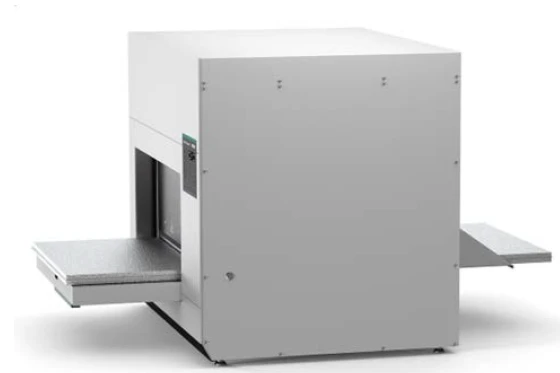
Vacuum insulation panels (VIPs) are high-performance insulation materials used in a variety of applications. They are characterized by their properties of excellent insulation even with minimal material thickness, making them an ideal solution for areas with limited space. NETZSCH offers the HFM 706 Lambda Large (see figure 1), a measuring system for determining the Thermal ConductivityThermal conductivity (λ with the unit W/(m•K)) describes the transport of energy – in the form of heat – through a body of mass as the result of a temperature gradient (see fig. 1). According to the second law of thermodynamics, heat always flows in the direction of the lower temperature.thermal conductivity of VIP materials.
This application note discusses the structure and application of VIP materials, the challenges involved in measurement and the results obtained using the HFM 706 Lambda Large on reference and VIP samples.
Structure and Mode of Operation of Vacuum Insulation Panels
A VIP consists of several key components that together guarantee its outstanding insulating properties. The excellent insulation performance of VIPs is based on the combination of vacuum and the specific core material. The core material forms the supporting structure of the VIP and usually consists of pressure-resistant, porous materials such as fumed silica, glass fibers, or PU foam. This material reduces heat conduction inside the panel. The core material is sealed in an airtight envelope under vacuum. Removing air molecules virtually eliminates heat transfer by convection.
A multi-layer barrier film, typically consisting of metal and polymer layers, ensures the vacuum seal. This film protects the vacuum and prevents air or moisture from entering. The barrier film also reflects infrared radiation, thereby limiting heat transfer through radiation. Additional protective layers of plastic or aluminum make VIPs resistant to mechanical damage. Thanks to these properties, VIPs offer up to ten times the insulation efficiency of conventional insulation materials of the same thickness.
Application of VIPs
VIPs are used in numerous industries where highly efficient insulation is required in confined spaces. They are used in walls, roofs and floors, particularly in passive houses or renovation projects, to achieve high insulation values without the need for thick materials.
In refrigerators and freezers, VIPs help reduce energy consumption and increase storage capacity. They are used to insulate containers and packaging that transport temperature-sensitive goods such as medicines and food. Due to their high efficiency and low weight, VIPs are also used in aerospace technology.
VIPs are used in electric vehicles to improve the Thermal StabilityA material is thermally stable if it does not decompose under the influence of temperature. One way to determine the thermal stability of a substance is to use a TGA (thermogravimetric analyzer). thermal stability of batteries and enhance interior climate control.
Measurement of the Thermal Conductivity of VIP Materials
The Thermal ConductivityThermal conductivity (λ with the unit W/(m•K)) describes the transport of energy – in the form of heat – through a body of mass as the result of a temperature gradient (see fig. 1). According to the second law of thermodynamics, heat always flows in the direction of the lower temperature.thermal conductivity (λ value) of a material is a decisive factor in evaluating its thermal performance. However, due to the unique structure and operating principle of VIPs, traditional measurement methods are often not directly applicable. Therefore, heat flow meter technology (HFM) has become the established method for measuring the Thermal ConductivityThermal conductivity (λ with the unit W/(m•K)) describes the transport of energy – in the form of heat – through a body of mass as the result of a temperature gradient (see fig. 1). According to the second law of thermodynamics, heat always flows in the direction of the lower temperature.thermal conductivity of VIPs.
Challenges in Measurement
Over time, the barrier film may allow gas to pass through, which would weaken the vacuum and increase Thermal ConductivityThermal conductivity (λ with the unit W/(m•K)) describes the transport of energy – in the form of heat – through a body of mass as the result of a temperature gradient (see fig. 1). According to the second law of thermodynamics, heat always flows in the direction of the lower temperature.thermal conductivity. Therefore, long-term measurements must be carried out. However, the Thermal ConductivityThermal conductivity (λ with the unit W/(m•K)) describes the transport of energy – in the form of heat – through a body of mass as the result of a temperature gradient (see fig. 1). According to the second law of thermodynamics, heat always flows in the direction of the lower temperature.thermal conductivity measurement results may not be reproducible.
The thermal properties of the edges of a VIP may differ from those of the main surface, affecting the accuracy of the measurement. Even the slightest irregularity in the core material or the barrier film can distort the measurement.
Due to their special insulating properties, VIPs are in the lower range outside the detection limit of many measurement systems. This places special demands on sensitivity and system stability.
VIP samples cannot usually be cut to fit into the measuring device. Therefore, it is necessary to be able to carry out measurements on the original sample.
HFM 706 Lambda Large
This new electronics and firmware, which has already been introduced in the Eco-Line, offers significant advantages in terms of measurement speed and accuracy when measuring VIP materials. A hinged rear door has also been added to the HFM 706 Lambda Large model. Tests were carried out on reference and VIP samples.
With the rear open, it is now possible to investigate not only ageing, but also the effects of edge losses and inhomogeneities in non-square samples, especially with VIP samples. To this end, the front and/or rear door can be left open during the measurement. Comparative measurements on reference samples have shown that there are no additional measurement errors due to open doors in the range around room temperature.
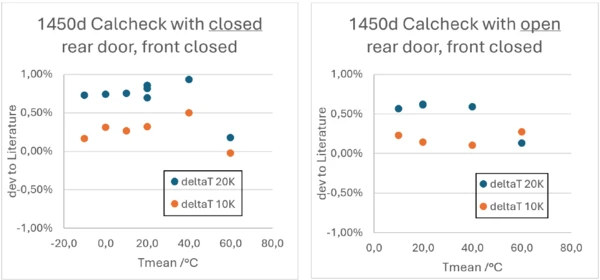
Figures 2 and 3 show the deviations from literature values for measurements on the NIST SRM 1450d reference sample with the front door closed or open (reference measurement with the door closed in each case). In both cases, the maximum deviation from the literature value is less than 1% between 10°C and 60°C.
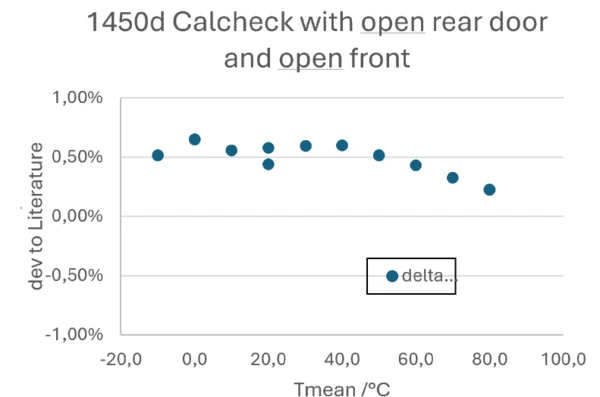
When both the front and rear doors are open, the deviation is also less than 1% (see figure 3).
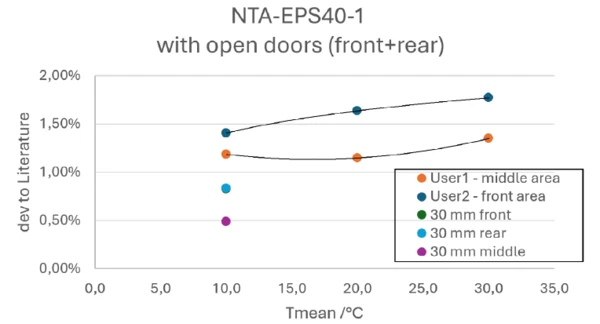
The influence of open doors on the measurement uncertainty was also tested using 'long' EPS samples of various thicknesses with a length of 1200 mm and a width of 600 mm. As these are homogeneous reference samples, the measured value should be independent of the measurement position along the sample’s longitudinal axis.
Figure 4 shows the deviations from the reference value between 10°C and 30°C for EPS samples with a thickness of 40 mm. The deviations are less than 2%, with slightly higher values observed in the front area of the sample. Additionally, figure 4 shows the deviations for EPS with a thickness of 30 mm at three different positions at 10°C. Again, slightly higher deviations are evident at the front and rear measuring positions compared to the center of the sample, with a deviation of approximately 0.5%. A deviation of approximately 0.8% was determined for the front and rear positions.
Measurements on VIPs are also straightforward with the HFM 706 Lambda Large. Stable measurement signals, sensitive sensor technology and low-noise signals are prerequisites for achieving high measurement accuracy and repeatability. Figure 5 shows the measurement results of an extra-long VIP sample.

When the average temperature of the VIP sample increases from 10°C to 40°C, its thermal conductivity increases by approx. 12%, from 0.00457 W/(m·K) to 0.00514 W/(m· K). Consequently, the insulating effect of the VIP deteriorates by up to 12% if the external temperature of a building façade rises from below 10°C to above 30°C, for example. This information is important for manufacturers and users of VIPs and is significant in product development and quality control.
Figure 5 additionally demonstrates the excellent repeatability of the measurements and the high resolution of the results. Three individual measurements were taken at each temperature and the maximum deviation between individual values was less than 1%. The values differ only in the fifth decimal place (0.00471, 0.00472 and
0.00474 W/(m·K) at 20°C), and the expected exponential trend in thermal conductivity with temperature is also clearly visible. This demonstrates the high resolution of the HFM 706 Lambda Large and the excellent repeatability of the VIP measurements. Even the slightest changes within the VIP, such as those due to structural changes caused by ageing or vacuum loss through microcracks in the barrier film, can be quickly and reliably detected at any time.
Summary
Vacuum insulation panels are a cutting-edge technology for applications requiring high insulation efficiency. Despite cost and durability challenges, VIPs offer significant advantages in terms of energy efficiency and space savings. As technology advances and demand grows, VIPs are expected to play an increasingly important role in various industrial fields. NETZSCH offers the HFM 706 Lambda Large, a reliable system for measuring the thermal conductivity of VIP materials. Effective measures in the instrument’s technology and design overcome the challenges posed by the sample properties during measurement.