12.08.2025 by Aileen Sammler
The Secrets of Biomass Pyrolysis: How Thermogravimetric Analysis Helps Optimize Olive Stone Valorization
The transition to sustainable energy systems depends on the intelligent use of biomass and organic waste. But how can we design efficient conversion processes for complex feedstocks such as olive stones? The answer lies in precise material characterization – and that’s where NETZSCH’s TG 309 Libra® thermogravimetric analyzer comes into play.
In this study, we use thermogravimetric analysis (TGA) and NETZSCH Kinetics Neo software to analyze the thermal behavior of olive stone biomass, a promising renewable feedstock derived from the olive oil industry. Combining high-resolution TGA data with advanced Kinetics Neo modeling provides a deeper understanding of PyrolysisPyrolysis is the thermal decomposition of organic compounds in an inert atmosphere.pyrolysis behavior and enables process optimization for biofuel and biocarbon production.
Why Olive Stones?
Olive stones, the hard inner pits left over from processing olives, are rich in cellulose, hemicellulose, and lignin. Their low moisture content and high energy DensityThe mass density is defined as the ratio between mass and volume. density make them an ideal feedstock for PyrolysisPyrolysis is the thermal decomposition of organic compounds in an inert atmosphere.pyrolysis, a thermochemical process that breaks down biomass into gas, oil, and solid char.
To exploit their full potential, it is crucial to understand how olive stones decompose when heated. TGA reveals this information by measuring the mass loss as a function of temperature. This provides insight into each step of the PyrolysisPyrolysis is the thermal decomposition of organic compounds in an inert atmosphere.pyrolysis reaction.
Powerful Analysis with the Thermobalance NETZSCH TG 309 Libra® Classic
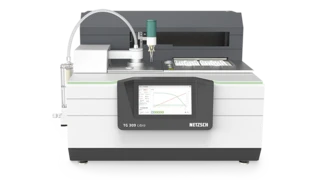
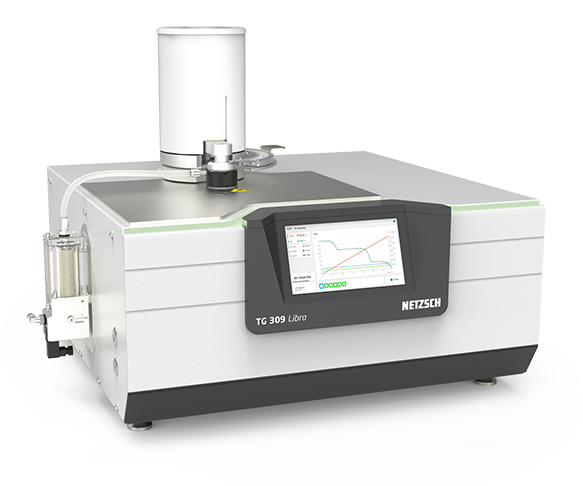
The measurements in this study were performed using the NETZSCH TG 309 Libra® Classic, a robust and versatile thermobalance for temperatures up to 1025°C. It is designed for demanding routine analyses and research tasks alike – particularly in the field of biomass and polymer degradation, carbon capture, and environmental studies.
Key features of the TG 309 Libra® Classic:
- Top-loading ultra-sensitive weighing system with an outstanding balance resolution
- Precise temperature control for slow and fast heating rates
- Corrosion-resistant furnace for challenging atmospheres
- Seamless integration with NETZSCH Kinetics Neo for advanced reaction modeling
These features make the system a powerful tool for analyzing the complex, multi-step degradation behavior of natural materials, such as olive stones, as demonstrated in the application note.
Step-by-Step: From Measurement to Process Optimization
The TGA measurements revealed a typical multi-stage Decomposition reactionA decomposition reaction is a thermally induced reaction of a chemical compound forming solid and/or gaseous products. decomposition pattern:
- Moisture release (up to ~130°C)
- Hemicellulose degradation (starting ~200°C)
- Cellulose breakdown (~300°C)
- Lignin Decomposition reactionA decomposition reaction is a thermally induced reaction of a chemical compound forming solid and/or gaseous products. decomposition (up to ~700°C and beyond)
With increasing heating rates, the thermal degradation peaks shifted, indicating kinetic effects. These were systematically analyzed using Kinetics Neo, which enabled the researchers to:
- Identify five distinct reaction steps
- Determine activation energies and reaction orders
- Simulate the PyrolysisPyrolysis is the thermal decomposition of organic compounds in an inert atmosphere.pyrolysis process under different temperature programs
- Optimize heating profiles for maximum efficiency
The result is a validated, data-driven model for PyrolysisPyrolysis is the thermal decomposition of organic compounds in an inert atmosphere.pyrolysis that can be used to design industrial processes such as the production of biochar or activated carbon with optimal yields and minimal energy input.

Thermogravimetry as a Gateway to Green Innovation
This case study highlights how state-of-the-art thermal analysis supports the development of greener, more efficient processes in the bioeconomy. Whether you're working on renewable feedstocks, plastic waste, or advanced materials, the NETZSCH TG 309 Libra® thermobalance provides the data clarity you need to innovate with confidence.
Read the full Application Note!
Want to dive deeper into the Decomposition reactionA decomposition reaction is a thermally induced reaction of a chemical compound forming solid and/or gaseous products. decomposition profile of olive stone biomass and the full kinetic model? Read the full Application Note here:
Learn more about NETZSCH TG 309 Thermobalance and Kinetics Neo Software