Introduction
PyrolysisPyrolysis is the thermal decomposition of organic compounds in an inert atmosphere.Pyrolysis has emerged as a key thermochemical process in the transition toward sustainable and circular energy systems. It enables the conversion of a wide range of carbon-based feedstocks into valuable fuels, chemicals, and carbon-rich solids.
Among the various materials suitable for PyrolysisPyrolysis is the thermal decomposition of organic compounds in an inert atmosphere.pyrolysis are biomass and organic waste, plastics, and rubber-based materials like waste tires. These feedstocks offer different end products, from biochar and syngas to fuels and industrial carbon materials depending on their composition and processing conditions.
Focusing on biomass as a renewable resource has significant potential in biofuel production and the generation of value-added chemicals. The conversion of biomass through processes such as PyrolysisPyrolysis is the thermal decomposition of organic compounds in an inert atmosphere.pyrolysis, gasification, and combustion offers sustainable solutions to meet the growing demand for energy [1]. Among the various biomass feedstocks, olive stones stand out as a particularly valuable resource [2]. A byproduct of the olive industry, olive stones possess high energy potential due to their low moisture content and rich lignocellulosic composition. These characteristics make olive stones ideal for biofuel production through PyrolysisPyrolysis is the thermal decomposition of organic compounds in an inert atmosphere.pyrolysis. Also, olive stones can be converted into biochar, activated carbon, and biochemicals, offering diverse applications beyond energy production.
This study focuses on the PyrolysisPyrolysis is the thermal decomposition of organic compounds in an inert atmosphere.pyrolysis kinetics of olive stone biomass. Based on thermogravimetric measurements, a comprehensive kinetic analysis of olive stone biomass is performed using the NETZSCH Kinetics Neo software to determine key kinetic parameters and perform process optimization through simulation.
Measurement Conditions
The measurement condition are detailed in table 1. The TGA curves obtained are the basis for kinetic evaluation of the Decomposition reactionA decomposition reaction is a thermally induced reaction of a chemical compound forming solid and/or gaseous products. decomposition reaction.
Table 1: Thermogravimetric analysis (TG) test parameters
| Instrument | NETZSCH TG 309 Classic |
|---|---|
| Crucible | Al2O3, open |
| Sample mass | 9.65 mg to 9.85 mg |
| Temperature range | 25°C to 1000°C |
| Atmosphere | Nitrogen (40 ml/min), switch to synthetic air (40 ml/min) at 900°C |
| Heating rates | 2.5 K/min, 5 K/min, 7.5 K/min, 10 K/min, 15 K/min, 20 K/min, |
Measurement Results
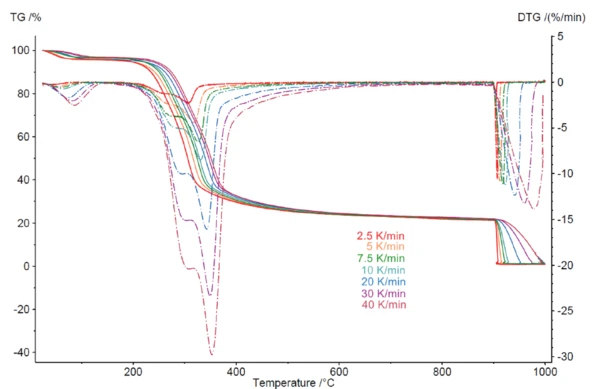
The TGA measurements in figure 1 depict the TGA and DTG (first derivative) curves of the measurements on olive stone at heating rates of 2.5, 5, 7.5, 10, 20, 30 and 40 K/min under an inert atmosphere. The first mass-loss step, detected between room temperature and 130°C, results from moisture evaporation and is accompanied by a mass loss of 3.3% [3]. After the dehydration process, several overlapped mass-loss steps take place at temperatures between 130°C and 700°C, attributed to the thermal degradation of hemicellulose; this is followed by cellulose degradation, and finally a prolonged mass loss, which might be attributed to the degradation of lignin [4]. The mass losses observed at temperatures above 700°C are due to the thermal degradation of resilient lignin structures [5]. They are shifted to higher temperatures with increasing heating rates (kinetic influence) [6].
Kinetic Analysis of Thermal Decomposition
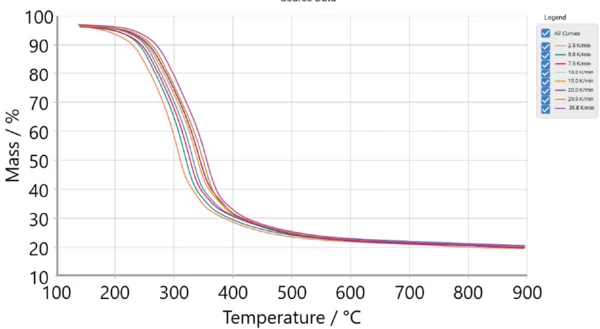
Using the NETZSCH Kinetics Neo software, the dependence of the Decomposition reactionA decomposition reaction is a thermally induced reaction of a chemical compound forming solid and/or gaseous products. decomposition process on the heating rate can be evaluated. The TGA profile for the rate of 40 K/min is depicted in figure 2. This observation indicates that the PyrolysisPyrolysis is the thermal decomposition of organic compounds in an inert atmosphere.pyrolysis process is not fully completed by 700°C, but rather proceeds gradually up to 900°C, accompanied by a mass loss. The initial mass-loss step prior to 140°C, which pertains to the removal of moisture, was not taken into account in the data that was subjected to kinetic analysis [3]. When switching from nitrogen to oxygen at 900°C, a mass loss occurs due to combustion. This data was excluded from the kinetic analysis. Figure 2 shows the TGA measurement curves between 130°C and 900°C used for the kinetic evaluation.
The degree of conversion, α, is calculated by Kinetics Neo software from thermogravimetry measurements where α ranges from 0 to 1 (Eq 1).
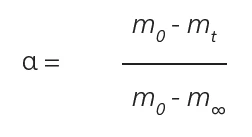
m0: initial mass
mt: mass at time t
m∞: final mass
Due to the complexity of biomass, a detailed understanding of reaction kinetics is essential for designing efficient reactors and optimizing process conditions [8]. The PyrolysisPyrolysis is the thermal decomposition of organic compounds in an inert atmosphere.pyrolysis of hemicellulose begins at a relatively low temperature (~200°C) [9]. Cellulose Decomposition reactionA decomposition reaction is a thermally induced reaction of a chemical compound forming solid and/or gaseous products. decomposition involves multiple steps, including the formation of an amorphous intermediate and the production of levoglucosan [10]. Lignin is the most stable component due to its aromatic ring structure, with Decomposition reactionA decomposition reaction is a thermally induced reaction of a chemical compound forming solid and/or gaseous products. decomposition occurring over a temperature range from 170°C to the end of the process [3].
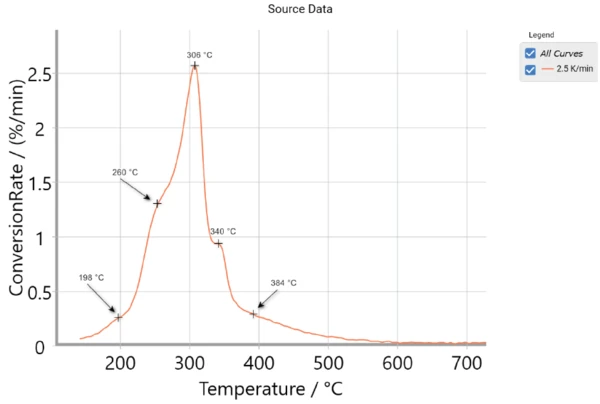
The thermal Decomposition reactionA decomposition reaction is a thermally induced reaction of a chemical compound forming solid and/or gaseous products. decomposition of olive stone occurs in multiple stages, as illustrated in figure 3, where the conversion rate is defined as the first derivative of conversion with respect to time. The first shoulder at 198°C marks the early Decomposition reactionA decomposition reaction is a thermally induced reaction of a chemical compound forming solid and/or gaseous products. decomposition of hemicellulose, followed by its main decomposition phase around 260°C. The primary breakdown of cellulose occurs at the main peak near 306°C with a late decomposition stage at 340°C. Finally, lignin decomposes slowly, showing a final shoulder at 384°C. [7]
This suggests a multi-step reaction process, which can be modeled with a five-step kinetic model:
A → B → C → D → E
F → G
The reaction rate of each step, j, is described by the function (Eq 2):
Reaction Rate j = Aj · f(ej, pj) · exp (-Ej/(RT)) (Eq 2)
Aj: pre-exponential factor
Ej: activation energy [J/mol]
T: temperature [K]
R: gas constant (8.314 J/K.mol)
f (ej ,pj): function dependent on the concentration of the initial reactant, ej, and the concentration of product, pj
The thermal decomposition of the olive stone can be fitted by five peaks, corresponding to the sum of peaks at temperatures 198°C, 260°C, 306°C, 340°C, and 384°C, as shown in figure 4. These peaks represent the sequential decomposition of hemicellulose, cellulose, and lignin during the PyrolysisPyrolysis is the thermal decomposition of organic compounds in an inert atmosphere.pyrolysis process [6].
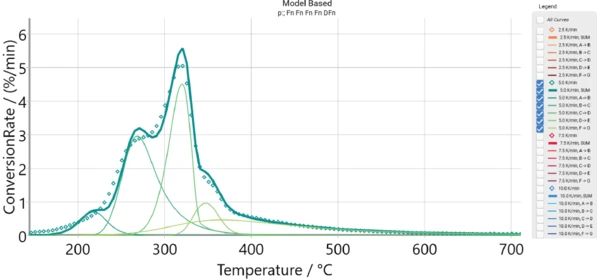
The measured data is presented as arhombus line, the thick green curve is the sum of the individual reaction steps. The good agreement between experimental and simulated data confirms the assumption of a 5-step process.
Figure 5 shows the measured TGA curves as well as the curves calculated using the five-step kinetics model in the NETZSCH Kinetics Neo software. Table 2 summarizes the parameters of the kinetics. The results demonstrate strong agreement between the measured and calculated data, with a coefficient of determination of 0.999.
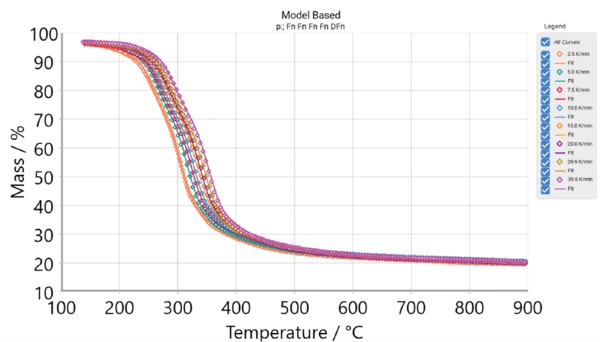
Table 2: Kinetic parameters of the thermal degradation of olive stone
Reaction step | A → B Fn1 | B → C Fn1 | C → D Fn1 | D → E Fn2 | F → G DFn2 |
|---|---|---|---|---|---|
| Activation energy [kJ/mol] | 151.824 | 165.479 | 194.592 | 206.720 | 179.468 |
| Log (Pre-Exp) Log (1/s) | 14.083 | 13.792 | 15.116 | 15.286 | 12.093 |
| Reaction order | 1.832 | 2.732 | 1.039 | 1.466 | 6.304 |
| Contribution | 0.061 | 0.336 | 0.313 | 0.073 | 0.217 |
| Coefficient of determination | 0.999 |
1Fn: Reaction of nth order
2DFn: One-dimensional diffusion of nth order
Simulation: Process Optimization
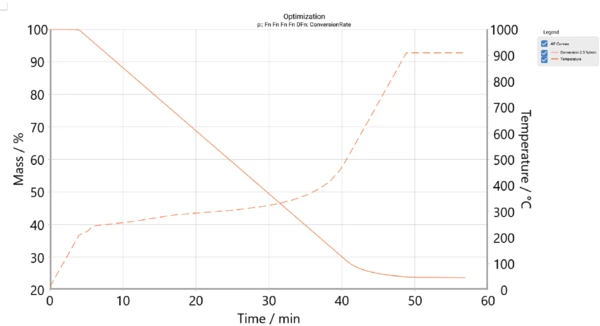
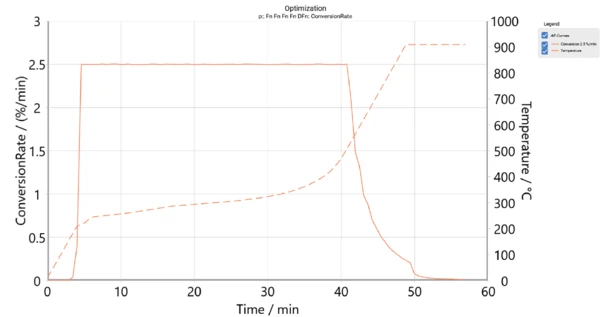
Following kinetic analysis and the determination of all relevant kinetic parameters, the next step involves process optimization as shown in figures 6 and 7. At this stage, the goal is to control the decomposition process by adjusting the conversion rate in order to minimize the total time required to achieve the desired conversion. Figure 7 presents the temperature program and time for a 2.5%/min conversion rate, corresponding to the simulated conversion rate.
Conclusion
A comprehensive kinetic analysis can be conducted by combining NETZSCH TGA measurements with the NETZSCH Kinetics Neo software. The resulting determination of kinetic parameters allows for process optimization, enhancing overall efficiency and minimizing the total time required to achieve the desired conversion. Accurate kinetic parameters are essential for designing efficient reactors that enhance overall process performance. This approach can be applied to a wide range of feedstock materials such as biomass, plastics, and rubber.