Introduction
Pyrolysis has emerged as a key thermochemical process in the transition toward sustainable and circular energy systems. It enables the conversion of a wide range of carbon-based feedstocks into valuable fuels, chemicals, and carbon-rich solids.
Among the various materials suitable for pyrolysis are biomass and organic waste, plastics, and rubber-based materials like waste tires. These feedstocks offer different end products, from biochar and syngas to fuels and industrial carbon materials depending on their composition and processing conditions.
Focusing on biomass as a renewable resource has significant potential in biofuel production and the generation of value-added chemicals. The conversion of biomass through processes such as pyrolysis, gasification, and combustion offers sustainable solutions to meet the growing demand for energy [1]. Among the various biomass feedstocks, olive stones stand out as a particularly valuable resource [2]. A byproduct of the olive industry, olive stones possess high energy potential due to their low moisture content and rich lignocellulosic composition. These characteristics make olive stones ideal for biofuel production through pyrolysis. Also, olive stones can be converted into biochar, activated carbon, and biochemicals, offering diverse applications beyond energy production.
This study focuses on the pyrolysis kinetics of olive stone biomass. Based on thermogravimetric measurements, a comprehensive kinetic analysis of olive stone biomass is performed using the NETZSCH Kinetics Neo software to determine key kinetic parameters and perform process optimization through simulation.
Условия за измерване
Условията за измерване са описани подробно в таблица 1. Получените TGA криви са основа за кинетична оценка на реакцията на разлагане.
Таблица 1: Параметри на теста за термогравиметричен анализ (TG)
| Инструмент | NETZSCH TG 309 Classic |
|---|---|
| Тигел | Al2O3, отворен |
| Маса на пробата | 9.65 mg до 9,85 mg |
| Температурен диапазон | 25°C до 1000°C |
| Атмосфера | Азот (40 ml/min), преминаване към синтетичен въздух (40 ml/min) при 900°C |
| Скорост на нагряване | 2.5 K/min, 5 K/min, 7,5 K/min, 10 K/min, 15 K/min, 20 K/min, |
Measurement Results
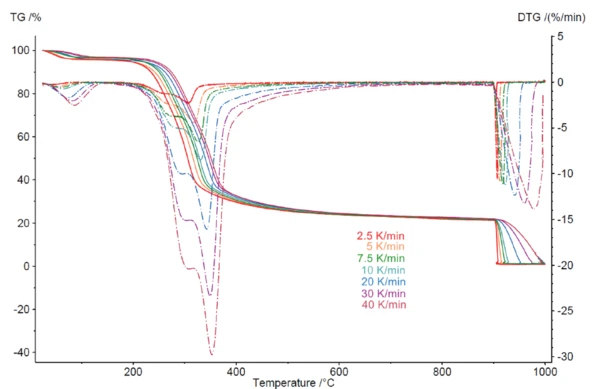
Измерванията на TGA на фигура 1 представят кривите на TGA и DTG (първа производна) от измерванията върху маслинова костилка при скорости на нагряване 2,5, 5, 7,5, 10, 20, 30 и 40 K/min в инертна атмосфера. Първата стъпка на загуба на маса, открита между стайна температура и 130 °C, е резултат от изпаряване на влагата и е съпроводена със загуба на маса от 3,3 % [3]. След процеса на дехидратация, при температури между 130°С и 700°С се извършват няколко застъпващи се стъпки на загуба на маса, които се дължат на термичното разграждане на хемицелулозата; след това следва разграждане на целулозата и накрая продължителна загуба на маса, която може да се дължи на разграждането на лигнина [4]. Загубите на маса, наблюдавани при температури над 700 °C, се дължат на термичното разграждане на устойчивите лигнинови структури [5]. Те се изместват към по-високи температури с увеличаване на скоростта на нагряване (кинетично влияние) [6].
Кинетичен анализ на термичното разлагане
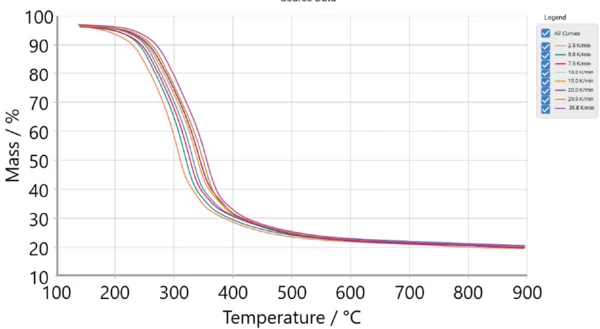
С помощта на софтуера NETZSCH Kinetics Neo може да се оцени зависимостта на процеса на разлагане от скоростта на нагряване. Профилът на TGA за скорост от 40 K/min е представен на фигура 2. Това наблюдение показва, че процесът на пиролиза не е напълно завършен до 700°C, а по-скоро протича постепенно до 900°C, придружен от загуба на маса. Първоначалната стъпка на загуба на маса преди 140°C, която се отнася до отстраняването на влагата, не е взета предвид в данните, които са били подложени на кинетичен анализ [3]. При преминаването от азот към кислород при 900°C се наблюдава загуба на маса вследствие на горене. Тези данни бяха изключени от кинетичния анализ. На фигура 2 са показани кривите на TGA измерванията между 130°C и 900°C, използвани за кинетичната оценка.
The degree of conversion, α, is calculated by Kinetics Neo software from thermogravimetry measurements where α ranges from 0 to 1 (Eq 1).
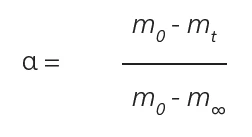
m0: initial mass
mt: mass at time t
m∞: final mass
Due to the complexity of biomass, a detailed understanding of reaction kinetics is essential for designing efficient reactors and optimizing process conditions [8]. The pyrolysis of hemicellulose begins at a relatively low temperature (~200°C) [9]. Cellulose decomposition involves multiple steps, including the formation of an amorphous intermediate and the production of levoglucosan [10]. Lignin is the most stable component due to its aromatic ring structure, with decomposition occurring over a temperature range from 170°C to the end of the process [3].
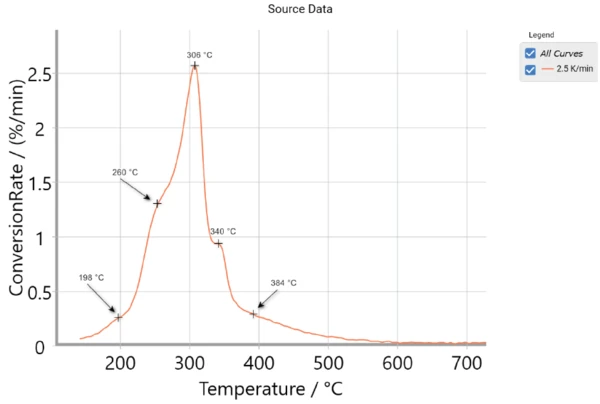
The thermal decomposition of olive stone occurs in multiple stages, as illustrated in figure 3, where the conversion rate is defined as the first derivative of conversion with respect to time. The first shoulder at 198°C marks the early decomposition of hemicellulose, followed by its main decomposition phase around 260°C. The primary breakdown of cellulose occurs at the main peak near 306°C with a late decomposition stage at 340°C. Finally, lignin decomposes slowly, showing a final shoulder at 384°C. [7]
This suggests a multi-step reaction process, which can be modeled with a five-step kinetic model:
A → B → C → D → E
F → G
The reaction rate of each step, j, is described by the function (Eq 2):
Reaction Rate j = Aj · f(ej, pj) · exp (-Ej/(RT)) (Eq 2)
Aj: pre-exponential factor
Ej: activation energy [J/mol]
T: temperature [K]
R: gas constant (8.314 J/K.mol)
f (ej ,pj): function dependent on the concentration of the initial reactant, ej, and the concentration of product, pj
Термичното разлагане на маслиновата костилка може да се опише с пет пика, съответстващи на сумата от пикове при температури 198°C, 260°C, 306°C, 340°C и 384°C, както е показано на фигура 4. Тези пикове представляват последователното разлагане на хемицелулоза, целулоза и лигнин по време на процеса на пиролиза [6].
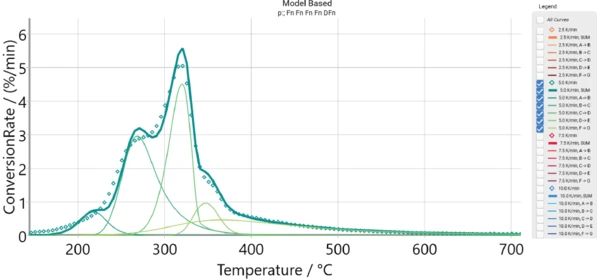
The measured data is presented as arhombus line, the thick green curve is the sum of the individual reaction steps. The good agreement between experimental and simulated data confirms the assumption of a 5-step process.
Figure 5 shows the measured TGA curves as well as the curves calculated using the five-step kinetics model in the NETZSCH Kinetics Neo software. Table 2 summarizes the parameters of the kinetics. The results demonstrate strong agreement between the measured and calculated data, with a coefficient of determination of 0.999.
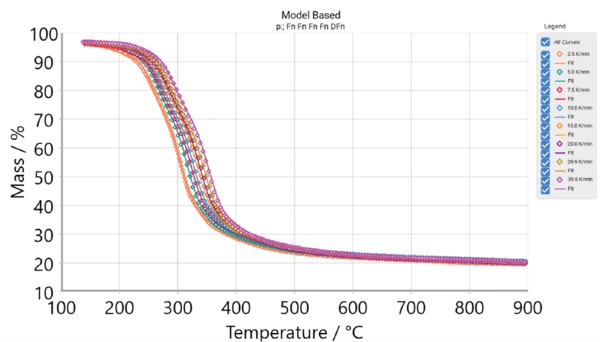
Таблица 2: Кинетични параметри на термичното разграждане на маслинови костилки
Етап на реакция | A → B Fn1 | B → C Fn1 | C → D Fn1 | D → E Fn2 | F → G DFn2 |
|---|---|---|---|---|---|
| Енергия на активация [kJ/mol] | 151.824 | 165.479 | 194.592 | 206.720 | 179.468 |
| Log (Pre-Exp) Log (1/s) | 14.083 | 13.792 | 15.116 | 15.286 | 12.093 |
| Ред на реакция | 1.832 | 2.732 | 1.039 | 1.466 | 6.304 |
| Вноска | 0.061 | 0.336 | 0.313 | 0.073 | 0.217 |
| Коефициент на детерминация | 0.999 |
1Fn: Реакция от n-ти порядък
2DFn: Едноизмерна дифузия от n-ти ред
Симулация: Оптимизиране на процесите
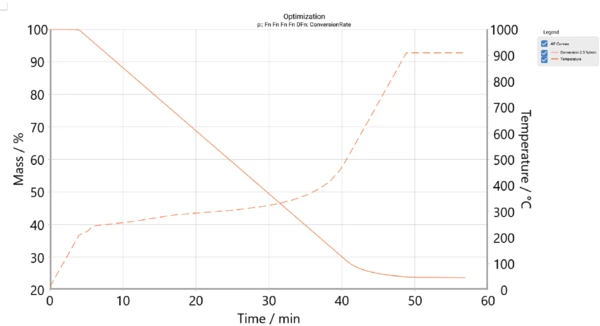
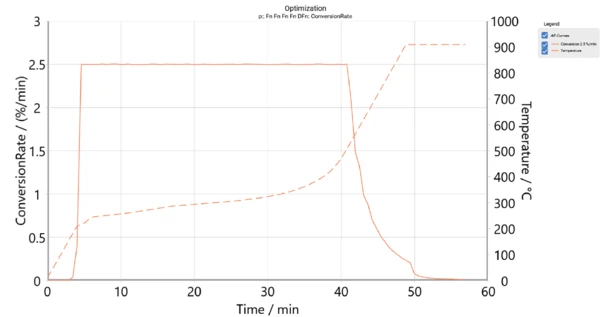
Following kinetic analysis and the determination of all relevant kinetic parameters, the next step involves process optimization as shown in figures 6 and 7. At this stage, the goal is to control the decomposition process by adjusting the conversion rate in order to minimize the total time required to achieve the desired conversion. Figure 7 presents the temperature program and time for a 2.5%/min conversion rate, corresponding to the simulated conversion rate.
Conclusion
Може да се извърши цялостен кинетичен анализ чрез комбиниране на измерванията на NETZSCH TGA със софтуера NETZSCH Kinetics Neo . Полученото в резултат на това определяне на кинетичните параметри позволява оптимизиране на процеса, повишаване на общата ефективност и свеждане до минимум на общото време, необходимо за постигане на желаното преобразуване. Точните кинетични параметри са от съществено значение за проектирането на ефективни реактори, които подобряват цялостната ефективност на процеса. Този подход може да се прилага за широк спектър от изходни материали, като биомаса, пластмаси и каучук.