Introduction
Pyrolysis has emerged as a key thermochemical process in the transition toward sustainable and circular energy systems. It enables the conversion of a wide range of carbon-based feedstocks into valuable fuels, chemicals, and carbon-rich solids.
Among the various materials suitable for pyrolysis are biomass and organic waste, plastics, and rubber-based materials like waste tires. These feedstocks offer different end products, from biochar and syngas to fuels and industrial carbon materials depending on their composition and processing conditions.
Focusing on biomass as a renewable resource has significant potential in biofuel production and the generation of value-added chemicals. The conversion of biomass through processes such as pyrolysis, gasification, and combustion offers sustainable solutions to meet the growing demand for energy [1]. Among the various biomass feedstocks, olive stones stand out as a particularly valuable resource [2]. A byproduct of the olive industry, olive stones possess high energy potential due to their low moisture content and rich lignocellulosic composition. These characteristics make olive stones ideal for biofuel production through pyrolysis. Also, olive stones can be converted into biochar, activated carbon, and biochemicals, offering diverse applications beyond energy production.
This study focuses on the pyrolysis kinetics of olive stone biomass. Based on thermogravimetric measurements, a comprehensive kinetic analysis of olive stone biomass is performed using the NETZSCH Kinetics Neo software to determine key kinetic parameters and perform process optimization through simulation.
شروط القياس
ترد تفاصيل ظروف القياس في الجدول 1. وتعد منحنيات TGA التي تم الحصول عليها أساسًا للتقييم الحركي لتفاعل التحلل.
الجدول 1: معلمات اختبار تحليل الثقل الحراري (TG)
| الأداة | NETZSCH TG 309 Classic |
|---|---|
| البوتقة | Al2O3، مفتوح |
| كتلة العينة | 9.65 مجم إلى 9.85 مجم |
| نطاق درجة الحرارة | 25 درجة مئوية إلى 1000 درجة مئوية |
| الغلاف الجوي | النيتروجين (40 مل/دقيقة)، التحول إلى الهواء الصناعي (40 مل/دقيقة) عند 900 درجة مئوية |
| معدلات التسخين | 2.5 كلفن/دقيقة، 5 كلفن/دقيقة، 5 كلفن/دقيقة، 7.5 كلفن/دقيقة، 10 كلفن/دقيقة، 15 كلفن/دقيقة، 20 كلفن/دقيقة |
Measurement Results
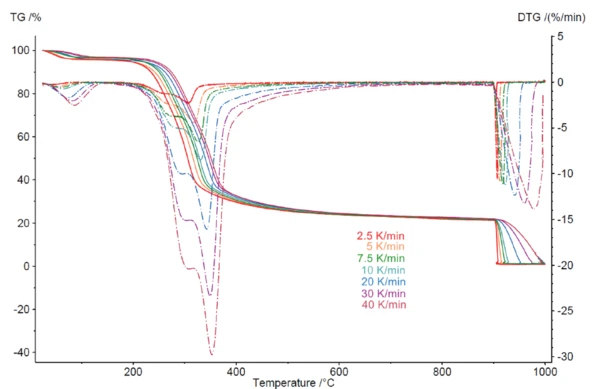
توضح قياسات TGA في الشكل 1 منحنيات TGA وDTG (المشتق الأول) للقياسات على حجر الزيتون بمعدلات تسخين 2.5 و5 و7.5 و10 و20 و30 و40 كلفن/الدقيقة تحت جو خامل. تنتج الخطوة الأولى لفقدان الكتلة، التي تم اكتشافها بين درجة حرارة الغرفة و130 درجة مئوية، عن تبخر الرطوبة ويصاحبها فقدان كتلة بنسبة 3.3% [3]. بعد عملية الجفاف، تحدث عدة خطوات متداخلة لفقدان الكتلة عند درجات حرارة تتراوح بين 130 درجة مئوية و700 درجة مئوية، ويعزى ذلك إلى التحلل الحراري للهيميسليلوز؛ ويلي ذلك تحلل السليولوز، وأخيرًا فقدان الكتلة لفترة طويلة، والذي قد يعزى إلى تحلل اللجنين [4]. وتُعزى خسائر الكتلة التي لوحظت عند درجات حرارة أعلى من 700 درجة مئوية إلى التحلل الحراري لهياكل اللجنين المرنة [5]. وتتحول إلى درجات حرارة أعلى مع زيادة معدلات التسخين (التأثير الحركي) [6].
التحليل الحركي للتحلل الحراري
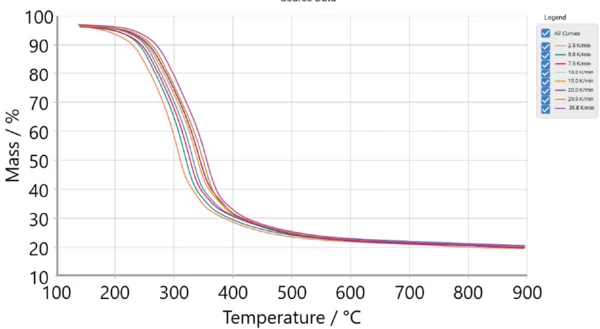
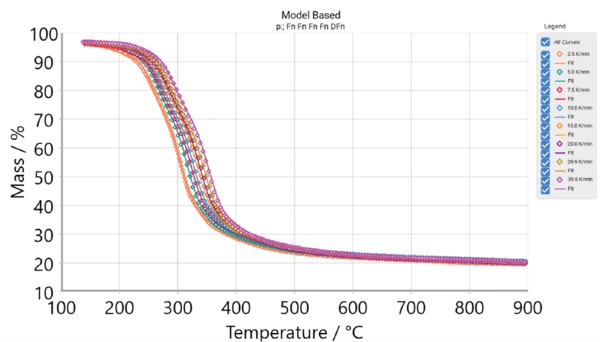
باستخدام برنامج NETZSCH Kinetics Neo ، يمكن تقييم اعتماد عملية التحلل على معدل التسخين. ويرد في الشكل 2 الشكل 2، وهو يوضح ملف تعريف TGA لمعدل 40 كلفن/الدقيقة. تشير هذه الملاحظة إلى أن عملية التحلل الحراري لا تكتمل تمامًا عند 700 درجة مئوية، بل تستمر تدريجيًا حتى 900 درجة مئوية، مصحوبة بفقدان الكتلة. لم تؤخذ خطوة فقدان الكتلة الأولية قبل 140 درجة مئوية، والتي تتعلق بإزالة الرطوبة، في الاعتبار في البيانات التي خضعت للتحليل الحركي [3]. عند التحويل من النيتروجين إلى الأكسجين عند درجة حرارة 900 درجة مئوية، يحدث فقدان للكتلة بسبب الاحتراق. تم استبعاد هذه البيانات من التحليل الحركي. يوضح الشكل 2 منحنيات قياس TGA بين 130 درجة مئوية و900 درجة مئوية المستخدمة في التقييم الحركي.
The degree of conversion, α, is calculated by Kinetics Neo software from thermogravimetry measurements where α ranges from 0 to 1 (Eq 1).
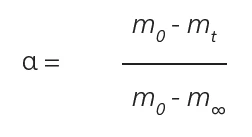
m0: initial mass
mt: mass at time t
m∞: final mass
Due to the complexity of biomass, a detailed understanding of reaction kinetics is essential for designing efficient reactors and optimizing process conditions [8]. The pyrolysis of hemicellulose begins at a relatively low temperature (~200°C) [9]. Cellulose decomposition involves multiple steps, including the formation of an amorphous intermediate and the production of levoglucosan [10]. Lignin is the most stable component due to its aromatic ring structure, with decomposition occurring over a temperature range from 170°C to the end of the process [3].
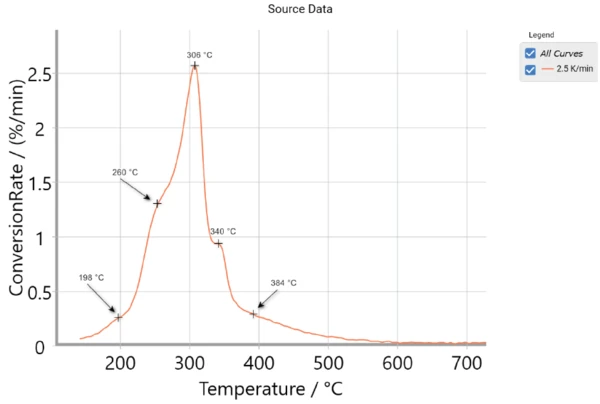
The thermal decomposition of olive stone occurs in multiple stages, as illustrated in figure 3, where the conversion rate is defined as the first derivative of conversion with respect to time. The first shoulder at 198°C marks the early decomposition of hemicellulose, followed by its main decomposition phase around 260°C. The primary breakdown of cellulose occurs at the main peak near 306°C with a late decomposition stage at 340°C. Finally, lignin decomposes slowly, showing a final shoulder at 384°C. [7]
This suggests a multi-step reaction process, which can be modeled with a five-step kinetic model:
A → B → C → D → E
F → G
The reaction rate of each step, j, is described by the function (Eq 2):
Reaction Rate j = Aj · f(ej, pj) · exp (-Ej/(RT)) (Eq 2)
Aj: pre-exponential factor
Ej: activation energy [J/mol]
T: temperature [K]
R: gas constant (8.314 J/K.mol)
f (ej ,pj): function dependent on the concentration of the initial reactant, ej, and the concentration of product, pj
يمكن تركيب التحلل الحراري لحجر الزيتون من خلال خمس قمم تقابل مجموع القمم عند درجات حرارة 198 درجة مئوية، و260 درجة مئوية، و306 درجة مئوية، و340 درجة مئوية، و384 درجة مئوية، كما هو موضح في الشكل 4. تمثل هذه القمم التحلل المتسلسل للهيميسليلوز والسليلوز واللجنين أثناء عملية التحلل الحراري [6].
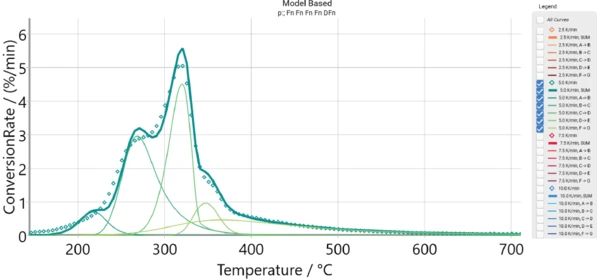
The measured data is presented as arhombus line, the thick green curve is the sum of the individual reaction steps. The good agreement between experimental and simulated data confirms the assumption of a 5-step process.
Figure 5 shows the measured TGA curves as well as the curves calculated using the five-step kinetics model in the NETZSCH Kinetics Neo software. Table 2 summarizes the parameters of the kinetics. The results demonstrate strong agreement between the measured and calculated data, with a coefficient of determination of 0.999.
الجدول 2: البارامترات الحركية للتحلل الحراري لحجر الزيتون
خطوة التفاعل | أ → ب و1 | ب → ج ف ن1 | ج → د ف ن1 | د → ه و2 | و → ز DFn2 |
|---|---|---|---|---|---|
| طاقة التنشيط [كيلوجول/مول] | 151.824 | 165.479 | 194.592 | 206.720 | 179.468 |
| سجل (ما قبل الإكسب) سجل (1/ث) | 14.083 | 13.792 | 15.116 | 15.286 | 12.093 |
| ترتيب التفاعل | 1.832 | 2.732 | 1.039 | 1.466 | 6.304 |
| المساهمة | 0.061 | 0.336 | 0.313 | 0.073 | 0.217 |
| معامل التحديد | 0.999 |
1Fn: رد فعل من الرتبة ن
2DFn 2DFn: انتشار أحادي البُعد من الرتبة ن
المحاكاة: تحسين العمليات
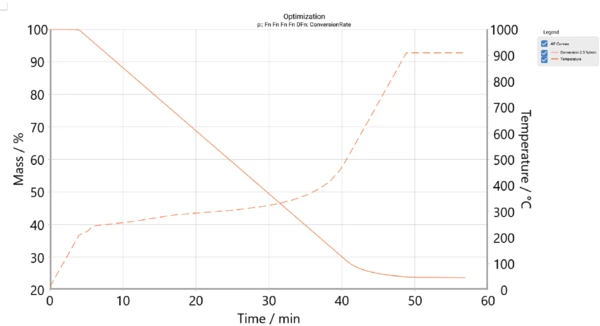
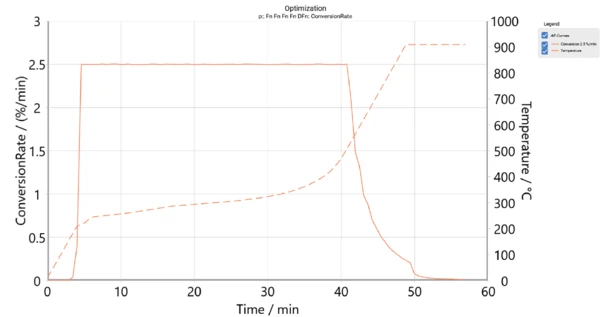
Following kinetic analysis and the determination of all relevant kinetic parameters, the next step involves process optimization as shown in figures 6 and 7. At this stage, the goal is to control the decomposition process by adjusting the conversion rate in order to minimize the total time required to achieve the desired conversion. Figure 7 presents the temperature program and time for a 2.5%/min conversion rate, corresponding to the simulated conversion rate.
Conclusion
يمكن إجراء تحليل حركي شامل من خلال الجمع بين قياسات NETZSCH TGA مع برنامج NETZSCH Kinetics Neo . ويسمح تحديد المعلمات الحركية الناتجة بتحسين العملية، مما يعزز الكفاءة الكلية ويقلل من الوقت الإجمالي المطلوب لتحقيق التحويل المطلوب. وتعد المعلمات الحركية الدقيقة ضرورية لتصميم مفاعلات فعالة تعزز الأداء الكلي للعملية. ويمكن تطبيق هذا النهج على مجموعة واسعة من المواد الأولية مثل الكتلة الحيوية والبلاستيك والمطاط.