Introduction
Pyrolysis has emerged as a key thermochemical process in the transition toward sustainable and circular energy systems. It enables the conversion of a wide range of carbon-based feedstocks into valuable fuels, chemicals, and carbon-rich solids.
Among the various materials suitable for pyrolysis are biomass and organic waste, plastics, and rubber-based materials like waste tires. These feedstocks offer different end products, from biochar and syngas to fuels and industrial carbon materials depending on their composition and processing conditions.
Focusing on biomass as a renewable resource has significant potential in biofuel production and the generation of value-added chemicals. The conversion of biomass through processes such as pyrolysis, gasification, and combustion offers sustainable solutions to meet the growing demand for energy [1]. Among the various biomass feedstocks, olive stones stand out as a particularly valuable resource [2]. A byproduct of the olive industry, olive stones possess high energy potential due to their low moisture content and rich lignocellulosic composition. These characteristics make olive stones ideal for biofuel production through pyrolysis. Also, olive stones can be converted into biochar, activated carbon, and biochemicals, offering diverse applications beyond energy production.
This study focuses on the pyrolysis kinetics of olive stone biomass. Based on thermogravimetric measurements, a comprehensive kinetic analysis of olive stone biomass is performed using the NETZSCH Kinetics Neo software to determine key kinetic parameters and perform process optimization through simulation.
Συνθήκες μέτρησης
Οι συνθήκες μέτρησης περιγράφονται λεπτομερώς στον πίνακα 1. Οι καμπύλες TGA που λαμβάνονται αποτελούν τη βάση για την κινητική αξιολόγηση της αντίδρασης διάσπασης.
Πίνακας 1: Παράμετροι δοκιμής θερμοβαρυμετρικής ανάλυσης (TG)
| Όργανο | NETZSCH TG 309 Classic |
|---|---|
| Χωνευτήρι | Al2O3, ανοικτό |
| Μάζα δείγματος | 9.65 mg έως 9,85 mg |
| Εύρος θερµοκρασίας | 25°C έως 1000°C |
| Ατµόσφαιρα | Άζωτο (40 ml/min), μετάβαση σε συνθετικό αέρα (40 ml/min) στους 900°C |
| Ρυθμοί θέρμανσης | 2.5 K/min, 5 K/min, 7,5 K/min, 10 K/min, 15 K/min, 20 K/min, |
Measurement Results
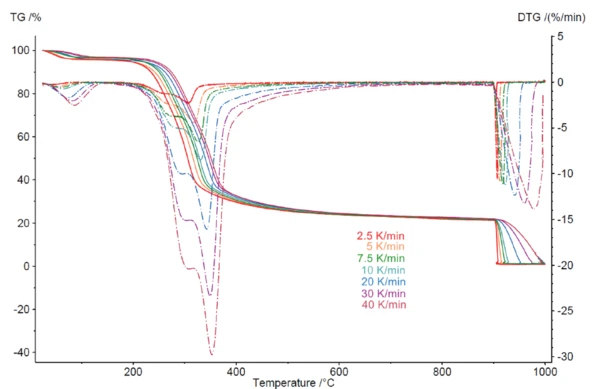
Οι μετρήσεις TGA στο σχήμα 1 απεικονίζουν τις καμπύλες TGA και DTG (πρώτη παράγωγος) των μετρήσεων στον ελαιόκαρπο με ρυθμούς θέρμανσης 2,5, 5, 7,5, 10, 20, 30 και 40 K/min υπό αδρανή ατμόσφαιρα. Το πρώτο βήμα απώλειας μάζας, που εντοπίζεται μεταξύ της θερμοκρασίας δωματίου και των 130°C, προκύπτει από την εξάτμιση της υγρασίας και συνοδεύεται από απώλεια μάζας 3,3% [3]. Μετά τη διαδικασία αφυδάτωσης, λαμβάνουν χώρα διάφορα επικαλυπτόμενα στάδια απώλειας μάζας σε θερμοκρασίες μεταξύ 130°C και 700°C, που αποδίδονται στη θερμική αποδόμηση της ημικυτταρίνης- ακολουθεί η αποδόμηση της κυτταρίνης και, τέλος, μια παρατεταμένη απώλεια μάζας, η οποία μπορεί να αποδοθεί στην αποδόμηση της λιγνίνης [4]. Οι απώλειες μάζας που παρατηρούνται σε θερμοκρασίες άνω των 700°C οφείλονται στη θερμική αποικοδόμηση των ελαστικών δομών της λιγνίνης [5]. Μετατοπίζονται σε υψηλότερες θερμοκρασίες με την αύξηση των ρυθμών θέρμανσης (κινητική επίδραση) [6].
Κινητική ανάλυση της θερμικής αποσύνθεσης
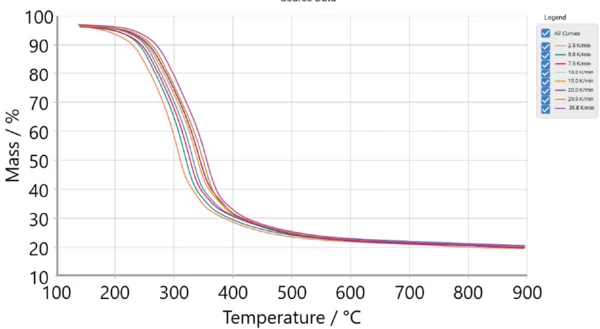
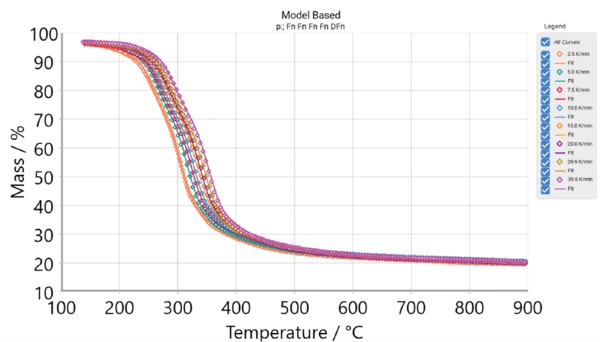
Χρησιμοποιώντας το λογισμικό NETZSCH Kinetics Neo , μπορεί να αξιολογηθεί η εξάρτηση της διαδικασίας αποσύνθεσης από τον ρυθμό θέρμανσης. Το προφίλ TGA για ρυθμό 40 K/min απεικονίζεται στο σχήμα 2. Η παρατήρηση αυτή δείχνει ότι η διαδικασία πυρόλυσης δεν ολοκληρώνεται πλήρως στους 700°C, αλλά προχωρά σταδιακά μέχρι τους 900°C, συνοδευόμενη από απώλεια μάζας. Το αρχικό στάδιο απώλειας μάζας πριν από τους 140°C, το οποίο αφορά την απομάκρυνση της υγρασίας, δεν ελήφθη υπόψη στα δεδομένα που υποβλήθηκαν σε κινητική ανάλυση [3]. Κατά τη μετάβαση από άζωτο σε οξυγόνο στους 900°C, παρατηρείται απώλεια μάζας λόγω καύσης. Τα δεδομένα αυτά εξαιρέθηκαν από την κινητική ανάλυση. Στο Σχήμα 2 παρουσιάζονται οι καμπύλες μέτρησης TGA μεταξύ 130°C και 900°C που χρησιμοποιήθηκαν για την κινητική αξιολόγηση.
The degree of conversion, α, is calculated by Kinetics Neo software from thermogravimetry measurements where α ranges from 0 to 1 (Eq 1).
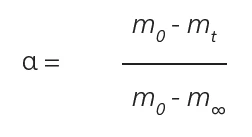
m0: initial mass
mt: mass at time t
m∞: final mass
Due to the complexity of biomass, a detailed understanding of reaction kinetics is essential for designing efficient reactors and optimizing process conditions [8]. The pyrolysis of hemicellulose begins at a relatively low temperature (~200°C) [9]. Cellulose decomposition involves multiple steps, including the formation of an amorphous intermediate and the production of levoglucosan [10]. Lignin is the most stable component due to its aromatic ring structure, with decomposition occurring over a temperature range from 170°C to the end of the process [3].
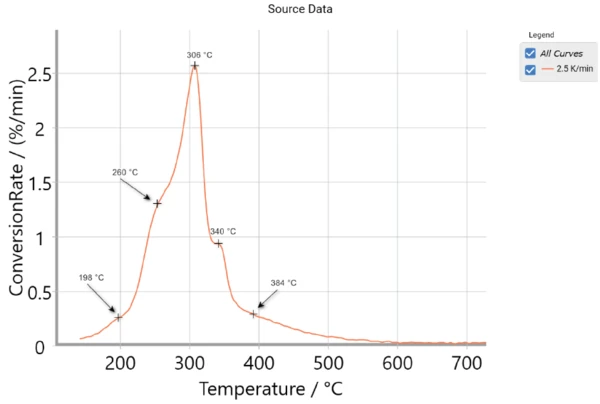
The thermal decomposition of olive stone occurs in multiple stages, as illustrated in figure 3, where the conversion rate is defined as the first derivative of conversion with respect to time. The first shoulder at 198°C marks the early decomposition of hemicellulose, followed by its main decomposition phase around 260°C. The primary breakdown of cellulose occurs at the main peak near 306°C with a late decomposition stage at 340°C. Finally, lignin decomposes slowly, showing a final shoulder at 384°C. [7]
This suggests a multi-step reaction process, which can be modeled with a five-step kinetic model:
A → B → C → D → E
F → G
The reaction rate of each step, j, is described by the function (Eq 2):
Reaction Rate j = Aj · f(ej, pj) · exp (-Ej/(RT)) (Eq 2)
Aj: pre-exponential factor
Ej: activation energy [J/mol]
T: temperature [K]
R: gas constant (8.314 J/K.mol)
f (ej ,pj): function dependent on the concentration of the initial reactant, ej, and the concentration of product, pj
Η θερμική αποσύνθεση του ελαιόκαρπου μπορεί να προσαρμοστεί με πέντε κορυφές, που αντιστοιχούν στο άθροισμα των κορυφών στις θερμοκρασίες 198°C, 260°C, 306°C, 340°C και 384°C, όπως φαίνεται στο σχήμα 4. Οι κορυφές αυτές αντιπροσωπεύουν τη διαδοχική αποσύνθεση της ημικυτταρίνης, της κυτταρίνης και της λιγνίνης κατά τη διαδικασία πυρόλυσης [6].
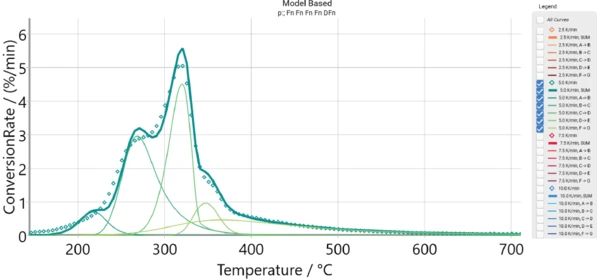
The measured data is presented as arhombus line, the thick green curve is the sum of the individual reaction steps. The good agreement between experimental and simulated data confirms the assumption of a 5-step process.
Figure 5 shows the measured TGA curves as well as the curves calculated using the five-step kinetics model in the NETZSCH Kinetics Neo software. Table 2 summarizes the parameters of the kinetics. The results demonstrate strong agreement between the measured and calculated data, with a coefficient of determination of 0.999.
Πίνακας 2: Κινητικές παράμετροι της θερμικής αποικοδόμησης του πυρήνα της ελιάς
Στάδιο αντίδρασης | A → B Fn1 | B → C Fn1 | C → D Fn1 | D → E Fn2 | F → G DFn2 |
|---|---|---|---|---|---|
| Ενέργεια ενεργοποίησης [kJ/mol] | 151.824 | 165.479 | 194.592 | 206.720 | 179.468 |
| Log (Pre-Exp) Log (1/s) | 14.083 | 13.792 | 15.116 | 15.286 | 12.093 |
| Σειρά αντίδρασης | 1.832 | 2.732 | 1.039 | 1.466 | 6.304 |
| Συνεισφορά | 0.061 | 0.336 | 0.313 | 0.073 | 0.217 |
| Συντελεστής προσδιορισμού | 0.999 |
1Fn: Αντίδραση n-οστής τάξης
2DFn: Μονοδιάστατη διάχυση n-οστής τάξης
Προσομοίωση: Βελτιστοποίηση διαδικασίας
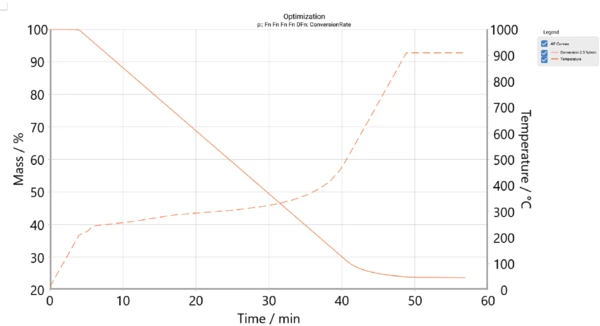
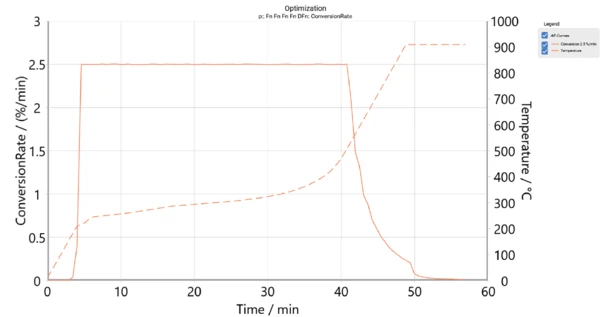
Following kinetic analysis and the determination of all relevant kinetic parameters, the next step involves process optimization as shown in figures 6 and 7. At this stage, the goal is to control the decomposition process by adjusting the conversion rate in order to minimize the total time required to achieve the desired conversion. Figure 7 presents the temperature program and time for a 2.5%/min conversion rate, corresponding to the simulated conversion rate.
Conclusion
Μια ολοκληρωμένη κινητική ανάλυση μπορεί να διεξαχθεί συνδυάζοντας τις μετρήσεις NETZSCH TGA με το λογισμικό NETZSCH Kinetics Neo . Ο προκύπτων προσδιορισμός των κινητικών παραμέτρων επιτρέπει τη βελτιστοποίηση της διεργασίας, την ενίσχυση της συνολικής απόδοσης και την ελαχιστοποίηση του συνολικού χρόνου που απαιτείται για την επίτευξη της επιθυμητής μετατροπής. Οι ακριβείς κινητικές παράμετροι είναι απαραίτητες για το σχεδιασμό αποδοτικών αντιδραστήρων που βελτιώνουν τη συνολική απόδοση της διεργασίας. Η προσέγγιση αυτή μπορεί να εφαρμοστεί σε ένα ευρύ φάσμα πρώτων υλών, όπως βιομάζα, πλαστικά και καουτσούκ.