Introduction
Pyrolysis has emerged as a key thermochemical process in the transition toward sustainable and circular energy systems. It enables the conversion of a wide range of carbon-based feedstocks into valuable fuels, chemicals, and carbon-rich solids.
Among the various materials suitable for pyrolysis are biomass and organic waste, plastics, and rubber-based materials like waste tires. These feedstocks offer different end products, from biochar and syngas to fuels and industrial carbon materials depending on their composition and processing conditions.
Focusing on biomass as a renewable resource has significant potential in biofuel production and the generation of value-added chemicals. The conversion of biomass through processes such as pyrolysis, gasification, and combustion offers sustainable solutions to meet the growing demand for energy [1]. Among the various biomass feedstocks, olive stones stand out as a particularly valuable resource [2]. A byproduct of the olive industry, olive stones possess high energy potential due to their low moisture content and rich lignocellulosic composition. These characteristics make olive stones ideal for biofuel production through pyrolysis. Also, olive stones can be converted into biochar, activated carbon, and biochemicals, offering diverse applications beyond energy production.
This study focuses on the pyrolysis kinetics of olive stone biomass. Based on thermogravimetric measurements, a comprehensive kinetic analysis of olive stone biomass is performed using the NETZSCH Kinetics Neo software to determine key kinetic parameters and perform process optimization through simulation.
Meetomstandigheden
De meetomstandigheden staan in tabel 1. De verkregen TGA-curves vormen de basis voor de kinetische evaluatie van de OntledingsreactieEen ontledingsreactie is een thermisch geïnduceerde reactie van een chemische verbinding waarbij vaste en/of gasvormige producten worden gevormd. ontledingsreactie.
Tabel 1: Testparameters voor thermogravimetrische analyse (TG)
| Instrument | NETZSCH TG 309 Classic |
|---|---|
| Kroes | Al2O3, open |
| Monstermassa | 9.65 mg tot 9,85 mg |
| Temperatuurbereik | 25 °C tot 1000 °C |
| Atmosfeer | Stikstof (40 ml/min), overschakelen naar synthetische lucht (40 ml/min) bij 900 °C |
| Verwarmingssnelheden | 2.5 K/min, 5 K/min, 7,5 K/min, 10 K/min, 15 K/min, 20 K/min, |
Measurement Results
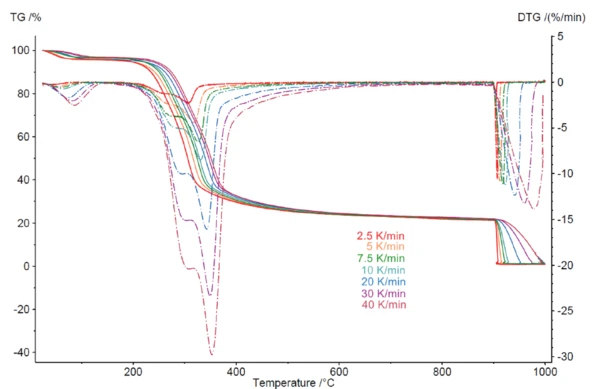
De TGA-metingen in figuur 1 tonen de TGA- en DTG-curven (eerste afgeleide) van de metingen aan olijfsteen bij een verwarmingssnelheid van 2,5, 5, 7,5, 10, 20, 30 en 40 K/min onder een inerte atmosfeer. De eerste massaverliesstap, gedetecteerd tussen kamertemperatuur en 130°C, is het gevolg van vochtverdamping en gaat gepaard met een massaverlies van 3,3% [3]. Na het dehydratieproces vinden er verschillende overlappende massaverliesstappen plaats bij temperaturen tussen 130°C en 700°C, die worden toegeschreven aan de thermische afbraak van hemicellulose; dit wordt gevolgd door celluloseafbraak en tot slot een langdurig massaverlies, dat kan worden toegeschreven aan de afbraak van lignine [4]. De massaverliezen die waargenomen worden bij temperaturen boven 700°C zijn te wijten aan de thermische afbraak van veerkrachtige ligninestructuren [5]. Ze verschuiven naar hogere temperaturen met toenemende verhittingssnelheden (kinetische invloed) [6].
Kinetische analyse van thermische ontleding
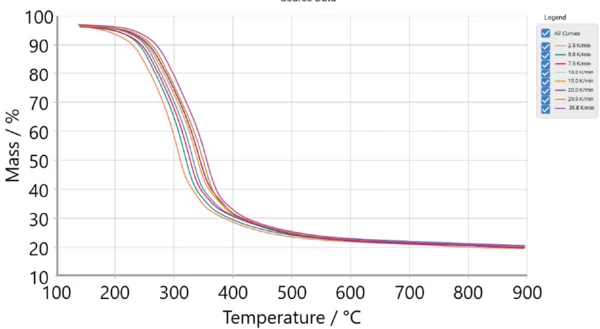
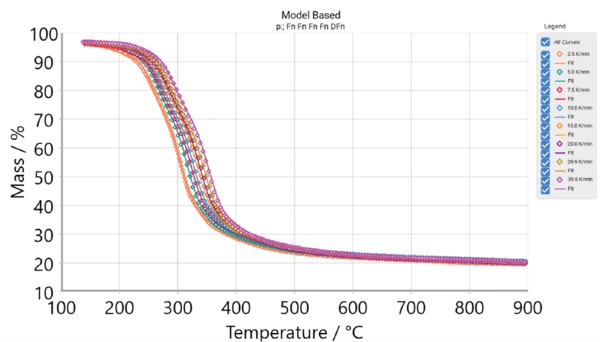
Met behulp van de NETZSCH Kinetics Neo software kan de afhankelijkheid van het ontledingsproces van de verwarmingssnelheid worden geëvalueerd. Het TGA-profiel voor de snelheid van 40 K/min wordt weergegeven in figuur 2. Deze observatie geeft aan dat het pyrolyseproces niet volledig voltooid is bij 700°C, maar geleidelijk verloopt tot 900°C, gepaard gaande met een massaverlies. De initiële massaverliesstap vóór 140°C, die betrekking heeft op de verwijdering van vocht, werd niet meegenomen in de gegevens die werden onderworpen aan kinetische analyse [3]. Bij het overschakelen van stikstof naar zuurstof bij 900°C treedt een massaverlies op door verbranding. Deze gegevens zijn niet meegenomen in de kinetische analyse. Figuur 2 toont de TGA-meetcurven tussen 130°C en 900°C die gebruikt zijn voor de kinetische evaluatie.
The degree of conversion, α, is calculated by Kinetics Neo software from thermogravimetry measurements where α ranges from 0 to 1 (Eq 1).
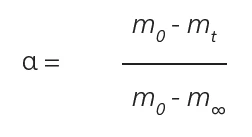
m0: initial mass
mt: mass at time t
m∞: final mass
Due to the complexity of biomass, a detailed understanding of reaction kinetics is essential for designing efficient reactors and optimizing process conditions [8]. The pyrolysis of hemicellulose begins at a relatively low temperature (~200°C) [9]. Cellulose decomposition involves multiple steps, including the formation of an amorphous intermediate and the production of levoglucosan [10]. Lignin is the most stable component due to its aromatic ring structure, with decomposition occurring over a temperature range from 170°C to the end of the process [3].
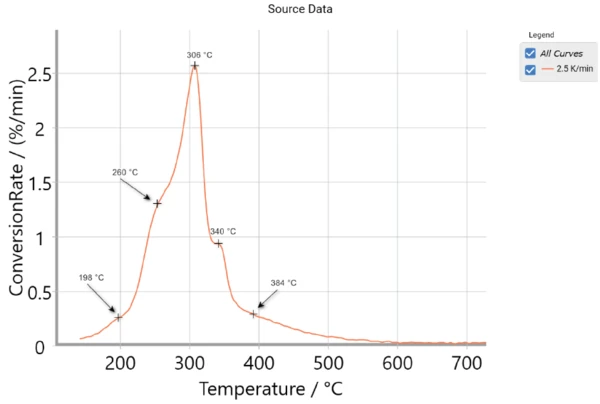
The thermal decomposition of olive stone occurs in multiple stages, as illustrated in figure 3, where the conversion rate is defined as the first derivative of conversion with respect to time. The first shoulder at 198°C marks the early decomposition of hemicellulose, followed by its main decomposition phase around 260°C. The primary breakdown of cellulose occurs at the main peak near 306°C with a late decomposition stage at 340°C. Finally, lignin decomposes slowly, showing a final shoulder at 384°C. [7]
This suggests a multi-step reaction process, which can be modeled with a five-step kinetic model:
A → B → C → D → E
F → G
The reaction rate of each step, j, is described by the function (Eq 2):
Reaction Rate j = Aj · f(ej, pj) · exp (-Ej/(RT)) (Eq 2)
Aj: pre-exponential factor
Ej: activation energy [J/mol]
T: temperature [K]
R: gas constant (8.314 J/K.mol)
f (ej ,pj): function dependent on the concentration of the initial reactant, ej, and the concentration of product, pj
De thermische ontleding van de olijfpit kan worden weergegeven met vijf pieken, die overeenkomen met de som van de pieken bij temperaturen van 198°C, 260°C, 306°C, 340°C en 384°C, zoals weergegeven in figuur 4. Deze pieken vertegenwoordigen de opeenvolgende ontledingen van hemicellulose, cellulose en lignine tijdens het pyrolyseproces [6]. Deze pieken vertegenwoordigen de opeenvolgende ontleding van hemicellulose, cellulose en lignine tijdens het pyrolyseproces [6].
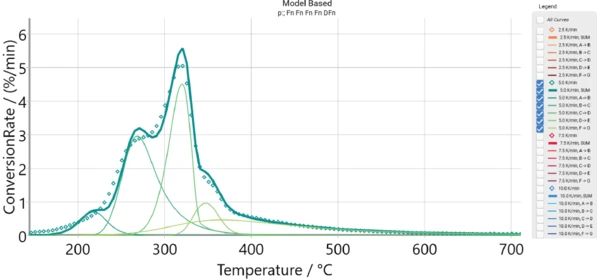
The measured data is presented as arhombus line, the thick green curve is the sum of the individual reaction steps. The good agreement between experimental and simulated data confirms the assumption of a 5-step process.
Figure 5 shows the measured TGA curves as well as the curves calculated using the five-step kinetics model in the NETZSCH Kinetics Neo software. Table 2 summarizes the parameters of the kinetics. The results demonstrate strong agreement between the measured and calculated data, with a coefficient of determination of 0.999.
Tabel 2: Kinetische parameters van de thermische afbraak van olijfsteen
Reactie stap | A → B Fn1 | B → C Fn1 | C → D Fn1 | D → E Fn2 | F → G DFn2 |
|---|---|---|---|---|---|
| Activeringsenergie [kJ/mol] | 151.824 | 165.479 | 194.592 | 206.720 | 179.468 |
| Log (Pre-Exp) Log (1/s) | 14.083 | 13.792 | 15.116 | 15.286 | 12.093 |
| Reactievolgorde | 1.832 | 2.732 | 1.039 | 1.466 | 6.304 |
| Bijdrage | 0.061 | 0.336 | 0.313 | 0.073 | 0.217 |
| Determinatiecoëfficiënt | 0.999 |
1Fn: Reactie van de n-de orde
2DFn: Eendimensionale diffusie van de n-de orde
Simulatie: Procesoptimalisatie
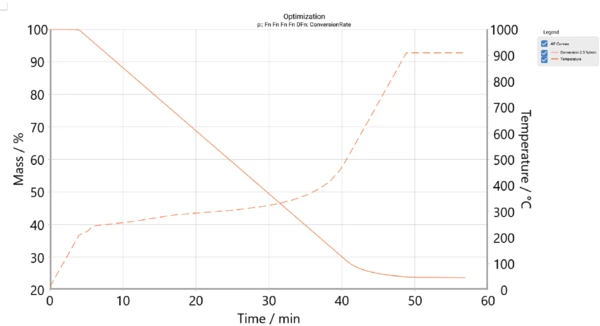
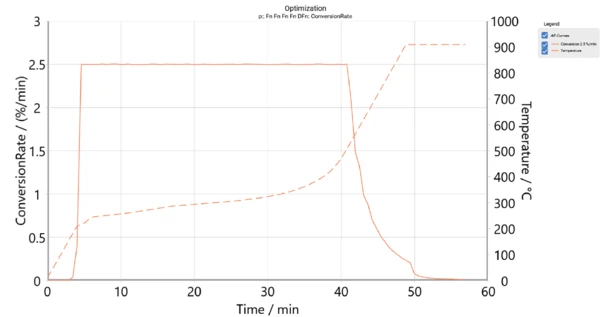
Following kinetic analysis and the determination of all relevant kinetic parameters, the next step involves process optimization as shown in figures 6 and 7. At this stage, the goal is to control the decomposition process by adjusting the conversion rate in order to minimize the total time required to achieve the desired conversion. Figure 7 presents the temperature program and time for a 2.5%/min conversion rate, corresponding to the simulated conversion rate.
Conclusion
Een uitgebreide kinetische analyse kan worden uitgevoerd door NETZSCH TGA-metingen te combineren met de NETZSCH Kinetics Neo software. De resulterende bepaling van kinetische parameters maakt procesoptimalisatie mogelijk, waardoor de algehele efficiëntie wordt verbeterd en de totale tijd die nodig is om de gewenste conversie te bereiken wordt geminimaliseerd. Nauwkeurige kinetische parameters zijn essentieel voor het ontwerpen van efficiënte reactoren die de algehele procesprestaties verbeteren. Deze aanpak kan worden toegepast op een breed scala aan grondstoffen zoals biomassa, kunststoffen en rubber.