Introduction
Pyrolysis has emerged as a key thermochemical process in the transition toward sustainable and circular energy systems. It enables the conversion of a wide range of carbon-based feedstocks into valuable fuels, chemicals, and carbon-rich solids.
Among the various materials suitable for pyrolysis are biomass and organic waste, plastics, and rubber-based materials like waste tires. These feedstocks offer different end products, from biochar and syngas to fuels and industrial carbon materials depending on their composition and processing conditions.
Focusing on biomass as a renewable resource has significant potential in biofuel production and the generation of value-added chemicals. The conversion of biomass through processes such as pyrolysis, gasification, and combustion offers sustainable solutions to meet the growing demand for energy [1]. Among the various biomass feedstocks, olive stones stand out as a particularly valuable resource [2]. A byproduct of the olive industry, olive stones possess high energy potential due to their low moisture content and rich lignocellulosic composition. These characteristics make olive stones ideal for biofuel production through pyrolysis. Also, olive stones can be converted into biochar, activated carbon, and biochemicals, offering diverse applications beyond energy production.
This study focuses on the pyrolysis kinetics of olive stone biomass. Based on thermogravimetric measurements, a comprehensive kinetic analysis of olive stone biomass is performed using the NETZSCH Kinetics Neo software to determine key kinetic parameters and perform process optimization through simulation.
측정 조건
측정 조건은 표 1에 자세히 나와 있습니다. 얻어진 TGA 곡선은 분해 반응의 동역학 평가의 기초가 됩니다.
표 1: 열 중량 분석(TG) 테스트 파라미터
| 기기 | NETZSCH TG 309 Classic |
|---|---|
| 도가니 | Al2O3, 개방형 |
| 시료 질량 | 9.65mg ~ 9.85mg |
| 온도 범위 | 25°C ~ 1000°C |
| 분위기 | 질소(40ml/min), 900°C에서 합성 공기(40ml/min)로 전환 |
| 가열 속도 | 2.5K/min, 5K/min, 7.5K/min, 10K/min, 15K/min, 20K/min, |
Measurement Results
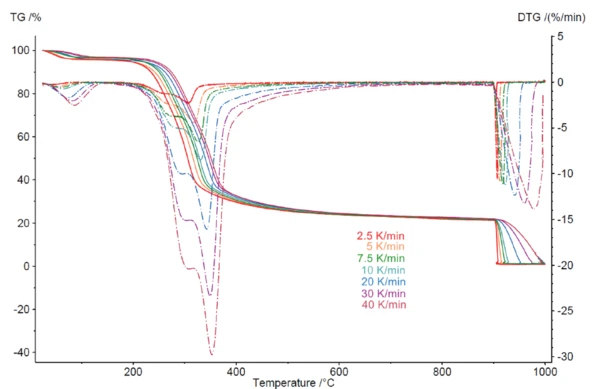
그림 1의 TGA 측정값은 불활성 분위기에서 2.5, 5, 7.5, 10, 20, 30, 40 K/min의 가열 속도에서 올리브석에 대한 측정값의 TGA 및 DTG(1차 도함수) 곡선을 보여줍니다. 실온과 130°C 사이에서 감지되는 첫 번째 질량 손실 단계는 수분 증발로 인해 발생하며 3.3%의 질량 손실이 수반됩니다[3]. 탈수 과정 후에는 130°C에서 700°C 사이의 온도에서 헤미셀룰로오스의 열 분해로 인한 몇 가지 중복된 질량 손실 단계가 발생하고, 그 다음에는 셀룰로오스 분해, 마지막으로 리그닌의 분해로 인한 장기간의 질량 손실이 이어집니다 [4]. 700°C 이상의 온도에서 관찰되는 질량 손실은 탄력성 있는 리그닌 구조의 열 분해로 인한 것입니다[5]. 가열 속도가 증가함에 따라 더 높은 온도로 이동합니다(동역학적 영향)[6].
열분해의 동역학 분석
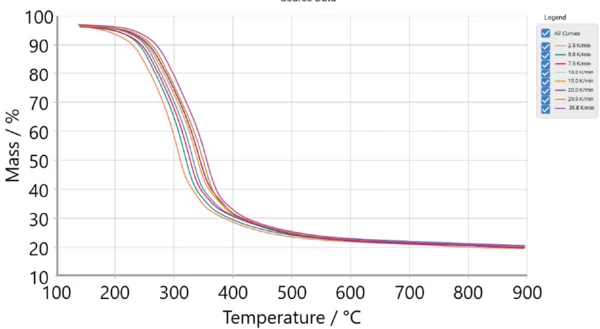
NETZSCH Kinetics Neo 소프트웨어를 사용하여 가열 속도에 대한 분해 과정의 의존성을 평가할 수 있습니다. 40K/min의 속도에 대한 TGA 프로파일은 그림 2에 나와 있습니다. 이 관찰은 열분해 공정이 700°C까지 완전히 완료되지 않고 질량 손실과 함께 900°C까지 점진적으로 진행됨을 나타냅니다. 수분 제거와 관련된 140°C 이전의 초기 질량 손실 단계는 동역학 분석 데이터에서 고려되지 않았습니다[3]. 900°C에서 질소에서 산소로 전환할 때 연소로 인해 질량 손실이 발생합니다. 이 데이터는 동역학 분석에서 제외되었습니다. 그림 2는 동역학 평가에 사용된 130°C와 900°C 사이의 TGA 측정 곡선을 보여줍니다.
The degree of conversion, α, is calculated by Kinetics Neo software from thermogravimetry measurements where α ranges from 0 to 1 (Eq 1).
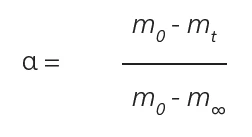
m0: initial mass
mt: mass at time t
m∞: final mass
Due to the complexity of biomass, a detailed understanding of reaction kinetics is essential for designing efficient reactors and optimizing process conditions [8]. The pyrolysis of hemicellulose begins at a relatively low temperature (~200°C) [9]. Cellulose decomposition involves multiple steps, including the formation of an amorphous intermediate and the production of levoglucosan [10]. Lignin is the most stable component due to its aromatic ring structure, with decomposition occurring over a temperature range from 170°C to the end of the process [3].
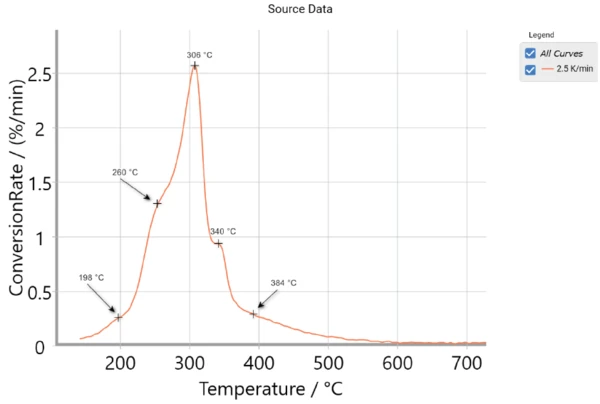
The thermal decomposition of olive stone occurs in multiple stages, as illustrated in figure 3, where the conversion rate is defined as the first derivative of conversion with respect to time. The first shoulder at 198°C marks the early decomposition of hemicellulose, followed by its main decomposition phase around 260°C. The primary breakdown of cellulose occurs at the main peak near 306°C with a late decomposition stage at 340°C. Finally, lignin decomposes slowly, showing a final shoulder at 384°C. [7]
This suggests a multi-step reaction process, which can be modeled with a five-step kinetic model:
A → B → C → D → E
F → G
The reaction rate of each step, j, is described by the function (Eq 2):
Reaction Rate j = Aj · f(ej, pj) · exp (-Ej/(RT)) (Eq 2)
Aj: pre-exponential factor
Ej: activation energy [J/mol]
T: temperature [K]
R: gas constant (8.314 J/K.mol)
f (ej ,pj): function dependent on the concentration of the initial reactant, ej, and the concentration of product, pj
올리브 돌의 열분해는 그림 4와 같이 198°C, 260°C, 306°C, 340°C, 384°C의 온도에서 피크의 합에 해당하는 5개의 피크로 나타낼 수 있습니다. 이러한 피크는 열분해 과정에서 헤미셀룰로오스, 셀룰로오스, 리그닌이 순차적으로 분해되는 것을 나타냅니다[6].
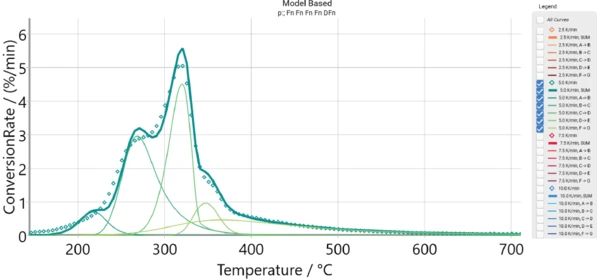
The measured data is presented as arhombus line, the thick green curve is the sum of the individual reaction steps. The good agreement between experimental and simulated data confirms the assumption of a 5-step process.
Figure 5 shows the measured TGA curves as well as the curves calculated using the five-step kinetics model in the NETZSCH Kinetics Neo software. Table 2 summarizes the parameters of the kinetics. The results demonstrate strong agreement between the measured and calculated data, with a coefficient of determination of 0.999.
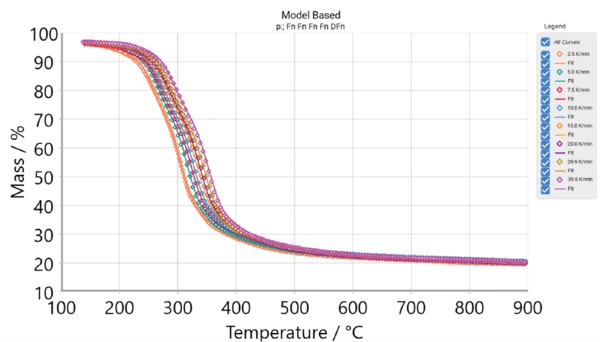
표 2: 올리브 석재의 열 분해에 대한 동역학적 파라미터
반응 단계 | A → B Fn1 | B → C Fn1 | C → D Fn1 | D → E Fn2 | F → G DFn2 |
|---|---|---|---|---|---|
| 활성화 에너지 [kJ/mol] | 151.824 | 165.479 | 194.592 | 206.720 | 179.468 |
| 로그(사전 경험) 로그(1/초) | 14.083 | 13.792 | 15.116 | 15.286 | 12.093 |
| 반응 순서 | 1.832 | 2.732 | 1.039 | 1.466 | 6.304 |
| 기여도 | 0.061 | 0.336 | 0.313 | 0.073 | 0.217 |
| 결정 계수 | 0.999 |
1Fn: N차 반응
2DFn: N차 1차원 확산
시뮬레이션: 프로세스 최적화
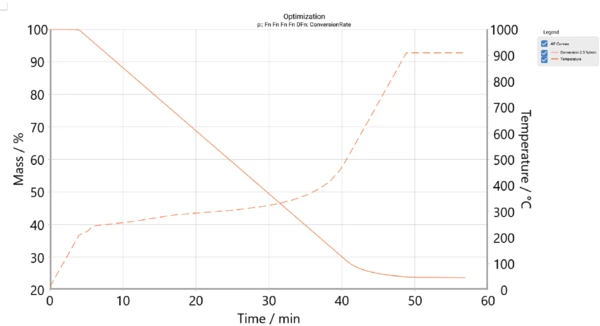
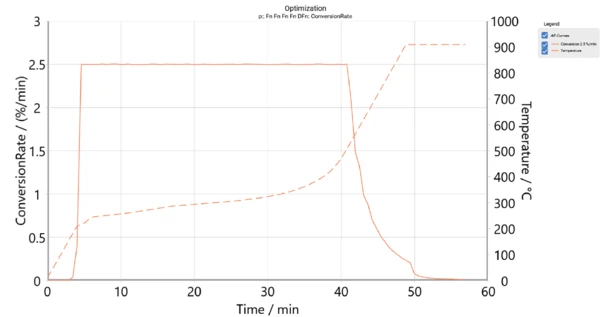
Following kinetic analysis and the determination of all relevant kinetic parameters, the next step involves process optimization as shown in figures 6 and 7. At this stage, the goal is to control the decomposition process by adjusting the conversion rate in order to minimize the total time required to achieve the desired conversion. Figure 7 presents the temperature program and time for a 2.5%/min conversion rate, corresponding to the simulated conversion rate.
Conclusion
NETZSCH TGA 측정과 NETZSCH Kinetics Neo 소프트웨어를 결합하여 종합적인 동역학 분석을 수행할 수 있습니다. 결과적으로 동역학 파라미터를 결정하면 공정 최적화를 통해 전반적인 효율성을 높이고 원하는 전환을 달성하는 데 필요한 총 시간을 최소화할 수 있습니다. 정확한 동역학 파라미터는 전반적인 공정 성능을 향상시키는 효율적인 반응기를 설계하는 데 필수적입니다. 이 접근 방식은 바이오매스, 플라스틱, 고무와 같은 다양한 공급 원료에 적용할 수 있습니다.