Introduction
Pyrolysis has emerged as a key thermochemical process in the transition toward sustainable and circular energy systems. It enables the conversion of a wide range of carbon-based feedstocks into valuable fuels, chemicals, and carbon-rich solids.
Among the various materials suitable for pyrolysis are biomass and organic waste, plastics, and rubber-based materials like waste tires. These feedstocks offer different end products, from biochar and syngas to fuels and industrial carbon materials depending on their composition and processing conditions.
Focusing on biomass as a renewable resource has significant potential in biofuel production and the generation of value-added chemicals. The conversion of biomass through processes such as pyrolysis, gasification, and combustion offers sustainable solutions to meet the growing demand for energy [1]. Among the various biomass feedstocks, olive stones stand out as a particularly valuable resource [2]. A byproduct of the olive industry, olive stones possess high energy potential due to their low moisture content and rich lignocellulosic composition. These characteristics make olive stones ideal for biofuel production through pyrolysis. Also, olive stones can be converted into biochar, activated carbon, and biochemicals, offering diverse applications beyond energy production.
This study focuses on the pyrolysis kinetics of olive stone biomass. Based on thermogravimetric measurements, a comprehensive kinetic analysis of olive stone biomass is performed using the NETZSCH Kinetics Neo software to determine key kinetic parameters and perform process optimization through simulation.
Podmínky měření
Podmínky měření jsou podrobně uvedeny v tabulce 1. Získané křivky TGA jsou základem pro kinetické vyhodnocení Rozkladná reakceRozkladná reakce je tepelně indukovaná reakce chemické sloučeniny za vzniku pevných a/nebo plynných produktů. rozkladné reakce.
Tabulka 1: Parametry zkoušky termogravimetrickou analýzou (TG)
| Přístroj | NETZSCH TG 309 Classic |
|---|---|
| Kelímek | Al2O3, otevřený |
| Hmotnost vzorku | 9.65 mg až 9,85 mg |
| Teplotní rozsah | 25 °C až 1000 °C |
| Atmosféra | Dusík (40 ml/min), při 900 °C přepnout na syntetický vzduch (40 ml/min) |
| Rychlost zahřívání | 2.5 K/min, 5 K/min, 7,5 K/min, 10 K/min, 15 K/min, 20 K/min, |
Measurement Results
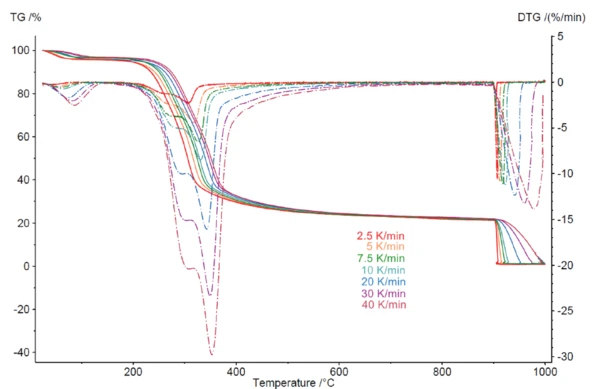
Měření TGA na obrázku 1 znázorňují křivky TGA a DTG (první derivace) měření na olivové pecce při rychlostech ohřevu 2,5, 5, 7,5, 10, 20, 30 a 40 K/min v inertní atmosféře. První stupeň úbytku hmotnosti, zjištěný mezi pokojovou teplotou a 130 °C, je důsledkem odpařování vlhkosti a je doprovázen úbytkem hmotnosti 3,3 % [3]. Po procesu dehydratace dochází při teplotách mezi 130 °C a 700 °C k několika překrývajícím se krokům úbytku hmotnosti, které se připisují tepelné degradaci hemicelulózy; následuje degradace celulózy a nakonec prodloužený úbytek hmotnosti, který lze připsat degradaci ligninu [4]. Úbytky hmotnosti pozorované při teplotách nad 700 °C jsou způsobeny tepelnou degradací pružných ligninových struktur [5]. S rostoucí rychlostí ohřevu se posouvají k vyšším teplotám (kinetický vliv) [6].
Kinetická analýza termického rozkladu
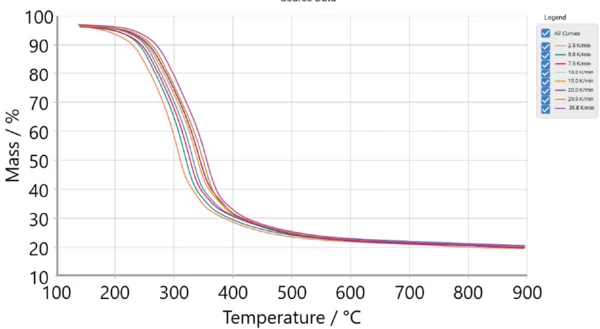
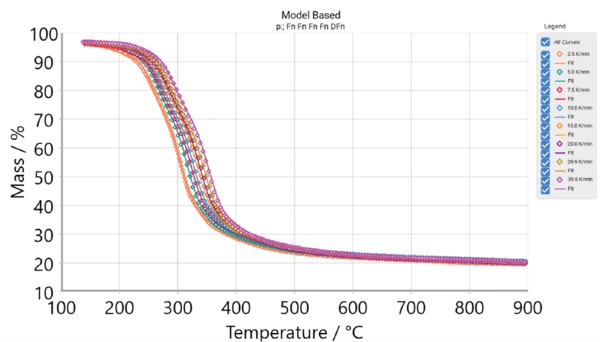
Pomocí softwaru NETZSCH Kinetics Neo lze vyhodnotit závislost rozkladného procesu na rychlosti ohřevu. Profil TGA pro rychlost 40 K/min je znázorněn na obrázku 2. Z tohoto pozorování vyplývá, že proces pyrolýzy není zcela ukončen při 700 °C, ale postupně probíhá až do 900 °C, což je doprovázeno úbytkem hmotnosti. Počáteční krok ztráty hmotnosti před 140 °C, který se týká odstranění vlhkosti, nebyl v datech, která byla podrobena kinetické analýze, zohledněn [3]. Při přechodu z dusíku na kyslík při 900 °C dochází k úbytku hmotnosti v důsledku hoření. Tato data byla z kinetické analýzy vyloučena. Obrázek 2 ukazuje křivky měření TGA mezi 130 °C a 900 °C použité pro kinetické vyhodnocení.
The degree of conversion, α, is calculated by Kinetics Neo software from thermogravimetry measurements where α ranges from 0 to 1 (Eq 1).
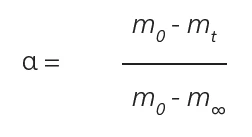
m0: initial mass
mt: mass at time t
m∞: final mass
Due to the complexity of biomass, a detailed understanding of reaction kinetics is essential for designing efficient reactors and optimizing process conditions [8]. The pyrolysis of hemicellulose begins at a relatively low temperature (~200°C) [9]. Cellulose decomposition involves multiple steps, including the formation of an amorphous intermediate and the production of levoglucosan [10]. Lignin is the most stable component due to its aromatic ring structure, with decomposition occurring over a temperature range from 170°C to the end of the process [3].
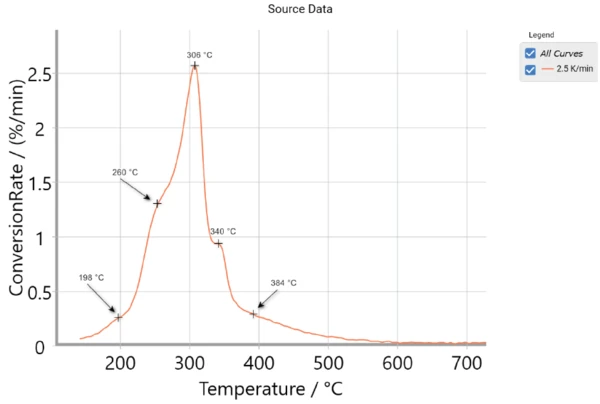
The thermal decomposition of olive stone occurs in multiple stages, as illustrated in figure 3, where the conversion rate is defined as the first derivative of conversion with respect to time. The first shoulder at 198°C marks the early decomposition of hemicellulose, followed by its main decomposition phase around 260°C. The primary breakdown of cellulose occurs at the main peak near 306°C with a late decomposition stage at 340°C. Finally, lignin decomposes slowly, showing a final shoulder at 384°C. [7]
This suggests a multi-step reaction process, which can be modeled with a five-step kinetic model:
A → B → C → D → E
F → G
The reaction rate of each step, j, is described by the function (Eq 2):
Reaction Rate j = Aj · f(ej, pj) · exp (-Ej/(RT)) (Eq 2)
Aj: pre-exponential factor
Ej: activation energy [J/mol]
T: temperature [K]
R: gas constant (8.314 J/K.mol)
f (ej ,pj): function dependent on the concentration of the initial reactant, ej, and the concentration of product, pj
Tepelný Rozkladná reakceRozkladná reakce je tepelně indukovaná reakce chemické sloučeniny za vzniku pevných a/nebo plynných produktů. rozklad olivové pecky lze vyjádřit pěti píky, které odpovídají součtu píků při teplotách 198 °C, 260 °C, 306 °C, 340 °C a 384 °C, jak je znázorněno na obrázku 4. Tyto píky představují postupný Rozkladná reakceRozkladná reakce je tepelně indukovaná reakce chemické sloučeniny za vzniku pevných a/nebo plynných produktů. rozklad hemicelulózy, celulózy a ligninu během pyrolýzy [6].
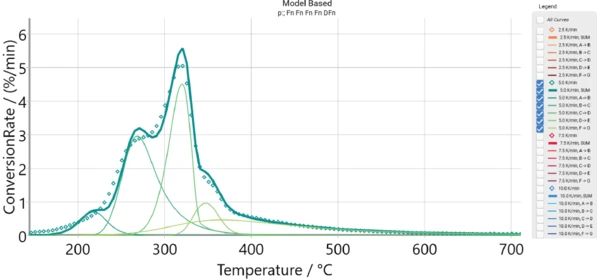
The measured data is presented as arhombus line, the thick green curve is the sum of the individual reaction steps. The good agreement between experimental and simulated data confirms the assumption of a 5-step process.
Figure 5 shows the measured TGA curves as well as the curves calculated using the five-step kinetics model in the NETZSCH Kinetics Neo software. Table 2 summarizes the parameters of the kinetics. The results demonstrate strong agreement between the measured and calculated data, with a coefficient of determination of 0.999.
Tabulka 2: Kinetické parametry tepelné degradace olivových pecek
Reakční krok | A → B Fn1 | B → C Fn1 | C → D Fn1 | D → E Fn2 | F → G DFn2 |
|---|---|---|---|---|---|
| Aktivační energie [kJ/mol] | 151.824 | 165.479 | 194.592 | 206.720 | 179.468 |
| Log (Pre-Exp) Log (1/s) | 14.083 | 13.792 | 15.116 | 15.286 | 12.093 |
| Objednávka reakce | 1.832 | 2.732 | 1.039 | 1.466 | 6.304 |
| Příspěvek | 0.061 | 0.336 | 0.313 | 0.073 | 0.217 |
| Koeficient determinace | 0.999 |
1Fn: 2DFn: Reakce n-tého řádu
2DFn: Jednorozměrná difúze n-tého řádu
Simulace: Optimalizace procesů
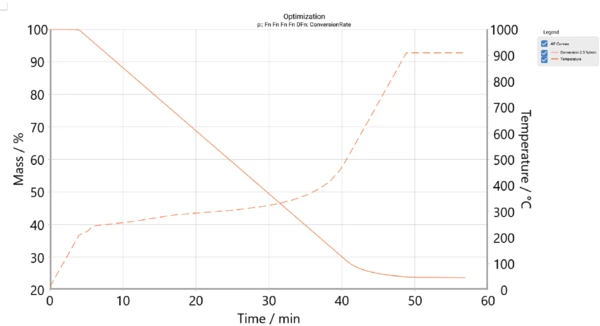
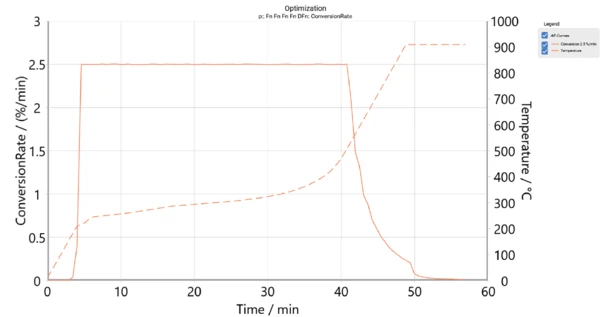
Following kinetic analysis and the determination of all relevant kinetic parameters, the next step involves process optimization as shown in figures 6 and 7. At this stage, the goal is to control the decomposition process by adjusting the conversion rate in order to minimize the total time required to achieve the desired conversion. Figure 7 presents the temperature program and time for a 2.5%/min conversion rate, corresponding to the simulated conversion rate.
Conclusion
Komplexní kinetickou analýzu lze provést kombinací měření NETZSCH TGA se softwarem NETZSCH Kinetics Neo . Výsledné stanovení kinetických parametrů umožňuje optimalizaci procesu, zvýšení celkové účinnosti a minimalizaci celkové doby potřebné k dosažení požadované konverze. Přesné kinetické parametry jsou nezbytné pro návrh účinných reaktorů, které zvyšují celkovou výkonnost procesu. Tento přístup lze použít pro širokou škálu vstupních materiálů, jako je biomasa, plasty a pryž.