Introduction
Pyrolysis has emerged as a key thermochemical process in the transition toward sustainable and circular energy systems. It enables the conversion of a wide range of carbon-based feedstocks into valuable fuels, chemicals, and carbon-rich solids.
Among the various materials suitable for pyrolysis are biomass and organic waste, plastics, and rubber-based materials like waste tires. These feedstocks offer different end products, from biochar and syngas to fuels and industrial carbon materials depending on their composition and processing conditions.
Focusing on biomass as a renewable resource has significant potential in biofuel production and the generation of value-added chemicals. The conversion of biomass through processes such as pyrolysis, gasification, and combustion offers sustainable solutions to meet the growing demand for energy [1]. Among the various biomass feedstocks, olive stones stand out as a particularly valuable resource [2]. A byproduct of the olive industry, olive stones possess high energy potential due to their low moisture content and rich lignocellulosic composition. These characteristics make olive stones ideal for biofuel production through pyrolysis. Also, olive stones can be converted into biochar, activated carbon, and biochemicals, offering diverse applications beyond energy production.
This study focuses on the pyrolysis kinetics of olive stone biomass. Based on thermogravimetric measurements, a comprehensive kinetic analysis of olive stone biomass is performed using the NETZSCH Kinetics Neo software to determine key kinetic parameters and perform process optimization through simulation.
Mérési feltételek
A mérési feltételeket az 1. táblázat részletezi. A kapott TGA-görbék képezik a bomlási reakció kinetikai értékelésének alapját.
Táblázat: Termogravimetriás analízis (TG) vizsgálati paraméterei
| Műszer | NETZSCH TG 309 Classic |
|---|---|
| Tégely | Al2O3, nyitott |
| A minta tömege | 9.65 mg és 9,85 mg között |
| Hőmérséklet-tartomány | 25 °C-tól 1000 °C-ig |
| Atmoszféra | Nitrogén (40 ml/perc), 900°C-on átváltás szintetikus levegőre (40 ml/perc) |
| Fűtési sebesség | 2.5 K/min, 5 K/min, 7,5 K/min, 10 K/min, 15 K/min, 20 K/min, |
Measurement Results
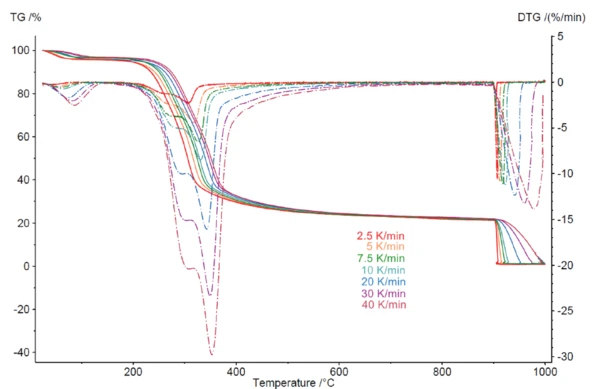
Az 1. ábrán látható TGA-mérések az olajbogyón végzett mérések TGA- és DTG-görbéit (első derivált) ábrázolják 2,5, 5, 7,5, 10, 20, 30 és 40 K/perc fűtési sebességgel, inert atmoszféra mellett. A szobahőmérséklet és 130 °C között észlelt első tömegveszteségi lépés a nedvesség PárologtatásEgy elem vagy vegyület elpárolgása fázisátalakulás a folyékony fázisból gőzzé. A párolgásnak két típusa létezik: a párolgás és a forrás.elpárolgásából ered, és 3,3%-os tömegveszteséggel jár együtt [3]. A dehidratálási folyamatot követően 130°C és 700°C közötti hőmérsékleten több, egymást átfedő tömegvesztési lépés következik be, ami a hemicellulóz termikus lebomlásának tulajdonítható; ezt követi a cellulóz lebomlása, és végül egy elhúzódó tömegveszteség, ami a lignin lebomlásának tulajdonítható [4]. A 700°C feletti hőmérsékleten megfigyelt tömegveszteség a rugalmas ligninszerkezetek termikus lebomlásának köszönhető [5]. Ezek a fűtési sebesség növekedésével magasabb hőmérsékletre tolódnak (kinetikus hatás) [6].
A termikus bomlás kinetikai elemzése
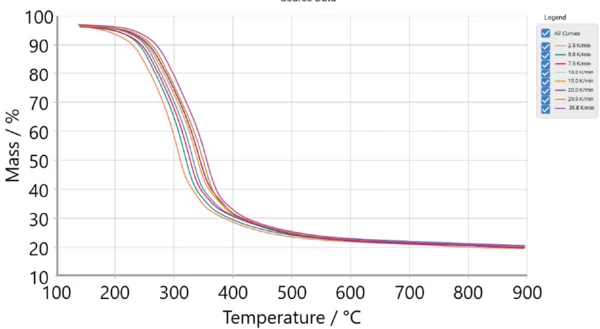
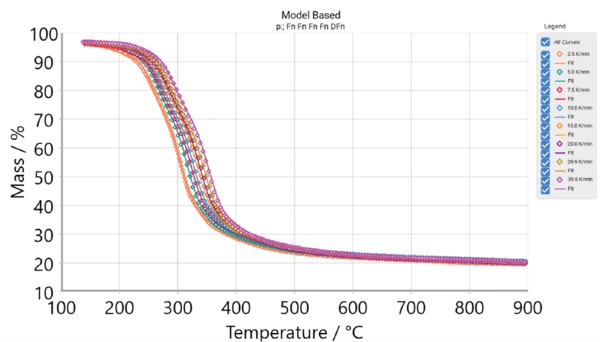
A NETZSCH Kinetics Neo szoftver segítségével kiértékelhető a bomlási folyamat függése a fűtési sebességtől. A TGA-profil 40 K/perc sebesség esetén a 2. ábrán látható. Ez a megfigyelés azt jelzi, hogy a PirolízisA pirolízis szerves vegyületek termikus bomlása inert atmoszférában.pirolízis folyamata nem fejeződik be teljesen 700 °C-ra, hanem fokozatosan halad 900 °C-ig, tömegveszteséggel kísérve. A 140°C előtti kezdeti tömegvesztési lépést, amely a nedvesség eltávolítására vonatkozik, nem vettük figyelembe a kinetikai elemzésnek alávetett adatokban [3]. Amikor 900°C-on nitrogénről oxigénre váltunk, az égés miatt tömegveszteség következik be. Ezt az adatot kizártuk a kinetikai elemzésből. A 2. ábra a kinetikai értékeléshez használt 130°C és 900°C közötti TGA mérési görbéket mutatja.
The degree of conversion, α, is calculated by Kinetics Neo software from thermogravimetry measurements where α ranges from 0 to 1 (Eq 1).
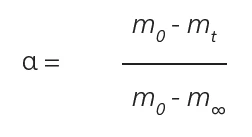
m0: initial mass
mt: mass at time t
m∞: final mass
Due to the complexity of biomass, a detailed understanding of reaction kinetics is essential for designing efficient reactors and optimizing process conditions [8]. The pyrolysis of hemicellulose begins at a relatively low temperature (~200°C) [9]. Cellulose decomposition involves multiple steps, including the formation of an amorphous intermediate and the production of levoglucosan [10]. Lignin is the most stable component due to its aromatic ring structure, with decomposition occurring over a temperature range from 170°C to the end of the process [3].
The thermal decomposition of olive stone occurs in multiple stages, as illustrated in figure 3, where the conversion rate is defined as the first derivative of conversion with respect to time. The first shoulder at 198°C marks the early decomposition of hemicellulose, followed by its main decomposition phase around 260°C. The primary breakdown of cellulose occurs at the main peak near 306°C with a late decomposition stage at 340°C. Finally, lignin decomposes slowly, showing a final shoulder at 384°C. [7]
This suggests a multi-step reaction process, which can be modeled with a five-step kinetic model:
A → B → C → D → E
F → G
The reaction rate of each step, j, is described by the function (Eq 2):
Reaction Rate j = Aj · f(ej, pj) · exp (-Ej/(RT)) (Eq 2)
Aj: pre-exponential factor
Ej: activation energy [J/mol]
T: temperature [K]
R: gas constant (8.314 J/K.mol)
f (ej ,pj): function dependent on the concentration of the initial reactant, ej, and the concentration of product, pj
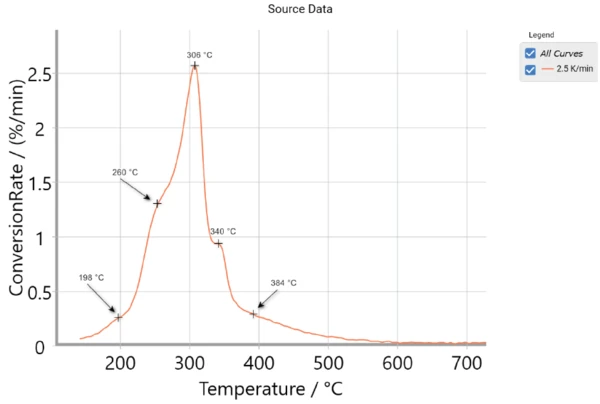
Az olajbogyó termikus Bomlási reakcióA bomlási reakció egy kémiai vegyület szilárd és/vagy gáznemű termékeket képező, hő hatására lejátszódó reakciója. bomlását öt csúcs jellemzi, amelyek a 198°C, 260°C, 306°C, 340°C és 384°C hőmérsékletű csúcsok összegének felelnek meg, amint az a 4. ábrán látható. Ezek a csúcsok a hemicellulóz, a cellulóz és a lignin egymást követő Bomlási reakcióA bomlási reakció egy kémiai vegyület szilárd és/vagy gáznemű termékeket képező, hő hatására lejátszódó reakciója. bomlását jelzik a PirolízisA pirolízis szerves vegyületek termikus bomlása inert atmoszférában.pirolízis során [6].
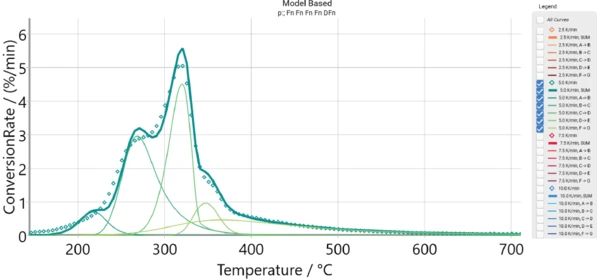
The measured data is presented as arhombus line, the thick green curve is the sum of the individual reaction steps. The good agreement between experimental and simulated data confirms the assumption of a 5-step process.
Figure 5 shows the measured TGA curves as well as the curves calculated using the five-step kinetics model in the NETZSCH Kinetics Neo software. Table 2 summarizes the parameters of the kinetics. The results demonstrate strong agreement between the measured and calculated data, with a coefficient of determination of 0.999.
Táblázat: Az olajbogyó termikus lebomlásának kinetikai paraméterei
Reakciós lépés | A → B Fn1 | B → C Fn1 | C → D Fn1 | D → E Fn2 | F → G DFn2 |
|---|---|---|---|---|---|
| Aktiválási energia [kJ/mol] | 151.824 | 165.479 | 194.592 | 206.720 | 179.468 |
| Log (Pre-Exp) Log (1/s) | 14.083 | 13.792 | 15.116 | 15.286 | 12.093 |
| Reakció sorrendje | 1.832 | 2.732 | 1.039 | 1.466 | 6.304 |
| Hozzájárulás | 0.061 | 0.336 | 0.313 | 0.073 | 0.217 |
| Meghatározási együttható | 0.999 |
1Fn: Az n-edik rend reakciója
2DFn: Egydimenziós diffúzió n-edik rendben
Szimuláció: Folyamatoptimalizálás
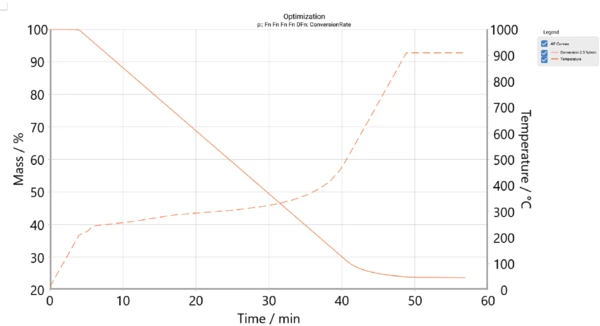
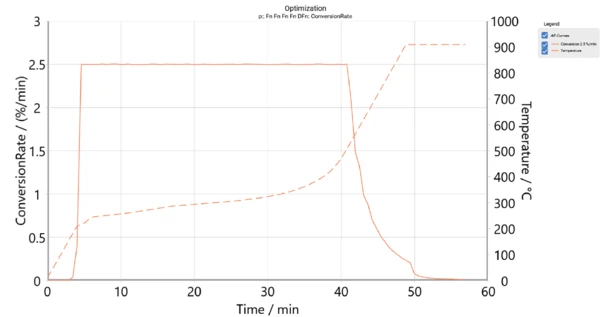
Following kinetic analysis and the determination of all relevant kinetic parameters, the next step involves process optimization as shown in figures 6 and 7. At this stage, the goal is to control the decomposition process by adjusting the conversion rate in order to minimize the total time required to achieve the desired conversion. Figure 7 presents the temperature program and time for a 2.5%/min conversion rate, corresponding to the simulated conversion rate.
Conclusion
Átfogó kinetikai elemzés végezhető a NETZSCH TGA-mérések és a NETZSCH Kinetics Neo szoftver kombinálásával. Az így kapott kinetikai paraméterek meghatározása lehetővé teszi a folyamat optimalizálását, növelve az általános hatékonyságot és minimalizálva a kívánt konverzió eléréséhez szükséges teljes időt. A pontos kinetikai paraméterek elengedhetetlenek a hatékony reaktorok tervezéséhez, amelyek javítják a folyamat általános teljesítményét. Ez a megközelítés a kiindulási anyagok széles körére, például biomasszára, műanyagokra és gumira alkalmazható.