Introduction
Pyrolysis has emerged as a key thermochemical process in the transition toward sustainable and circular energy systems. It enables the conversion of a wide range of carbon-based feedstocks into valuable fuels, chemicals, and carbon-rich solids.
Among the various materials suitable for pyrolysis are biomass and organic waste, plastics, and rubber-based materials like waste tires. These feedstocks offer different end products, from biochar and syngas to fuels and industrial carbon materials depending on their composition and processing conditions.
Focusing on biomass as a renewable resource has significant potential in biofuel production and the generation of value-added chemicals. The conversion of biomass through processes such as pyrolysis, gasification, and combustion offers sustainable solutions to meet the growing demand for energy [1]. Among the various biomass feedstocks, olive stones stand out as a particularly valuable resource [2]. A byproduct of the olive industry, olive stones possess high energy potential due to their low moisture content and rich lignocellulosic composition. These characteristics make olive stones ideal for biofuel production through pyrolysis. Also, olive stones can be converted into biochar, activated carbon, and biochemicals, offering diverse applications beyond energy production.
This study focuses on the pyrolysis kinetics of olive stone biomass. Based on thermogravimetric measurements, a comprehensive kinetic analysis of olive stone biomass is performed using the NETZSCH Kinetics Neo software to determine key kinetic parameters and perform process optimization through simulation.
Mittausolosuhteet
Mittausolosuhteet on esitetty yksityiskohtaisesti taulukossa 1. Saadut TGA-käyrät ovat perustana hajoamisreaktion kineettiselle arvioinnille.
Taulukko 1: Termogravimetrisen analyysin (TG) testiparametrit
| Laite | NETZSCH TG 309 Classic |
|---|---|
| Upokas | Al2O3, avoin |
| Näytteen massa | 9.65 mg-9,85 mg |
| Lämpötila-alue | 25 °C - 1000 °C |
| Ilmakehä | Typpi (40 ml/min), siirtyminen synteettiseen ilmaan (40 ml/min) 900 °C:ssa |
| Lämmitysnopeudet | 2.5 K/min, 5 K/min, 7,5 K/min, 10 K/min, 15 K/min, 20 K/min, |
Measurement Results
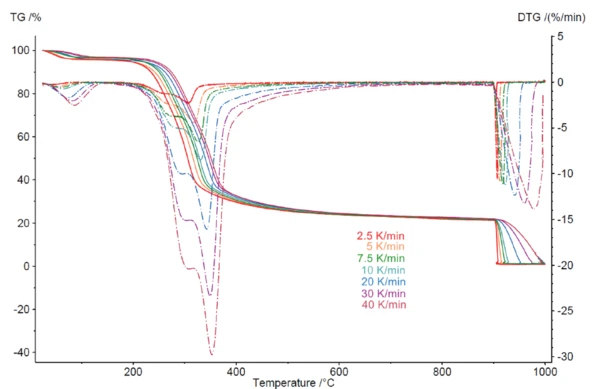
Kuvassa 1 esitetyt TGA-mittaukset kuvaavat TGA- ja DTG-käyriä (ensimmäinen derivaatta) oliivikivellä tehdyistä mittauksista lämmitysnopeuksilla 2,5, 5, 7,5, 10, 20, 30 ja 40 K/min inertissä ilmakehässä. Ensimmäinen massahäviö, joka havaitaan huoneenlämpötilan ja 130 °C:n välillä, johtuu kosteuden haihtumisesta, ja siihen liittyy 3,3 prosentin massahäviö [3]. Dehydraatioprosessin jälkeen tapahtuu useita päällekkäisiä massahäviövaiheita lämpötiloissa 130 °C:n ja 700 °C:n välillä, mikä johtuu hemiselluloosan termisestä hajoamisesta; tätä seuraa selluloosan HajoamisreaktioHajoamisreaktio on kemiallisen yhdisteen lämpöreaktio, jossa muodostuu kiinteitä ja/tai kaasumaisia tuotteita. hajoaminen ja lopuksi pitkittynyt massahäviö, joka saattaa johtua ligniinin hajoamisesta [4]. Yli 700 °C:n lämpötiloissa havaitut massahäviöt johtuvat elastisten ligniinirakenteiden termisestä hajoamisesta [5]. Ne siirtyvät korkeampiin lämpötiloihin lämmitysnopeuden kasvaessa (kineettinen vaikutus) [6].
Termisen hajoamisen kineettinen analyysi
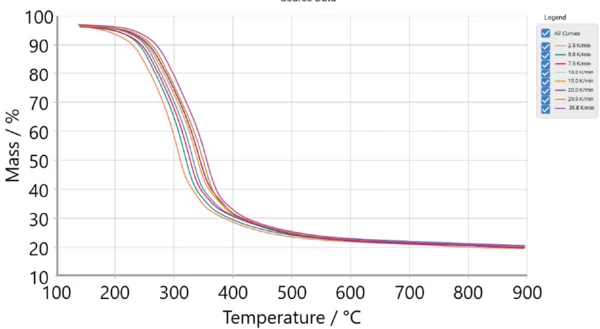
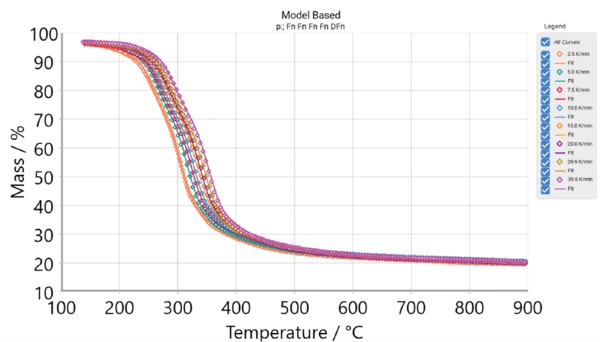
Käyttämällä NETZSCH Kinetics Neo -ohjelmistoa voidaan arvioida hajoamisprosessin riippuvuutta lämmitysnopeudesta. Kuvassa 2 on esitetty TGA-profiili nopeudella 40 K/min. Tämä havainto osoittaa, että pyrolyysiprosessi ei ole täysin valmis 700 °C:n lämpötilaan mennessä, vaan se etenee asteittain 900 °C:n lämpötilaan asti, mihin liittyy massahäviö. Ennen 140 °C:n lämpötilaa tapahtuvaa kosteuden poistumiseen liittyvää massan häviämisen alkuvaihetta ei otettu huomioon kineettisen analyysin kohteena olleissa tiedoissa [3]. Kun typestä siirrytään happiin 900 °C:ssa, tapahtuu palamisesta johtuvaa massahäviötä. Tämä tieto jätettiin pois kineettisestä analyysistä. Kuvassa 2 esitetään kineettisessä arvioinnissa käytetyt TGA-mittauskäyrät 130 °C:n ja 900 °C:n välillä.
The degree of conversion, α, is calculated by Kinetics Neo software from thermogravimetry measurements where α ranges from 0 to 1 (Eq 1).
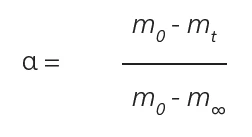
m0: initial mass
mt: mass at time t
m∞: final mass
Due to the complexity of biomass, a detailed understanding of reaction kinetics is essential for designing efficient reactors and optimizing process conditions [8]. The pyrolysis of hemicellulose begins at a relatively low temperature (~200°C) [9]. Cellulose decomposition involves multiple steps, including the formation of an amorphous intermediate and the production of levoglucosan [10]. Lignin is the most stable component due to its aromatic ring structure, with decomposition occurring over a temperature range from 170°C to the end of the process [3].
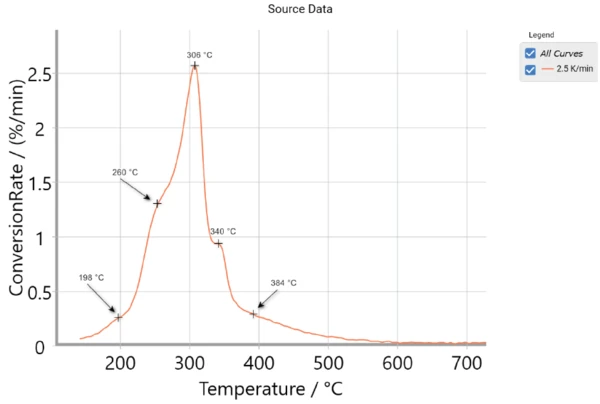
The thermal decomposition of olive stone occurs in multiple stages, as illustrated in figure 3, where the conversion rate is defined as the first derivative of conversion with respect to time. The first shoulder at 198°C marks the early decomposition of hemicellulose, followed by its main decomposition phase around 260°C. The primary breakdown of cellulose occurs at the main peak near 306°C with a late decomposition stage at 340°C. Finally, lignin decomposes slowly, showing a final shoulder at 384°C. [7]
This suggests a multi-step reaction process, which can be modeled with a five-step kinetic model:
A → B → C → D → E
F → G
The reaction rate of each step, j, is described by the function (Eq 2):
Reaction Rate j = Aj · f(ej, pj) · exp (-Ej/(RT)) (Eq 2)
Aj: pre-exponential factor
Ej: activation energy [J/mol]
T: temperature [K]
R: gas constant (8.314 J/K.mol)
f (ej ,pj): function dependent on the concentration of the initial reactant, ej, and the concentration of product, pj
Oliivikiven lämpöHajoamisreaktioHajoamisreaktio on kemiallisen yhdisteen lämpöreaktio, jossa muodostuu kiinteitä ja/tai kaasumaisia tuotteita. hajoaminen voidaan kuvata viidellä piikillä, jotka vastaavat 198 °C:n, 260 °C:n, 306 °C:n, 340 °C:n ja 384 °C:n piikkien summaa, kuten kuvassa 4 esitetään. Nämä piikit edustavat hemiselluloosan, selluloosan ja ligniinin peräkkäistä hajoamista pyrolyysiprosessin aikana [6].
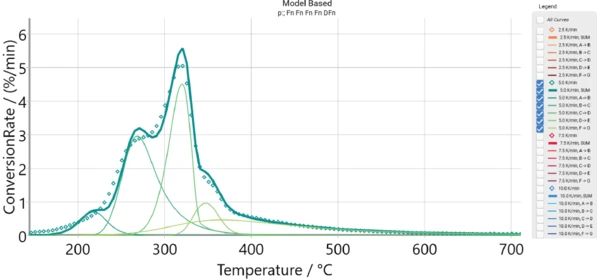
The measured data is presented as arhombus line, the thick green curve is the sum of the individual reaction steps. The good agreement between experimental and simulated data confirms the assumption of a 5-step process.
Figure 5 shows the measured TGA curves as well as the curves calculated using the five-step kinetics model in the NETZSCH Kinetics Neo software. Table 2 summarizes the parameters of the kinetics. The results demonstrate strong agreement between the measured and calculated data, with a coefficient of determination of 0.999.
Taulukko 2: Kineettiset parametrit oliivikiven lämpöhajoamiselle
Reaktiovaihe | A → B Fn1 | B → C Fn1 | C → D Fn1 | D → E Fn2 | F → G DFn2 |
|---|---|---|---|---|---|
| Aktivoitumisenergia [kJ/mol] | 151.824 | 165.479 | 194.592 | 206.720 | 179.468 |
| Log (Pre-Exp) Log (1/s) | 14.083 | 13.792 | 15.116 | 15.286 | 12.093 |
| Reaktiojärjestys | 1.832 | 2.732 | 1.039 | 1.466 | 6.304 |
| Maksuosuus | 0.061 | 0.336 | 0.313 | 0.073 | 0.217 |
| Määrityskerroin | 0.999 |
1Fn: N:nnen kertaluvun reaktio
2DFn: Yksiulotteinen n:nnen kertaluvun diffuusio
Simulointi: Simulointi: Prosessin optimointi
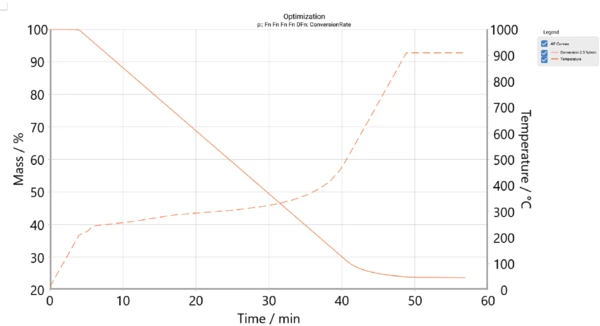
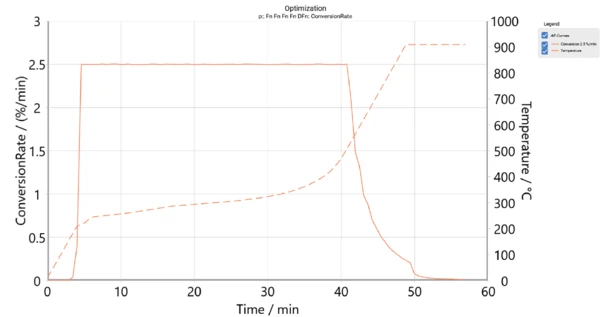
Following kinetic analysis and the determination of all relevant kinetic parameters, the next step involves process optimization as shown in figures 6 and 7. At this stage, the goal is to control the decomposition process by adjusting the conversion rate in order to minimize the total time required to achieve the desired conversion. Figure 7 presents the temperature program and time for a 2.5%/min conversion rate, corresponding to the simulated conversion rate.
Conclusion
Kattava kineettinen analyysi voidaan tehdä yhdistämällä NETZSCH TGA-mittaukset NETZSCH Kinetics Neo -ohjelmistoon. Tuloksena saatu kineettisten parametrien määritys mahdollistaa prosessin optimoinnin, parantaa kokonaistehokkuutta ja minimoi kokonaisajan, joka tarvitaan halutun konversion saavuttamiseen. Tarkat kineettiset parametrit ovat olennaisen tärkeitä suunniteltaessa tehokkaita reaktoreita, jotka parantavat prosessin kokonaistehokkuutta. Tätä lähestymistapaa voidaan soveltaa monenlaisiin raaka-aineisiin, kuten biomassaan, muoveihin ja kumiin.