Introduction
Pyrolysis has emerged as a key thermochemical process in the transition toward sustainable and circular energy systems. It enables the conversion of a wide range of carbon-based feedstocks into valuable fuels, chemicals, and carbon-rich solids.
Among the various materials suitable for pyrolysis are biomass and organic waste, plastics, and rubber-based materials like waste tires. These feedstocks offer different end products, from biochar and syngas to fuels and industrial carbon materials depending on their composition and processing conditions.
Focusing on biomass as a renewable resource has significant potential in biofuel production and the generation of value-added chemicals. The conversion of biomass through processes such as pyrolysis, gasification, and combustion offers sustainable solutions to meet the growing demand for energy [1]. Among the various biomass feedstocks, olive stones stand out as a particularly valuable resource [2]. A byproduct of the olive industry, olive stones possess high energy potential due to their low moisture content and rich lignocellulosic composition. These characteristics make olive stones ideal for biofuel production through pyrolysis. Also, olive stones can be converted into biochar, activated carbon, and biochemicals, offering diverse applications beyond energy production.
This study focuses on the pyrolysis kinetics of olive stone biomass. Based on thermogravimetric measurements, a comprehensive kinetic analysis of olive stone biomass is performed using the NETZSCH Kinetics Neo software to determine key kinetic parameters and perform process optimization through simulation.
Ölçüm Koşulları
Ölçüm koşulları Tablo 1'de ayrıntılı olarak verilmiştir. Elde edilen TGA eğrileri, Ayrışma reaksiyonuBir ayrışma reaksiyonu, katı ve/veya gaz ürünler oluşturan kimyasal bir bileşiğin termal olarak indüklenen reaksiyonudur. ayrışma reaksiyonunun kinetik değerlendirmesi için temel oluşturmaktadır.
Tablo 1: Termogravimetrik analiz (TG) test parametreleri
| Enstrüman | NETZSCH TG 309 Classic |
|---|---|
| Pota | Al2O3, açık |
| Örnek kütle | 9.65 mg ila 9,85 mg |
| Sıcaklık aralığı | 25°C ila 1000°C |
| Atmosfer | Azot (40 ml/dak), 900°C'de sentetik havaya (40 ml/dak) geçiş |
| Isıtma oranları | 2.5 K/dak, 5 K/dak, 7,5 K/dak, 10 K/dak, 15 K/dak, 20 K/dak, |
Measurement Results
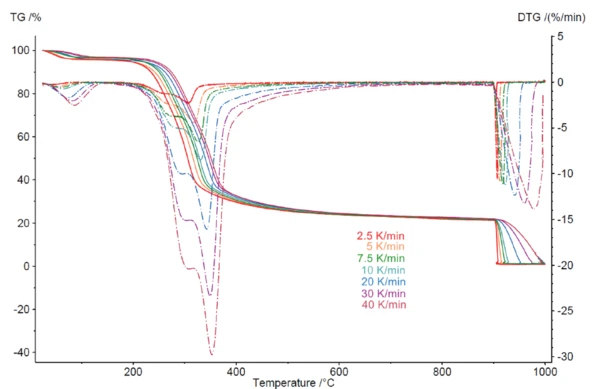
Şekil 1'deki TGA ölçümleri, inert bir atmosfer altında 2,5, 5, 7,5, 10, 20, 30 ve 40 K/dak ısıtma hızlarında zeytin taşı üzerinde yapılan ölçümlerin TGA ve DTG (birinci türev) eğrilerini göstermektedir. Oda sıcaklığı ile 130°C arasında tespit edilen ilk kütle kaybı adımı, nem buharlaşmasından kaynaklanır ve %3,3'lük bir kütle kaybına eşlik eder [3]. Dehidrasyon işleminden sonra, hemiselülozun termal bozunmasına atfedilen 130°C ile 700°C arasındaki sıcaklıklarda üst üste binen birkaç kütle kaybı adımı gerçekleşir; bunu selüloz bozunması ve son olarak ligninin bozunmasına atfedilebilecek uzun süreli bir kütle kaybı izler [4]. 700°C'nin üzerindeki sıcaklıklarda gözlemlenen kütle kayıpları, esnek lignin yapılarının termal bozunmasından kaynaklanmaktadır [5]. Artan ısıtma oranlarıyla (kinetik etki) daha yüksek sıcaklıklara kaymaktadırlar [6].
Termal Ayrışmanın Kinetik Analizi
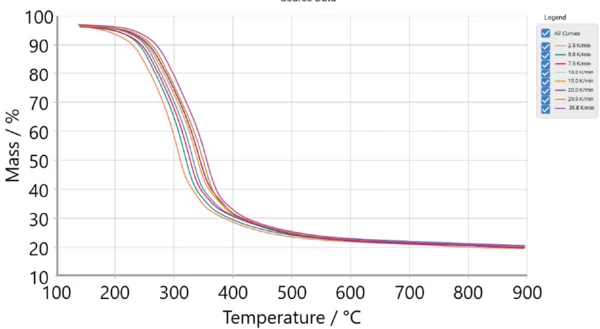
NETZSCH Kinetics Neo yazılımı kullanılarak, Ayrışma reaksiyonuBir ayrışma reaksiyonu, katı ve/veya gaz ürünler oluşturan kimyasal bir bileşiğin termal olarak indüklenen reaksiyonudur. ayrışma sürecinin ısıtma hızına bağımlılığı değerlendirilebilir. Şekil 2'de 40 K/dak hızı için TGA profili gösterilmektedir. Bu gözlem, PirolizPiroliz, organik bileşiklerin inert bir atmosferde termal olarak ayrışmasıdır.piroliz işleminin 700°C'de tam olarak tamamlanmadığını, bunun yerine kütle kaybıyla birlikte 900°C'ye kadar kademeli olarak ilerlediğini göstermektedir. Nemin uzaklaştırılmasıyla ilgili olan 140°C'den önceki ilk kütle kaybı adımı, kinetik analize tabi tutulan verilerde dikkate alınmamıştır [3]. 900°C'de azottan oksijene geçerken, yanma nedeniyle bir kütle kaybı meydana gelir. Bu veri kinetik analizin dışında tutulmuştur. Şekil 2, kinetik değerlendirme için kullanılan 130°C ile 900°C arasındaki TGA ölçüm eğrilerini göstermektedir.
The degree of conversion, α, is calculated by Kinetics Neo software from thermogravimetry measurements where α ranges from 0 to 1 (Eq 1).
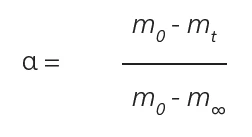
m0: initial mass
mt: mass at time t
m∞: final mass
Due to the complexity of biomass, a detailed understanding of reaction kinetics is essential for designing efficient reactors and optimizing process conditions [8]. The pyrolysis of hemicellulose begins at a relatively low temperature (~200°C) [9]. Cellulose decomposition involves multiple steps, including the formation of an amorphous intermediate and the production of levoglucosan [10]. Lignin is the most stable component due to its aromatic ring structure, with decomposition occurring over a temperature range from 170°C to the end of the process [3].
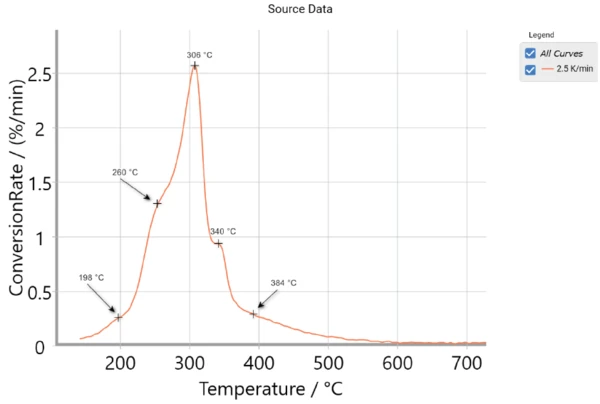
The thermal decomposition of olive stone occurs in multiple stages, as illustrated in figure 3, where the conversion rate is defined as the first derivative of conversion with respect to time. The first shoulder at 198°C marks the early decomposition of hemicellulose, followed by its main decomposition phase around 260°C. The primary breakdown of cellulose occurs at the main peak near 306°C with a late decomposition stage at 340°C. Finally, lignin decomposes slowly, showing a final shoulder at 384°C. [7]
This suggests a multi-step reaction process, which can be modeled with a five-step kinetic model:
A → B → C → D → E
F → G
The reaction rate of each step, j, is described by the function (Eq 2):
Reaction Rate j = Aj · f(ej, pj) · exp (-Ej/(RT)) (Eq 2)
Aj: pre-exponential factor
Ej: activation energy [J/mol]
T: temperature [K]
R: gas constant (8.314 J/K.mol)
f (ej ,pj): function dependent on the concentration of the initial reactant, ej, and the concentration of product, pj
Zeytin taşının termal ayrışması, şekil 4'te gösterildiği gibi 198°C, 260°C, 306°C, 340°C ve 384°C sıcaklıklardaki piklerin toplamına karşılık gelen beş pik ile takılabilir. Bu pikler PirolizPiroliz, organik bileşiklerin inert bir atmosferde termal olarak ayrışmasıdır.piroliz işlemi sırasında hemiselüloz, selüloz ve ligninin sıralı ayrışmasını temsil etmektedir [6].
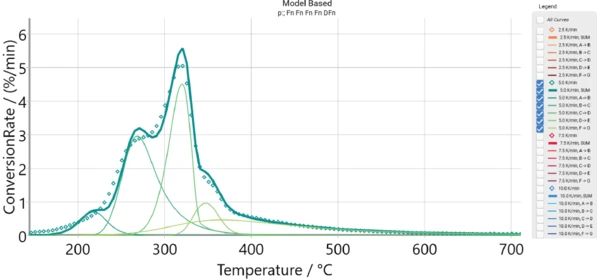
The measured data is presented as arhombus line, the thick green curve is the sum of the individual reaction steps. The good agreement between experimental and simulated data confirms the assumption of a 5-step process.
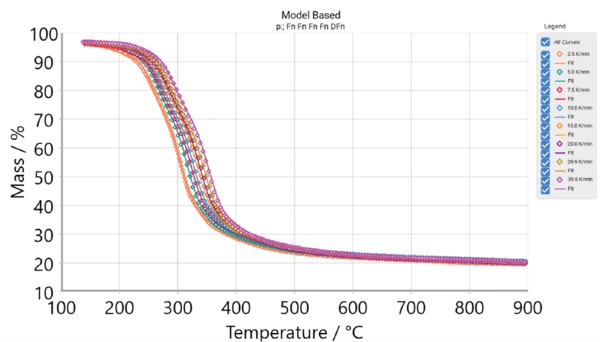
Figure 5 shows the measured TGA curves as well as the curves calculated using the five-step kinetics model in the NETZSCH Kinetics Neo software. Table 2 summarizes the parameters of the kinetics. The results demonstrate strong agreement between the measured and calculated data, with a coefficient of determination of 0.999.
Tablo 2: Zeytin taşının termal bozunmasının kinetik parametreleri
Reaksiyon adımı | A → B Fn1 | B → C Fn1 | C → D Fn1 | D → E Fn2 | F → G DFn2 |
|---|---|---|---|---|---|
| Aktivasyon enerjisi [kJ/mol] | 151.824 | 165.479 | 194.592 | 206.720 | 179.468 |
| Log (Exp Öncesi) Log (1/s) | 14.083 | 13.792 | 15.116 | 15.286 | 12.093 |
| Reaksiyon düzeni | 1.832 | 2.732 | 1.039 | 1.466 | 6.304 |
| Katkı | 0.061 | 0.336 | 0.313 | 0.073 | 0.217 |
| Belirleme katsayısı | 0.999 |
1Fn: N 'inci dereceden reaksiyon
2DFn: N 'inci mertebeden tek boyutlu difüzyon
Simülasyon: Süreç Optimizasyonu
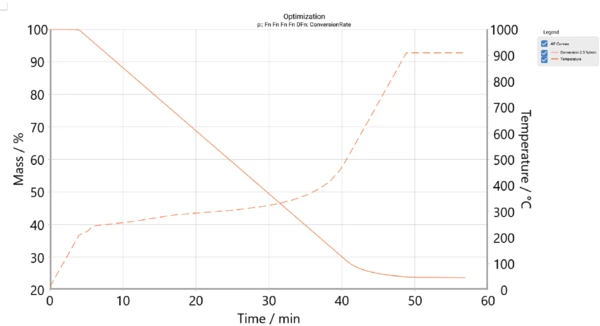
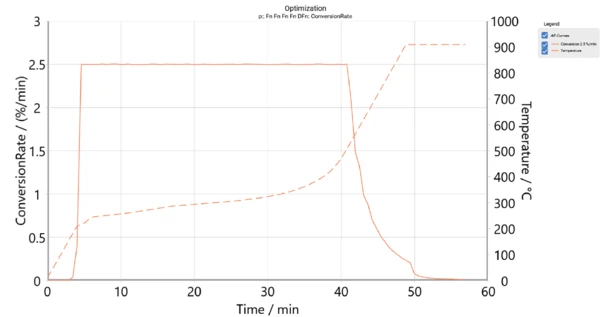
Following kinetic analysis and the determination of all relevant kinetic parameters, the next step involves process optimization as shown in figures 6 and 7. At this stage, the goal is to control the decomposition process by adjusting the conversion rate in order to minimize the total time required to achieve the desired conversion. Figure 7 presents the temperature program and time for a 2.5%/min conversion rate, corresponding to the simulated conversion rate.
Conclusion
NETZSCH TGA ölçümleri NETZSCH Kinetics Neo yazılımı ile birleştirilerek kapsamlı bir kinetik analiz gerçekleştirilebilir. Sonuçta kinetik parametrelerin belirlenmesi, proses optimizasyonuna olanak tanıyarak genel verimliliği artırır ve istenen dönüşümü elde etmek için gereken toplam süreyi en aza indirir. Doğru kinetik parametreler, genel proses performansını artıran verimli reaktörler tasarlamak için gereklidir. Bu yaklaşım biyokütle, plastik ve kauçuk gibi çok çeşitli hammaddelere uygulanabilir.