Introduction
Stearic acid is a naturally occurring saturated fatty acid with a long carbon chain, present in both plant-derived oils and animal fats. It is widely used across various industry, including pharmaceuticals, cosmetics, food products, and household goods like candles and detergents. In pharmaceutical applications, however, pharmaceuticalgrade stearic acid is not a single, chemically pure substance, but a mixture of fatty acids, primarily stearic and palmitic acid, the relative proportions of which may vary within defined specification limits. This compositional variability can influence key properties such as melting behavior.
Stearic Acid: Structure, Properties, and Applications
Stearic acid (also known as octadecanoic acid) is a hard, white to slightly yellowish crystalline solid and a longchain saturated fatty acid (C₁₈H₃₆O₂, Fig. 1). Its structure consists of a linear hydrocarbon chain of seventeen methylene groups terminating in a carboxylic acid group, giving it an amphiphilic character, although it is predominantly hydrophobic due to its long nonpolar tail. The absence of double bonds confers high chemical stability and resistance to OxidationOxidation can describe different processes in the context of thermal analysis.oxidation. It is poorly soluble in water, but readily soluble in organic solvents such as benzene, carbon tetrachloride, chloroform, and ether, with the polar head group enabling interfacial interactions.
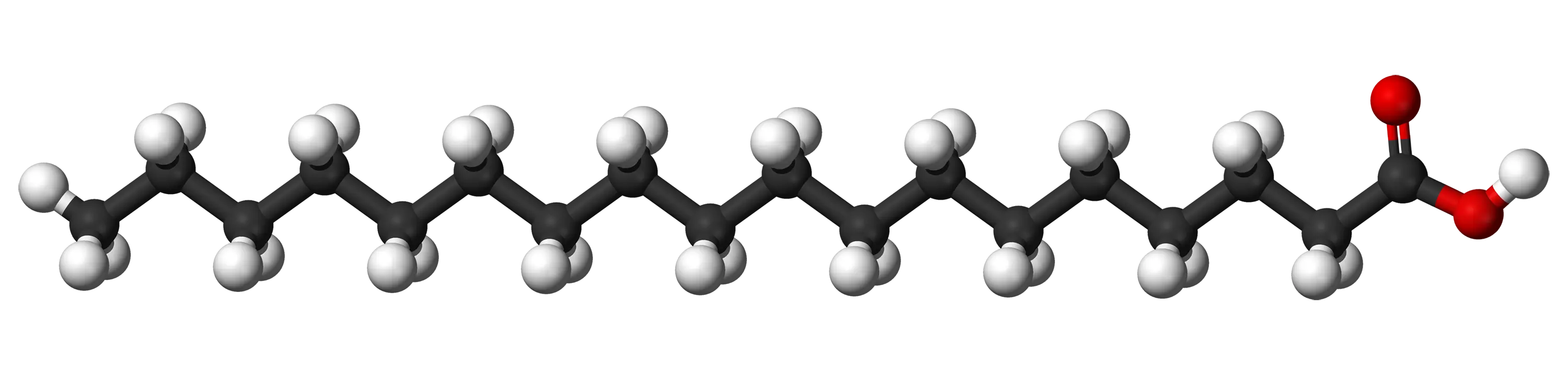
Stearic acid readily undergoes esterification with alcohols to form esters, used as emollients and texture modifiers (e.g., octyl stearate, glyceryl stearate). It also forms metal salts such as magnesium, sodium, and zinc stearates that are widely used as lubricants, stabilizers, and mold release agents.
In pharmaceutical and cosmetic formulations, stearic acid functions as an emulsifier, thickener, solubilizer, and emollient in topical products, and as a lubricant, binder, and release-modifying agent in solid dosage forms [2]. In the food sector, it is listed as E570 (EU) [3] and recognized as GRAS (Generally Recognized as Safe) by the FDA [4]. It serves as an anti-caking agent, emulsifier, and flavor carrier in products such as baked goods, ice cream, chewing gum, and confectionery.
Fatty acids differ in chain length and saturation, which govern their melting behavior and physical state. Shortand medium-chain acids (e.g., C8:0 - C12:0) have low melting points (16 to 32°C) and are liquid or semi-solid at room temperature, whereas longer saturated chains (C14:0 - C18:0) exhibit higher melting points (44 to 70°C) and are solid. Unsaturation lowers the Melting Temperatures and EnthalpiesThe enthalpy of fusion of a substance, also known as latent heat, is a measure of the energy input, typically heat, which is necessary to convert a substance from solid to liquid state. The melting point of a substance is the temperature at which it changes state from solid (crystalline) to liquid (isotropic melt).melting point, as can be seen with oleic acid (C18:1, ~16 °C). Oleic acid also has 18 carbon atoms, but it contains one double bond. Compared to palmitic acid (C₁6H₃2O₂, hexadecanoic acid, Figure 2) – another fatty acid that occurs very frequently in nature – stearic acid provides slightly higher melting and contributes to firmer structures, while oleic acid disrupts the packing, resulting in softer systems with improved spreadability, but lower oxidative stability.

The structure of fatty acids thus dictates their physicochemical properties and applications in pharmaceutical, cosmetic, and food systems (see Table 1).
Table 1: Relationship of structure, property and application of common fatty acids
| Fatty Acid | Carbon Chain Length | Chain Type | Melting Temperatures and EnthalpiesThe enthalpy of fusion of a substance, also known as latent heat, is a measure of the energy input, typically heat, which is necessary to convert a substance from solid to liquid state. The melting point of a substance is the temperature at which it changes state from solid (crystalline) to liquid (isotropic melt).Melting Point (°C) [5] | Typical Applications (Pharma, Cosmetics and Food Industries) |
|---|---|---|---|---|
| Caprylic acid | C8:0 | Saturated medium | 16.5 | Antimicrobial agent, drug intermediate; protein stabilization; biopharmaceutical manufacturing aid [6] |
| Capric acid | C10:0 | Saturated medium | 31.6 | Flavoring and solubilizing agent in pharmaceutical preparations, providing a citrus-like flavor; emulsifying agent [2] |
| Lauric acid | C12:0 | Saturated medium | 43.8 | Emulsifying and solubilizing agent; food additive; lubricant; surfactant [2] |
| Myristic acid | C14:0 | Saturated long | 53.9 | Emulsifying and solubilizing agent; skin penetrant; tablet and capsule lubricant [2] |
| Palmitic acid | C16:0 | Saturated long | 62.5 | Emulsifying and solubilizing agent; skin penetrant; tablet and capsule lubricant [2] |
| Stearic acid | C18:0 | Saturated long | 69.3 | Emulsifying and solubilizing agent; tablet and capsule lubricant [2] |
| Oleic acid | C18:1 | Monosaturated | 16.3 | Emulsifying agent; skin penetrant [2] |
Effect of the Stearic-Palmitic Acid Composition on the Thermal Behavior
In pharmacopeial terms (USP–NF), stearic acid is defined as a mixture of stearic (C18:0) and palmitic (C16:0) acids, comprising not less than 40% stearic acid, with the combined content of these two saturated fatty acids being at least 90% (Figure 2). Consequently, commercially available pharmaceutical grades exhibit variability in the stearic-to-palmitic acid ratio, which directly influences their thermophysical properties. Given that fatty acid chain length governs both intermolecular van der Waals interactions and crystalline packing efficiency, compositional differences alter lattice stability and polymorphic behavior, resulting in distinct melting profiles. Higher proportions of stearic acid typically promote increased melting temperatures and enhanced crystalline order, whereas greater palmitic acid content may slightly reduce these parameters due to the shorter chain length. In this work, we analyzed two different samples of stearic acid, with different stearic acid-palmitic acid ratios.
Experimental
Two stearic acid samples were analyzed: one containing more than 95% stearic acid and a second containing 44% stearic acid; the first manufactured by Sigma-Adrich and the second by Caelo. Differential scanning calorimetry (DSC) was employed to characterize the differences in thermal behavior and to assess the impact of composition on melting transitions.
The samples were filled in aluminum crucibles (Concavus®), which were closed with pierced lids, and heated from 20°C to 160°C at a heating rate of 10 K/min under N2 at a flow of 20 ml/min. Each sample was measured in triplicate, with average measured masses recorded as 2.57 ± 0.05 mg for stearic acid 95% and 2.46 ± 0.05 mg for stearic acid 44%, see Table 2.
Table 2: Experimental conditions
| Parameter | Condition |
|---|---|
| Instrument | DSC 300 Caliris® Supreme, H-Module |
| Sample mass | 2.41 to 2.61 mg |
| Sample type | Stearic acid (SA 44%, SA 95%) |
| Crucible | Aluminum crucible, pierced lid |
| Atmosphere | N2 |
| Gas flow rate | 20 ml/min (purge gas) |
| Temperature range | 20°C to 160°C |
| Heating and cooling rates | 10 K/min |
| Software | NETZSCH Proteus® Protect version 9 |
Measurement Results
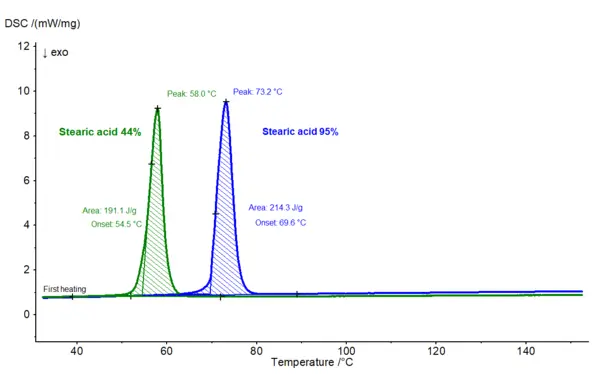
The DSC curves of stearic acid 44% (SA 44%) and stearic acid 95% (SA 95%), depicted in Figure 3, show melting peaks during both the first and second heating cycles, as well as recrystallization during cooling with excellent reproducibility (Figure 3A and 3B, respectively). Based on the extrapolated onset melting temperatures (Tm), SA 44% melts at approximately 54 to 55°C, while SA 95% melts at about 69 to 70°C.

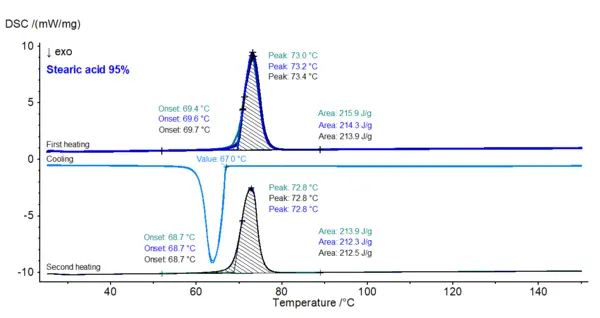
SA 44% exhibits a slight decrease in Tm between the first and second heating cycles. Similarly, for SA 95%, the second heating shows a Tm which is approximately 1°C lower than that observed during the first heating (see Table 3). These shifts may be attributed to several factors, including sample inhomogeneity during preparation, thermal history, PolymorphismPolymorphism is the ability of a solid material to form different crystalline structures (synonyms: forms, modifications).polymorphism, or variations in recrystallization behavior under the applied cooling conditions.
Table 3: DSC results for stearic acid 44% and stearic acid 95%
| Complex peak | Stearic acid 44% 1st heating | Stearic acid 44% 2nd heating | Stearic acid 95% 1st heating | Stearic acid 95% 2nd heating |
|---|---|---|---|---|
| Extrapolated onset Tm (°C) | 54.5 ± 3 0.1 | 54.0 ± 0.1 | 69.6 ± 0.2 | 68.7± 0.1 |
| Peak maximum (°C) | 57.9 ± 0.2 | 57.5 ± 0.1 | 73.2 ± 0.2 | 72.8± 0.0 |
| Enthalpy (J/g) | 188.0 ± 1.8 | 177.4 ± 2.1 | 215.2 ± 1.3 | 213.4 ± 0.9 |
Peak Width (°C at 37.0%) | 4.0 ± 0.2 | 5.0 ± 0.2 | 4.6 ± 0.1 | 4.9 ± 0.1 |
In addition, practice-related aspects of sample preparation and measurement can contribute to this effect. During the first heating cycle, the sample is initially introduced as a solid with potentially limited and non-uniform contact with the crucible bottom. Upon melting, the material redistributes and forms a layer with improved contact to the crucible during subsequent cooling. In the second heating cycle, this enhanced thermal contact and possible spreading of the sample over a larger surface area facilitates more efficient heat transfer. As a result, the observed shift to slightly lower melting temperatures in the second heating cycle is commonly observed.
Another observation is the increase in peak width for SA 44% after the first heating from 4.0 ± 0.2°C to 5.0 ± 0.2°C. In contrast, SA 95% exhibits only a slight increase of approximately 0.3°C in the average peak width (Table 3). While the peak width provides an indication of changes in melting behavior, the evolution of the melting enthalpy (ΔH) is considered more significant. For SA 44%, a clear decrease in enthalpy is observed, from 188.0 ± 1.8 J/g in the first heating to 177.4 ± 2.1 J/g in the second heating. In contrast, the higher-purity SA 95% sample shows only a minor change in ΔH, from 215.2 ± 1.3 J/g to 213.4 ± 0.9 J/g (see Table 3). This behavior suggests that the higher content of palmitic acid in SA 44% affects molecular packing and recrystallization, leading not only to broader melting transitions, but also to measurable changes in the energetic characteristics of the Phase TransitionsThe term phase transition (or phase change) is most commonly used to describe transitions between the solid, liquid and gaseous states.phase transition, whereas the more homogeneous SA 95% remains largely unaffected.
It is important to note that both stearic acid and palmitic acid can exist in different polymorphic forms or recrystallize from the molten phase. The melting points of these forms are usually very close to one another; however, these different polymorphic forms can affect the DSC curve.
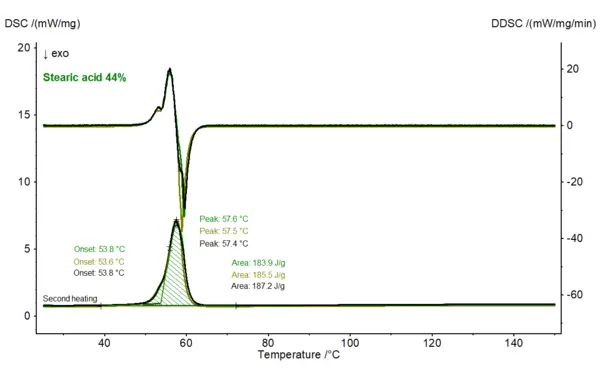
In addition, the presence of multiple thermal events during the second heating of SA 44% is indicated by a distinct shoulder in the first derivative (DDSC) signal (Figure 4A), which is not observed for SA 95%. This feature can be more clearly evaluated on the basis of the DDSC curve, where the shoulder becomes more pronounced. This further supports the presence of compositional heterogeneity and more complex CrystallizationCrystallization is the physical process of hardening during the formation and growth of crystals. During this process, heat of crystallization is released.crystallization behavior in the lower-purity sample.
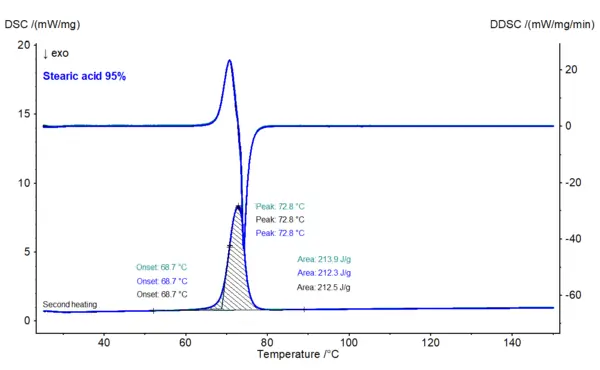
When the first heating curves of both samples are displayed in a single graph, the separation between their melting events becomes particularly evident. Figure 5 shows the first heating curves of SA 44% and SA 95%, revealing narrow and well-defined peaks with excellent resolution. The clear difference in peak position reflects the variation in chemical composition and purity, as well as differences in crystalline structure.
Conclusion
Overall, these results demonstrate that the DSC 300 Caliris® provides highly reproducible and well-resolved thermal data, enabling clear differentiation between samples with varying compositions and purities. Its sensitivity to changes in Melting Temperatures and EnthalpiesThe enthalpy of fusion of a substance, also known as latent heat, is a measure of the energy input, typically heat, which is necessary to convert a substance from solid to liquid state. The melting point of a substance is the temperature at which it changes state from solid (crystalline) to liquid (isotropic melt).melting temperature, peak shape, and recrystallization behavior makes it a powerful and efficient tool for research and industry.
In pharmaceutical, cosmetic, and food applications, where raw material consistency and purity are critical, the DSC 300 Caliris® allows rapid identification of material differences, detection of impurities, and verification of batch-to-batch consistency, supporting both product development and routine quality assurance.
This study has shown that pharmaceutical-grade stearic acid may not always meet the expected composition of pure stearic acid, even though the material complies with the requirements of the pharmacopoeia monograph. Its properties, such as melting behavior, depend heavily on its composition. It is therefore recommended that the substance be properly characterized prior to any industrial use.
Acknowledgement
A big thank-you to Gabriele Kaiser and Dr. Stefan Schmölzer for their valuable contributions to the technical evaluation and interpretation of the results.