18.11.2026 by NETZSCH Applications Laboratory
Understanding Citric Acid Decomposition: Deeper Insights with STA-FT-IR Analysis

Beyond Peaks and Curves: Application Insights by NETZSCH and Bruker
Citric acid is widely used in the food, pharmaceutical, and cosmetic industries, as well as in chemical applications such as chelating agents and bio-based polymer synthesis.
Understanding its behavior at elevated temperatures is important for maintaining material stability and defining suitable processing conditions.
When citric acid is exposed to heat, knowing when it starts to lose mass is only part of the picture. Is the material simply releasing moisture, or is its chemical structure already changing? And could the released compounds affect processing conditions or the properties of the final product?
Answering these questions requires more than thermal curves alone.
STA-FT-IR: Connecting Thermal Events with Gas Evolution
Simultaneous Thermal Analysis (STA) combines thermogravimetry (TGA) and differential scanning calorimetry (DSC) to record mass changes and thermal effects in a single measurement.
While these techniques provide valuable information about Thermal StabilityA material is thermally stable if it does not decompose under the influence of temperature. One way to determine the thermal stability of a substance is to use a TGA (thermogravimetric analyzer). thermal stability and Decomposition reactionA decomposition reaction is a thermally induced reaction of a chemical compound forming solid and/or gaseous products. decomposition behavior, they cannot identify the chemical nature of the gases released during heating.
Coupling STA with Fourier Transform Infrared Spectroscopy (FT-IR) adds this missing information. By correlating thermal events with the composition of evolved gases, STA-FT-IR helps distinguish physical transformations from chemical Decomposition reactionA decomposition reaction is a thermally induced reaction of a chemical compound forming solid and/or gaseous products. decomposition reactions.


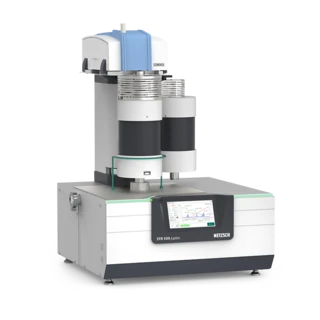
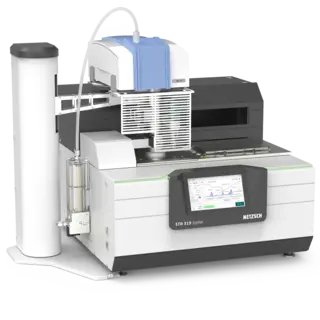
What Happens to Citric Acid During Heating?
STA-FT-IR analysis reveals a sequence of thermal events as citric acid is heated under a nitrogen atmosphere.
The main processes include:
- Initial moisture release: A first mass-loss step associated with the removal of water.
- Melting Temperatures and EnthalpiesThe enthalpy of fusion of a substance, also known as latent heat, is a measure of the energy input, typically heat, which is necessary to convert a substance from solid to liquid state. The melting point of a substance is the temperature at which it changes state from solid (crystalline) to liquid (isotropic melt).Melting: An EndothermicA sample transition or a reaction is endothermic if heat is needed for the conversion.endothermic transition occurring before significant thermal degradation.
- Thermal Decomposition reactionA decomposition reaction is a thermally induced reaction of a chemical compound forming solid and/or gaseous products. decomposition: At higher temperatures, a major mass-loss event accompanied by the evolution of gaseous Decomposition reactionA decomposition reaction is a thermally induced reaction of a chemical compound forming solid and/or gaseous products. decomposition products.
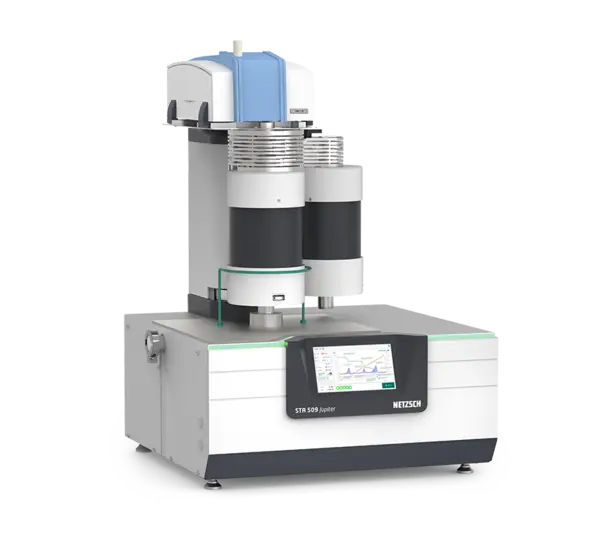
Identifying the Gases Released During Decomposition
The real strength of STA-FT-IR lies in the direct correlation between thermal events and the gases evolved.
In the analysis of citric acid, FT-IR reveals distinct gas-phase signatures at different stages of heating, providing valuable clues about the nature of the underlying transformations.
By correlating these signatures with mass-loss events and thermal effects, it becomes possible to distinguish moisture release from chemical degradation and gain deeper insight into the Decomposition reactionA decomposition reaction is a thermally induced reaction of a chemical compound forming solid and/or gaseous products. decomposition pathway.
Why This Matters for Industrial Applications
Citric acid is used in applications where Thermal StabilityA material is thermally stable if it does not decompose under the influence of temperature. One way to determine the thermal stability of a substance is to use a TGA (thermogravimetric analyzer). thermal stability can influence processing conditions and material performance.
Understanding its Decomposition reactionA decomposition reaction is a thermally induced reaction of a chemical compound forming solid and/or gaseous products. decomposition behavior helps to:
- Distinguish moisture loss from chemical degradation
- Identify the thermal conditions associated with decomposition
- Better understand the chemical transformations occurring during heating
- Support the selection of appropriate processing and storage conditions
By combining thermal analysis with gas identification, STA-FT-IR provides a more reliable basis for interpreting the thermal behavior of citric acid.
A Long-Standing Partnership: NETZSCH and Bruker Optics
The seamless integration of thermal analysis and FT-IR spectroscopy builds on a collaboration between NETZSCH and Bruker Optics dating back to 1993.
Combining decades of expertise, this partnership provides:
- Optimized gas transfer interfaces between thermal analyzers and FT-IR spectrometers
- Reliable synchronization of thermal and spectroscopic data
- Integrated, application-ready solutions for comprehensive material characterization
Explore More from Our Blog Series
This article is part of a blog series highlighting the benefits of combining thermal analysis with spectroscopic techniques in cooperation with Bruker Optics.
Missed the previous articles? Discover more applications and insights into evolved gas analysis in the articles linked below.
- 29.01.2026
Identification of Battery Separator Materials by Means of TGA-FT-IR

- 27.02.2026
How to Detect Plasticizers in Toys and Sporting Goods with TGA-FT-IR

- 17.03.2026
Moisture Matters: Understanding the Decomposition of Potassium Clavulanate Using TGA-FT-IR
- 21.04.2026
More Transparency in Combustion Gas Analysis: OMEGA 5 FT-IR Coupling on the NETZSCH TCC 918 Cone Calorimeter
- 19.05.2026
Understanding Cement Raw Materials: STA-FT-IR Analysis for Deeper Insight into Thermal Processes
- 25.06.2026
Tracking Down the Chemistry of PUR Powder Coatings with TGA-FT-IR and DSC