Rotational Rheometers
Rotational Rheology Technique by NETZSCH
Rotational rheometers (the NETZSCH Kinexus series) are precision instruments used to measure the flow and deformation behavior of liquids, pastes, and soft solids under controlled shear conditions. By applying rotational StressStress is defined as a level of force applied on a sample with a well-defined cross section. (Stress = force/area). Samples having a circular or rectangular cross section can be compressed or stretched. Elastic materials like rubber can be stretched up to 5 to 10 times their original length.stress or StrainStrain describes a deformation of a material, which is loaded mechanically by an external force or stress. Rubber compounds show creep properties, if a static load is applied.strain, they provide detailed insights into viscosity, viscoelasticity, and Yield StressYield stress is defined as the stress below which no flow occurs; literally behaves like a weak solid at rest and a liquid when yielded.yield stress, making them essential for material development and quality control.
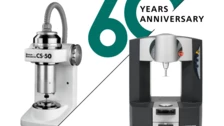
NETZSCH Kinexus rheometers are built on a decades-long tradition of excellence. Originally developed by Bohlin Instruments, then advanced by Malvern Instruments, the technology was brought into the NETZSCH Analyzing & Testing portfolio in 2020.
Today, NETZSCH is the only company on the market that offers both rotational and capillary rheometers; in combination with other thermal analysis instruments such as those for Differential Scanning Calorimetry (DSC), we provide extensive analysis capabilities from a single source.
Our Rotational Rheometers
Explore the range of NETZSCH Kinexus Prime instruments
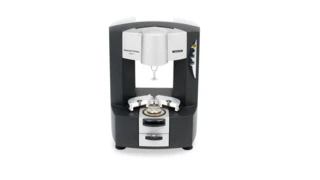
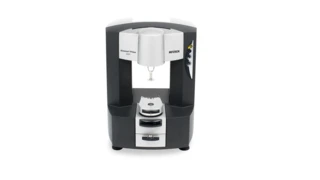
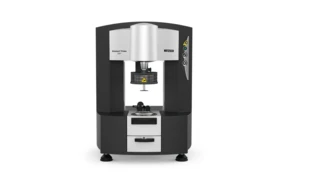


Customize, Integrate, Innovate
One size doesn’t fit all in rheological testing. That’s why the Kinexus rotational rheometer is built as an open platform for ultimate flexibility.
Integrate third-party tools, attach custom accessories, and even co-develop new software hand in hand with our NETZSCH experts.
Please see the examples of projects below. Contact us if you want yours to be the next!
Click on the appropriate box to learn more about open source rheology projects that have already been successfully implemented.



Accessories for Rotational Rheometers
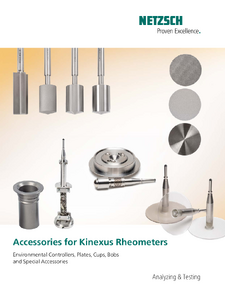
Get an overview of the environmental controllers, plates, upper cones, cups, bobs and special accessories available for our NETZSCH Kinexus Prime rheometers!
Kinexus rotational rheometers are designed as multifunctional solutions which can address a broad range of applications and can thus be easily adapted to suit your needs. The wide variety of measurement geometries in different diameters, shapes and surface finishes is optimized for the rheological characterization of complex fluids and soft solids, including dispersions, emulsions, polymer and surfactant solutions, and pastes and gels.
Expand your rheometer into a texture analyzer, DMA system, tensiometer, powder rheometer or tribometer with smart plug-and-play options.

About the Methods

Kinexus Rotational Rheometer - The Multi-Purpose Platform
Rotational rheometers can accommodate many different measuring systems, although the most common are the cone and plate, the parallel plates, the coaxial cylinders and the torsional fixtures.
In the case of the cone and plate or parallel plates, the sample is loaded onto a temperature controlled flat lower plate and an upper cone or flat plate is lowered onto the sample squeezing it into a defined space. After trimming away excess sample, the upper measuring system is then either sheared in one direction (viscometry) or oscillated rotationally (oscillation).
Additionally, your NETZSCH rheometer can also be used as a texture analyzer, DMA system, tensiometer, powder rheometer or tribometer with smart plug-and-play options.

How can rheology help you?
Rheology can support the product formulation to test and verify the chemical composition of products/materials
- Defining a particular time frame or temperature range
- A change in formulation
- Defining packaging and transportation of a material
- Determination of product stability or storage shelf-life
- In-Use Processes, Product Dispensing, Pouring, Sprayability
- Product Shape/Feel, Thickness, Firmness
- Product Application, Spreadability
- Product Appearance, Particle Suspending Capability, Stability
Your Benefits
>40
>500
50
7 Reasons to Choose the NETZSCH Kinexus Rotational Rheometer
- Intuitive Operation
The rSpace software automatically detects steady-state flow or harmonic distortion during oscillation tests to ensure ideal measurement conditions. Tool-free geometry changes and an easy cartridge setup (EasySwap) provide fast, safe, and repeatable measurements. - Transparent Data Handling
The rSpace software tracks every step of sample preparation and measurement. Raw data and live data are available to make the authenticity of your data transparent. - Purest Rheological Performance
With its ultra-low inertia motor, the NETZSCH Kinexus rheometer allows for efficient torque transfer to the sample – ideal for sensitive materials and fast-response testing. Rapid and accurate normal force detection and gap control enable the study of thermal deformation and structural changes in your material. - Individualized Testing Flexibility
Customize complex motion and thermal programs to suit demanding research and material testing applications. Extend your Kinexus rheometer for DMA, tribological measurements, and couplings by choosing from hundreds of accessories.
- Broadest Shear Rate Range
NETZSCH Analyzing & Testing is the only company on the market that offers both rotational and capillary rheometers and, in combination with other thermal analysis instruments such as those for Differential Scanning Calorimetry (DSC), provides extensive analysis capabilities from a single source. - Worldwide Support & Expertise
Rely on decades of experience from our worldwide team. NETZSCH offers expert service, training, and application support to help you get the best results from your rheometer. - Proven Excellence Paired with Unlimited Warranty
With a minimum spare parts availability span of 10 years, NETZSCH Kinexus rheometers promise top-tier quality, longevity and reliable performance. And to underline the quality and long-term availability of our services, we offer an unlimited warranty for the Kinexus Prime instrument series.
NETZSCH Rotational Rheometers – Rheology and Beyond
Why invest in multiple devices when one instrument does it all?
NETZSCH rotational rheometers allow for DMA, texture analyzing, powder rheology, tribology, and more – all in a single, modular platform. From shear viscosity and viscoelasticity to tack testing, texture, tribology, and interfacial measurements, our rheometers deliver comprehensive insights into material behavior while saving you time, space, and cost.


Discover how easy it is to work with our NETZSCH Kinexus rotational rheometers!
Do you work with multiple doctoral students or changing QC routines? Kinexus rotational rheometers offer clear advantages in everyday laboratory work. They make alternating experimental setups, measurement sequences, and analyses intuitive. Tool-free geometry changes and the unique EasySwap cartridge system ensure maximum flexibility and short setup times. A low-inertia drive guarantees energy-efficient operation, and high-precision normal force measurement provides accurate data, even for sensitive materials. Additionally, all raw and live data are fully accessible, allowing for seamless integration into your evaluation workflow.

Our Quality Promise:
NETZSCH’s Unlimited Warranty
At NETZSCH, our commitment to quality goes beyond the instruments themselves. We understand that your investment in advanced technology is a long-term one, and and that’s why we offer something truly unique – our Unlimited Warranty.
Frequently Asked Questions
Yes!
The NETZSCH Kinexus rheometers are built on a legacy of excellence that dates back decades. Originally developed by Bohlin Instruments, pioneers in rotational rheology, the technology was later advanced by Malvern Instruments, who introduced the widely respected Kinexus platform. In 2020, NETZSCH Analyzing & Testing took over the full rheology product line from Malvern Panalytical, combining this proven technology with its own expertise in thermal analysis.
Adding rheometers to the NETZSCH portfolio both added significant value to our business and enabled our customers to benefit from a comprehensive product and application service.
With this strong foundation, NETZSCH continues to deliver state-of-the-art rheometers that reflect decades of scientific innovation, precision engineering, and application know-how — and are trusted by researchers and industry leaders around the world.
Today, NETZSCH is home to both the Kinexus Prime series of rotational rheometers and the Rosand range of capillary rheometers. The service and support continue globally with monthly rheology webinars by both our rheology specialists and industry experts, comprehensive training courses, application materials and application rheology booklets.
Our renowned comprehensive customer support and expertise sit alongside a world-class R&D team ready to bring new, innovative solutions to the world of rheology.
Read more about the history of our rheometers in these blog articles:
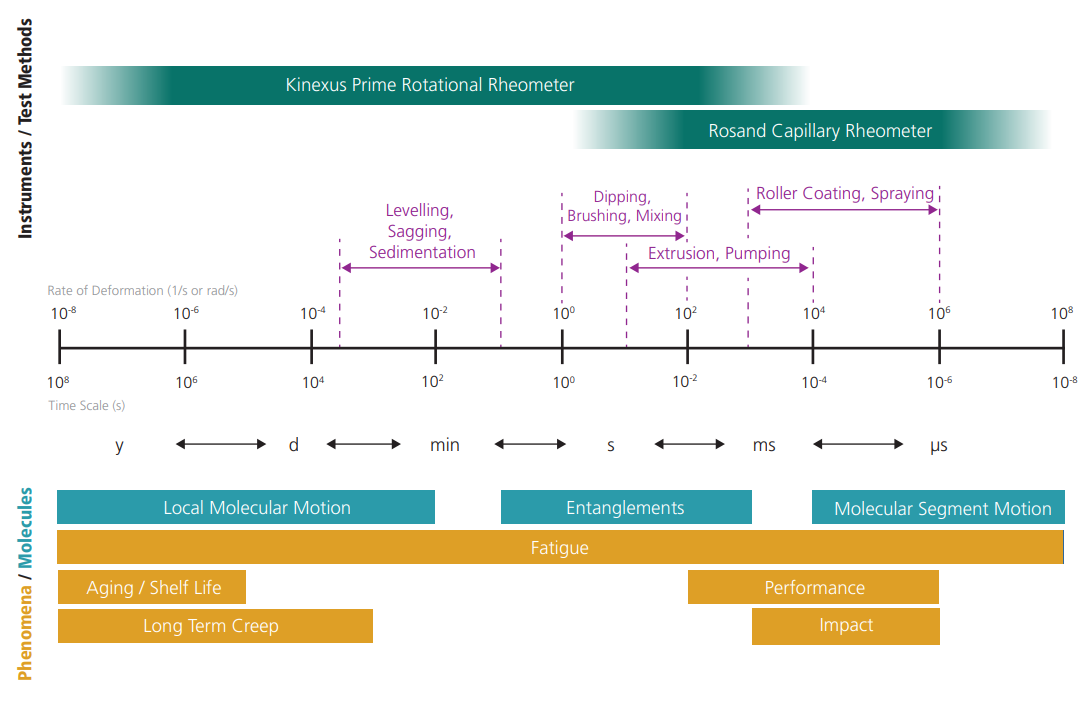
There are two types of rheometers: rotational and high-pressure capillary. The main difference between the two is the applied shear rate.
Why is it important to measure under different shear rates? We can build a picture of our materials, gaining insight on how formulation may influence rheology and in turn, affect processing and performance. How they behave at rest may be completely different from behavior during manufacture, transport, application or over time.
The shear rate, which is of great interest for rheological measurements, is dependent on the application. Spraying, for example, requires high shear rates; other applications, such as sedimentation, are associated with low shear rates. Accordingly, the choice of rheometer depends on the required shear rate. While the Kinexus, as a rotational rheometer, is the instrument of choice for measuring in the low shear rate range, a Rosand capillary rheometer would serve best for reaching high shear rates up to 1,000,000 s-1.
NETZSCH is the only company on the market offering both types of rheometer; in combination with our other thermal analysis instruments, we are thus able to provide far-reaching analysis possibilities from a single source.
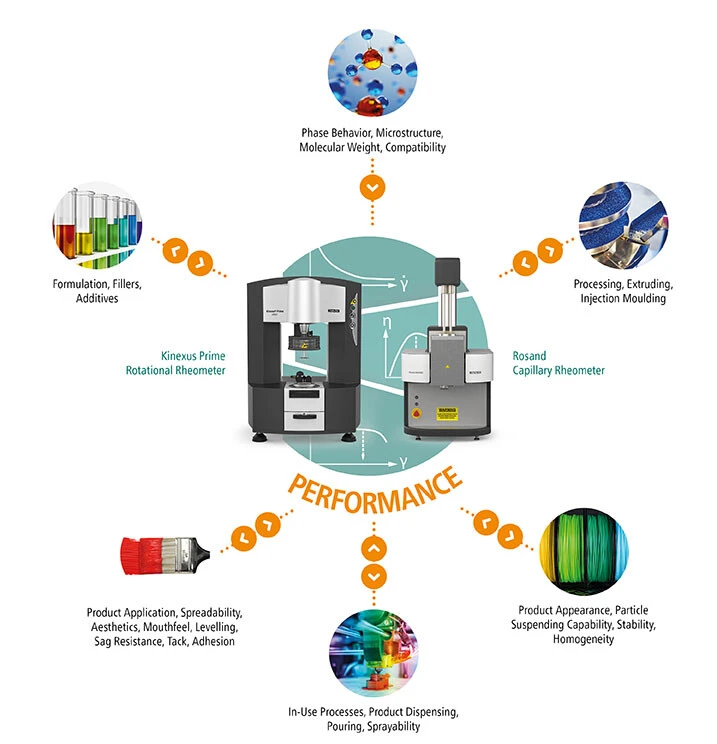
We perfect your processes: Which instrument matches your individual analysis needs?
Whether you need to measure the structure of a solid or determine performance when pumping, with over 14 decades of shear rate in rheometry, we have the best-suited instruments to help you.
NETZSCH Rotational rheometers come with state-of-the-art rSpace, which is customizable to your specific needs.
The intuitive rSpace software is easy to use. It offers over 200 built-in, customizable measurement sequences in 6 languages, including supporting application notes and educational tips.
The unique combination of Kinexus Prime hardware technology and rSpace software gives the user the ability to configure three critical rheometer functions independently:
- Rotational (shear) control: torque, speed and position
- Vertical (axial) control: gap and normal force
- Temperature control: IsothermalTests at controlled and constant temperature are called isothermal.isothermal, ramp or table
When performing viscosity measurements, the software can determine the steady state point, i.e. when the flow in the sample is no longer changing. This state can be detected directly by rSpace, which provides the characteristic value.
In oscillation tests, the harmonic distortion (clipping factor) can be easily outputted with a single click shortly before the sample is destroyed, which is very useful for quality control.
The rSpace software is driven by sequences – consisting of fundamental rheological actions (or test building blocks). These can be linked together with other test actions, to build intelligent tests.
NETZSCH ’s rSpace also includes an intuitive interactive guide during operation of the UV Curing (Crosslinking Reactions)Literally translated, the term “crosslinking“ means “cross networking”. In the chemical context, it is used for reactions in which molecules are linked together by introducing covalent bonds and forming three-dimensional networks.curing accessory.
Tips on how to select the appropriate measuring geometry:
There is no hard-and-fast rule for selecting a geometry, as there are a number of factors which could come into play. But when considering a new sample and geometry selection, ask yourself first:
What is the general viscosity of my sample?
- If you have a water-like low viscosity, select a large diameter cone/plate or plate/plate geometry (>50 mm).
- If you have a free-flowing liquid (e.g., shower gel), a medium-sized geometry will work well (40 mm.)
- If you have a very stiff, thick sample (e.g., treacle), a small geometry should be selected (<40 mm).
- If you have a very low-viscosity or volatile sample, consider using a cup- and bob- or double gap. For evaporating samples, a solvent trap should be used.
Do I have particles in my samples?
- If the answer is yes, what size? The measuring gap should be at least 10 times larger than the largest particle size which can be changed for parallel plates.
- Cup- and bob-systems should also be considered, especially for settling samples where circulating grooved bobs are advantageous.
What is the composition of my sample?
- Is my sample prone to slippage? Emulsions or concentrated dispersions can slip on smooth geometries. Consider using a roughened or serrated surface finish for plates and a roughened or splined one for bobs.
- Does my sample have a delicate structure? A vane tool can be used on samples such as foams or soft solids for Yield StressYield stress is defined as the stress below which no flow occurs; literally behaves like a weak solid at rest and a liquid when yielded.yield stress measurements.
- Is my sample aggressive? Acidic samples can be measured with polymeric PEEK materials instead.
Start with these simple questions and review your results. The Kinexus provides extra information to give users confidence that they have selected the correct geometry. Its clever feature of being able to easily swap to a different geometry, along with automatic recognition, will make testing new samples fun and effortless.
Read the full tips and tricks article to learn even more:
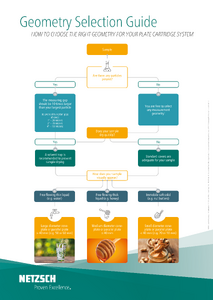
Download also our geometry selection guide poster; see below.
- NETZSCH_Rheology_Geometry-Selection-Guide.pdf(pdf – 1.65 MB)
- Accessories for Kinexus Rheometers(pdf – 3.99 MB)
To be 100% on the safe side, please contact our NETZSCH expert team. We will be happy to find the best geometry for your needs!
The rheological analysis of samples is a fundamental part of developing many types of products. Unlike a viscometer, a rheometer can actually measure sample properties at extremely low shear rates, as in sedimentation, or at the high shear rates seen in pumping, mixing and application. In the correct shear range, we can adequately simulate a flow process and so differentiate good products from poor ones. The rheometer can also determine the effect of process changes, or adding different quantities of an additive, and so can be used to optimize the formulation and production of a product.
The rheometer not only measures the viscosity of the product at room temperature, but can also be used to evaluate the viscosity during a programmed temperature profile. This can also be used with polymers to evaluate processability and Glass Transition TemperatureThe glass transition is one of the most important properties of amorphous and semi-crystalline materials, e.g., inorganic glasses, amorphous metals, polymers, pharmaceuticals and food ingredients, etc., and describes the temperature region where the mechanical properties of the materials change from hard and brittle to more soft, deformable or rubbery.glass transition temperatures. Results are accurate with minimal time spent testing, as a pre-programmed analysis may be started and left to run unattended, or even overnight.
Viscometry can be used to investigate the Yield StressYield stress is defined as the stress below which no flow occurs; literally behaves like a weak solid at rest and a liquid when yielded.yield stress, i.e. the StressStress is defined as a level of force applied on a sample with a well-defined cross section. (Stress = force/area). Samples having a circular or rectangular cross section can be compressed or stretched. Elastic materials like rubber can be stretched up to 5 to 10 times their original length.stress required to initiate sample flow, simulate a shearing process, measure shear stability or analyze how viscosity changes with temperature. Oscillation tests usually investigate the viscoelastic structure of a sample without breaking it down. Initially an amplitude sweep is run to determine how large an oscillation the sample can withstand before the structure breaks down, this is known as the Linear Viscoelastic Region (LVER)In the LVER, applied stresses are insufficient to cause structural breakdown (yielding) of the structure and hence important micro-structural properties are being measured.linear viscoelastic region. Once the Linear Viscoelastic Region (LVER)In the LVER, applied stresses are insufficient to cause structural breakdown (yielding) of the structure and hence important micro-structural properties are being measured.linear viscoelastic region has been determined, a frequency sweep, time sweep or temperature sweep may be performed to investigate how the viscoelastic structure and viscosity changes under dynamic conditions.
We know, that the decision as to whether to purchase a viscometer versus a rheometer is not always straightforward. The guide below will take you through the differences in greater detail and show the ways in which a rheometer may be better suited to your needs:
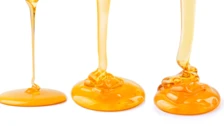
The Kinexus platform is designed to be modular, meaning that any temperature control unit (TCU) will fit on any model.
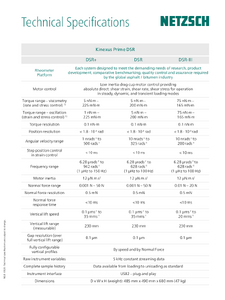
Our Dynamic Shear Rheometer (DSR) series is especially designed for asphalt binder and bitumen testing.
Download the catalog and datasheet here:
A rheometer can be configured according to sample type and application, with or without accessories. There are various models of both Kinexus Prime and Rosand, with bench-top and floor-standing options.
To get an accurate and up-to-date price for your personalized configuration, please contact your local NETZSCH representative or one of our authorized distributors. We will provide a quote tailored to your specific requirements, including any necessary training, installation, or additional features.
Our current delivery time is approximately 8 weeks, depending on the specific configuration of the instrument and current demand. For more complex customizations or during periods of high demand, the delivery time may extend beyond this range.
For the most up-to-date information, we encourage you to contact us directly with a specific request. This will ensure that we can provide you with an accurate timeline tailored to your specific needs.
Applications for Rotational Rheometers
Rotational rheometers are ideal for use in industries such as polymers, food, cosmetics, and pharmaceuticals, as they deliver accurate rheological data across a wide range of temperatures and shear rates.
Click on the appropriate application box to learn more.







Reference Customer Stories
Rheological analysis is a fundamental part of developing many types of products. A rheometer can actually measure sample properties at extremely low shear rates, as in sedimentation, or at the high shear rates seen in pumping, mixing and application. In the correct shear range, we can adequately simulate a flow process and so differentiate good products from poor ones.
Learn how our high-quality instruments have changed the work of our customers.
Here's what our customers say about using the NETZSCH rheometer:
"Since 1994, we have reliably used the Rosand rheometer to investigate the flow behaviour of polymers, thermoplastics, rubbers and highly filled plastics."
"Choosing NETZSCH rheometers was an easy decision. The instruments have (and, more importantly, meet!) excellent specifications."
"NETZSCH Kinexus rheometers help us to understand bubble dynamics in Yield StressYield stress is defined as the stress below which no flow occurs; literally behaves like a weak solid at rest and a liquid when yielded.yield stress fluids, reducing emissions from oil sands tailings ponds."
E-Learning
Media and Training
Brochures and Whitepapers
- Kinexus Prime SeriesBrochure(pdf – 1.88 MB)
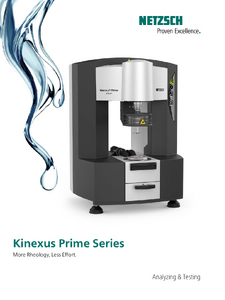
- Kinexus Prime DSR SeriesBrochure(pdf – 2.08 MB)
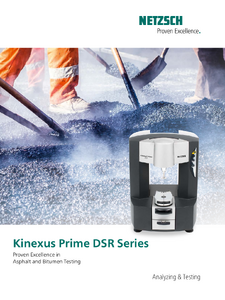
- Accessories for Kinexus Rheometers(pdf – 3.99 MB)
- Thermal and Rheological Characterization of PolymersBrochure(pdf – 6.2 MB)
- Investigation of Pharmaceuticals, Foods, Cosmetics and OrganicsBrochure(pdf – 4.43 MB)
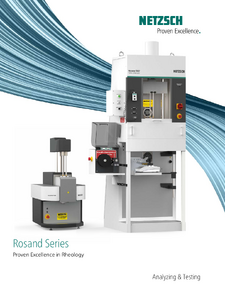
- Rosand Series(pdf – 2.02 MB)
- A Basic Introduction to RheologyWhite Paper(pdf – 391 KB)
- Introduction to the Rheology of DispersionsWhite Paper(pdf – 904 KB)
- Understanding Yield Stress MeasurementsWhite Paper(pdf – 600 KB)
- Analytical Characterization of Mouthfeel in Chocolate(pdf – 994 KB)
- Advanced Materials TestingBrochure(pdf – 3.67 MB)
- Product Overview(pdf – 1.65 MB)
Useful Application Posters
- Brewing yeast disintegration for protein release by horizontal disk milling(pdf – 787 KB)
- Developing Initial Rheological and Tribological Investigations of Pericardial Fluid(pdf – 1.35 MB)
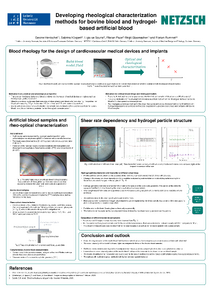
- Developing rheological characterization methods for bovine blood and hydrogelbased artificial blood(pdf – 427 KB)
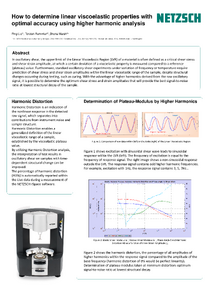
- How to determine linear viscoelastic properties with optimal accuracy using higher harmonic analysis(pdf – 525 KB)
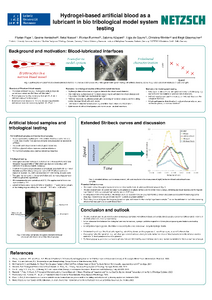
- Hydrogel-based artificial blood as a lubricant in bio tribological model system testing(pdf – 452 KB)
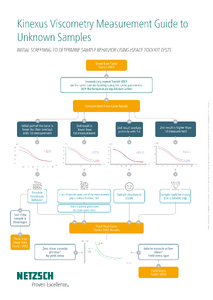
- Kinexus Viscometry Measurement Guide to Unknown SamplesPoster(pdf – 632 KB)
- NETZSCH_Rheology_Geometry-Selection-Guide.pdf(pdf – 1.65 MB)
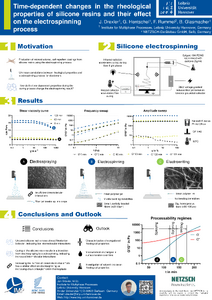
- Time dependent changes in the rheological properties of silicone resins and their effect on the electrospinning process(pdf – 1.26 MB)
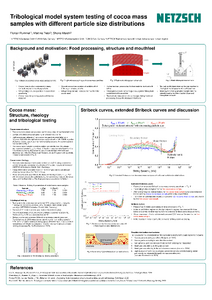
- Tribological model system testing of cocoa mass samples with different particle size distributions(pdf – 589 KB)
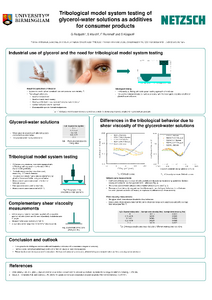
- Tribological model system testing of glycerol-water solutions as additives for consumer products(pdf – 667 KB)

Application book for Rotational Rheology: Interpretation of Data by Application
On more than 100 pages, this e-book shows many examples of rotational rheology measurements from the fields of:
- Paints, coatings & inks
- Polymers
- Food
- Pharmaceuticals & cosmetics
- Bitumen, petrochemical and miscellaneous.
In the introduction, the basic concepts of rheology are explained, making this a compact standard work that is especially helpful for beginners but also holds benefits for advanced users.
Application Literature about NETZSCH Kinexus Prime Rheometers
Our latest blog articles about rotational rheometers
- 09.09.2026
Introduction to the Rheology of Dispersions – Fundamentals, Influencing Factors and Measurement Methods

- 04.08.2026
Can Artificial Cartilage Behave Like the Real Thing? Rheology Provides the Answer
- 23.07.2026
Rheodialysis: Controlling Chemistry and Shear Simultaneously with the NETZSCH Kinexus Rheometer

- 11.05.2026
How Glass Fillers Influence Powder Aging in Polymer Additive Manufacturing

- 14.04.2026
The Art of Flow: Where Rheology Meets Creativity

- 14.01.2026
Learn, Apply, Achieve: NETZSCH Launches Free E-Learning Courses on Thermoanalytical Methods

- 19.12.2025
Frost Under the Christmas Tree: Why Material Testing Below 0°C Is Important

- 03.12.2025
Optimizing Electrode Production with Real-Time Viscosity Measurement

Videos related to NETZSCH Rotational Rheometers

FAQs about NETZSCH Rheometer Service
Yes – we also support you with method development! Our experts possess in-depth know-how in rheology and thermal analysis and work closely with you to design the ideal measuring method for your specific application.
Once the method has been developed, our NETZSCH applications laboratories can carry out contract testing for a wide range of industries and research centers. Equipped with state-of-the-art rheometers and thermal analysis instruments, we ensure accurate and reproducible results tailored to your needs.
Consult with the experts to develop the best-suited measuring method for your specific needs.
Some rheometers may no longer be included in our NETZSCH portfolio. However, we still have accessories and spare parts available for you. You can find information about our legacy products at the following link, see below.
To request service or support for your instrument, please contact your local service representative. We’re here to assist you with any service needs or queries about your instrument!
Benefit from our free e-learning basic courses:
Our basic e-learning courses are available free of charge on our website, designed to support you exactly where learning really happens: in everyday lab work. Whether you’re new to thermal analysis, rheology, or fire testing or simply want to refresh your knowledge: Our expert-led video courses help you:
✔ start measurements with confidence
✔ understand results correctly
✔ reduce operator errors
✔ save time searching for solutions
All courses are created by NETZSCH experts with decades of hands-on experience, sharing real knowledge you can directly apply in the lab.
👉 Start learning for free: netzs.ch/e-learning
Moreover, we offer
- online training via our NETZSCH Online Academy NOA,
- 1:1 remote training and
- on-site training at your location or our training centers.
Simply contact your sales representative or go to Know-How - NETZSCH Analyzing & Testing
We offer:
- Installation and Commissioning
- Relocation of your instrument
- Maintenance and inspection
- Calibration
- Repair
- Comprehensive training from basic to advanced use of the instrument – on-site and online.
Please note that our service may vary from region to region. Our Remote Service is available worldwide.
Yes, we offer maintenance contracts for your instruments according to the different regional and individual customer requirements. Please feel free to contact our Service Department or take a closer look at our website section Service-Level Agreement - NETZSCH Analyzing & Testing.
Furthermore, we offer an unlimited warranty for Kinexus Prime instruments!