Introduction
Polyvinyl alcohol (PVA) hydrogels are high-performance, soft polymer materials with broad application prospects in fields such as biomedicine, flexible electronics, and tissue engineering due to their excellent biocompatibility, tunable mechanical properties, and unique three-dimensional network structure. Rheological testing is a key method for investigating the viscoelastic properties, crosslinked network structure, and mechanical properties of PVA hydrogels, playing a significant role in understanding the relationship between a material's microstructure and macroscopic performance.
PVA hydrogels feature a three-dimensional network structure formed by connecting PVA molecular chains through physical or chemical crosslinking, enabling it to absorb and retain substantial amounts of water without dissolving. Polyvinyl alcohol (PVA) hydrogels exhibit excellent biocompatibility, non-toxic and non-irritating, making them suitable for biomedical applications. Its tunable mechanical properties allow characteristics to be adjusted from soft and elastic to high strength and high toughness by altering preparation conditions. Its strong hydrophilicity with high water content endows it with superior mass transport properties. Outstanding chemical stability make it maintain structural integrity in various environments.
Rheological modulus testing is critical in connecting the microstructure of PVA hydrogels to their macroscopic application performance, providing direct guidance for practical material applications. The storage modulus (G') directly reflects the material's crosslinking DensityThe mass density is defined as the ratio between mass and volume. density and network strength. For load-bearing applications like artificial cartilage or ligaments, a sufficiently high G' value indicates that the material can maintain its shape under dynamic load and effectively disperse StressStress is defined as a level of force applied on a sample with a well-defined cross section. (Stress = force/area). Samples having a circular or rectangular cross section can be compressed or stretched. Elastic materials like rubber can be stretched up to 5 to 10 times their original length.stress. Conversely, the Viscous modulusThe complex modulus (viscous component), loss modulus, or G’’, is the “imaginary” part of the samples the overall complex modulus. This viscous component indicates the liquid like, or out of phase, response of the sample being measurement. loss modulus (G'') and loss factor (tan δ) characterize the material's ability to dissipate energy through viscosity. In applications such as articular joint lubrication, appropriate viscosity facilitates energy absorption, while in the fields of drug release, viscosity can be used to control the release rates. Determining the Linear Viscoelastic Region (LVER)In the LVER, applied stresses are insufficient to cause structural breakdown (yielding) of the structure and hence important micro-structural properties are being measured.linear viscoelastic region (Linear Viscoelastic Region (LVER)In the LVER, applied stresses are insufficient to cause structural breakdown (yielding) of the structure and hence important micro-structural properties are being measured.LVER) via rheological tests helps assess the material's structural stability during actual use (e.g., repeated bending and friction of artificial cartilage). Therefore, the rheological modulus is not only a quantitative indicator for evaluating the mechanical properties of PVA hydrogels but also a core criterion for determining their suitability for specific applications and for optimization of preparation processes.
Measurements and Results
Preparation of a PVA Solution
The specific preparation method is detailed in the NETZSCH Application Note 421. First, a homogeneous PVA solution was prepared using a paddle bob and 34-mm cup (figure 1a). Subsequently, bulk PVA hydrogel was fabricated through a physical freeze-thaw method employing a cyclic heating and cooling sequence using our Kinexus (figure 1b). The resulting bulk hydrogel was then cut into pieces using a knife (figure 1d). Subsequently, the sample was loaded onto the rheometer (figure 1e) with normal force control to ensure good contact between the sample and the geometries. Then, the relevant rheological tests were conducted.
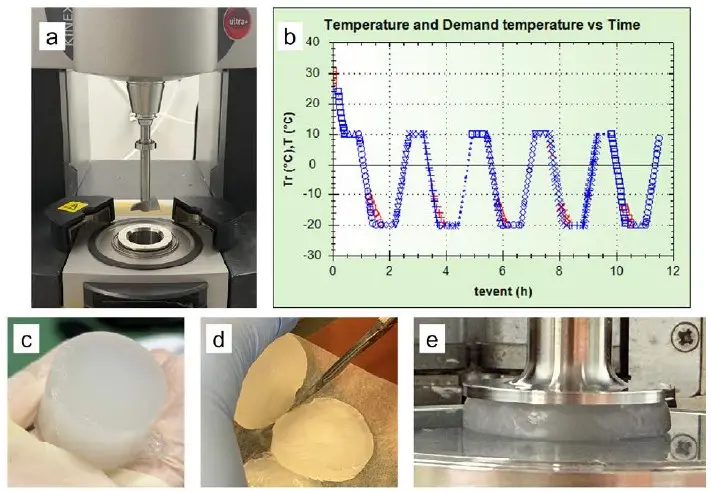
This Application Note not focuses solely on the effect of PVA content on the structural properties of hydrogels. Therefore, two types of hydrogels with different PVA contents of 8wt% and 15wt% were prepared. The freeze-thaw conditions were identical for the two sample as shown in figure 1b. The sequence includes 5 cycles and each cycle includes: ramping from 10°C to -20°C at 1 K/min; holding for 30 minutes at -20°C; ramping from -20°C to 10°C at 1 K/min; and holding for 30 minutes at 10°C.
Mechanical and Structural Tests on PVA Hydrogels
Figure 2 shows the amplitude sweep curves for PVA hydrogels with concentrations of 8wt% and 15wt%. The test results indicate that the 15-wt% PVA hydrogel exhibits a higher storage modulus, G', and a broader Linear Viscoelastic Region (LVER)In the LVER, applied stresses are insufficient to cause structural breakdown (yielding) of the structure and hence important micro-structural properties are being measured.linear viscoelastic region (Linear Viscoelastic Region (LVER)In the LVER, applied stresses are insufficient to cause structural breakdown (yielding) of the structure and hence important micro-structural properties are being measured.LVER). The storage modulus, G', of the 15-wt% PVA hydrogel is significantly higher than that of the 8-wt% PVA hydrogel. For load-bearing applications such as artificial cartilage, the modulus is a core indicator of a material’s ability to resist deformation. The higher G' value of the 15-wt% PVA hydrogel indicates a higher crosslinking DensityThe mass density is defined as the ratio between mass and volume. density and a stronger network structure, enabling it to provide greater stiffness to simulate the mechanical response of artificial cartilage under physiological loads. Therefore, the 15-wt% PVA hydrogel mimics the mechanical properties of natural cartilage more closely than the 8-wt% PVA hydrogel, potentially maintaining joint space and cushioning impact more effectively.
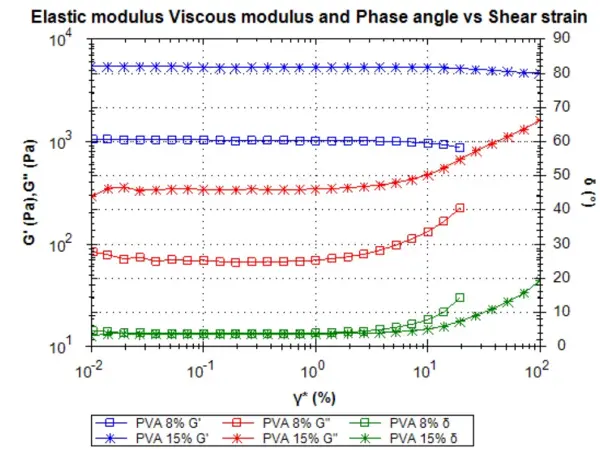
The Linear Viscoelastic Region (LVER)In the LVER, applied stresses are insufficient to cause structural breakdown (yielding) of the structure and hence important micro-structural properties are being measured.linear viscoelastic region (Linear Viscoelastic Region (LVER)In the LVER, applied stresses are insufficient to cause structural breakdown (yielding) of the structure and hence important micro-structural properties are being measured.LVER) of the 15-wt% PVA hydrogel is also broader than that of the 8-wt% PVA hydrogel, indicating that it can maintain its network structure without disruption over a larger range of shear StrainStrain describes a deformation of a material, which is loaded mechanically by an external force or stress. Rubber compounds show creep properties, if a static load is applied.strain, and possesses superior structural stability. Artificial cartilage in human joints must endure long-term, periodic, and large-amplitude shear and compressive strains, such as those experienced when walking or squatting. A broader Linear Viscoelastic Region (LVER)In the LVER, applied stresses are insufficient to cause structural breakdown (yielding) of the structure and hence important micro-structural properties are being measured.LVER indicates that the 15-wt% PVA hydrogel can maintain the integrity of its three-dimensional network under large deformations, making it less prone to yielding or failure. This ensures long-term durability and safety of the implant material under complex StressStress is defined as a level of force applied on a sample with a well-defined cross section. (Stress = force/area). Samples having a circular or rectangular cross section can be compressed or stretched. Elastic materials like rubber can be stretched up to 5 to 10 times their original length.stress states.
Figure 3 shows the frequency sweep curves for PVA hydrogels at concentrations of 8wt% and 15wt%. The entire frequency sweep range represents different motion speeds of human joints, from slow walking to running. The storage modulus of the 15-wt% PVA hydrogel is higher than that of the 8-wt% PVA hydrogel. This indicates that under dynamic loading conditions, the 15-wt% PVA hydrogel can provide greater stiffness to resist deformation. This means that whether under low-frequency static loads or high-frequency impact loads, the 15-wt% PVA can more effectively support body weight and relieve StressStress is defined as a level of force applied on a sample with a well-defined cross section. (Stress = force/area). Samples having a circular or rectangular cross section can be compressed or stretched. Elastic materials like rubber can be stretched up to 5 to 10 times their original length.stress. However, the phase angles of the two PVA hydrogels are essentially consistent. This suggests that although increasing the PVA concentration enhances the material's stiffness, it does not affect viscoelasticity. This implies that while providing stronger mechanical support, the 15-wt% PVA can still maintain energy absorption and buffering performance which is similar to those of the 8-wt% PVA with more water content. This appropriate viscoelasticity helps effectively absorb impact energy during joint movement and protect the joint.
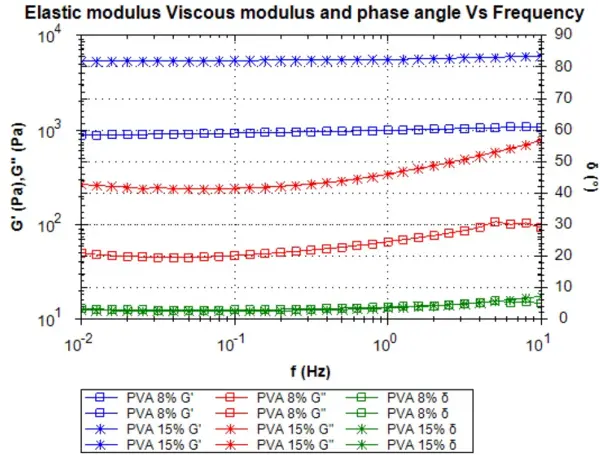
In summary, the 15-wt% PVA hydrogel is a superior choice compared to the 8-wt% PVA hydrogel. Although the 8-wt% PVA hydrogel has a lower modulus, which is softer and possesses higher water with better material transportability, its load-bearing capacity is insufficient for the weight-bearing environment of joints, making it more prone to mechanical fatigue or failure due to excessive deformation. In contrast, the 15-wt% PVA hydrogel can better simulate the viscoelastic mechanical behavior of articular cartilage due to its denser network structure. It significantly enhances stiffness without sacrificing viscoelasticity. In practical applications, this provides superior impact energy absorption and deformation resistance, potentially protecting the joint.
Conclusion
Rheology is a critical factor in understanding the relationship between the microstructure of PVA hydrogels and their macroscopic application performance. Amplitude sweep and frequency sweep tests results on PVA hydrogels with different concentrations show that increasing the PVA concentration effectively enhances the crosslinking DensityThe mass density is defined as the ratio between mass and volume. density and network strength of the gel, thereby improving its load-bearing capacity and structural stability under external StressStress is defined as a level of force applied on a sample with a well-defined cross section. (Stress = force/area). Samples having a circular or rectangular cross section can be compressed or stretched. Elastic materials like rubber can be stretched up to 5 to 10 times their original length.stress. Simultaneously, the change in concentration did not significantly affect the material's viscoelasticity, allowing it to maintain the good energy absorbing property characteristics while providing enhanced mechanical support. These results demonstrate that rheological testing enables quantitative evaluation of the viscoelastic properties of hydrogels and also provides critical guidance for material optimization of screening and preparation processes for specific application scenarios.