Introduction
Purity Determination is a key quality control measure to ensure that a substance is safe, reliable, and fit for its intended application. It confirms the identity and quality of the desired compound after isolation, synthesis, or production and verifies that it is free from significant impurities such as unreacted starting materials, by-products, and contaminants. This analysis helps evaluate the effectiveness of a synthesis or production process, indicates whether further purification is required, and supports consistency between production batches.
If a substance is intended for therapeutic applications, Purity Determination becomes even more relevant. The purity of active pharmaceutical ingredients is critical to their suitability for pharmaceutical use. Impurities can cause toxic effects or compromise the stability and bioavailability of the active pharmaceutical ingredient (API) during formulation and processing. From a quality-assurance perspective, this is particularly relevant for analytical standards, which are used as reference materials for method development, calibration, and routine control.
Eutectic Impurities
An impurity can form a eutectic system with a substance if it is soluble in the liquid phase but insoluble in the solid phase. In differential scanning calorimetry (DSC), such impurities can affect the melting behavior of the material by lowering the observed Melting Temperatures and EnthalpiesThe enthalpy of fusion of a substance, also known as latent heat, is a measure of the energy input, typically heat, which is necessary to convert a substance from solid to liquid state. The melting point of a substance is the temperature at which it changes state from solid (crystalline) to liquid (isotropic melt).melting temperature and broadening the melting endotherm as the impurity content increases. This melting-point depression is the basis of Purity Determination according to the van’t Hoff theory [3]. Eutectic impurities are therefore particularly critical, as they affect the melting behavior and interfere with processability. Hence, rapid thermal purity analysis is essential for quality control [4].
By analyzing the onset of the melting peak as a function of the melted fraction, the purity of a substance can be estimated using the van’t Hoff equation (Eq. 1), as described in method A of ASTM E928 [5]. It connects the degree of melting-point depression to the concentration of eutectic impurities.
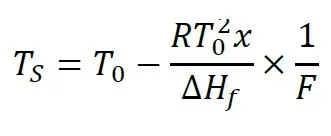
Where:
TS: sample temperature [K]
T0: Melting Temperatures and EnthalpiesThe enthalpy of fusion of a substance, also known as latent heat, is a measure of the energy input, typically heat, which is necessary to convert a substance from solid to liquid state. The melting point of a substance is the temperature at which it changes state from solid (crystalline) to liquid (isotropic melt).melting temperature of pure substance [K]
R: gas constant (= 8.314 J/mol-1·K-1)
x: mol fraction of impurity
Hf: heat of fusion [J·mol-1], calculated from the peak area
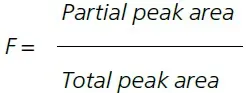
F: fraction melted
For the determination of the impurity concentration in a sample, it is necessary to establish a few conditions:
- The substance must be crystalline.
- The substance and the impurity must not form solid solutions; that is, they are immiscible in the solid phase.
- The substance forms a eutectic system with the impurity; that means, the substance and the impurity form a homogeneous mixture that melts and solidifies like a pure substance.
- Compounds exhibiting PolymorphismPolymorphism is the ability of a solid material to form different crystalline structures (synonyms: forms, modifications).polymorphism must be completely converted into a single polymorph.
- The substance must not degrade during melting.
The procedure for determining purity by DSC is described in USP <891>, Ph. Eur. 2.2.34, and in various other standards, such as ASTM E928 and DIN 51007 [3,6].
Specifically ASTM E928 [5] describes and standardizes the DSC-specific performance criteria for high-purity materials (concentration >98.5 mol-%, c <20%, bias <0.5 mol-% vs. reference methods) and defines the specific conditions under which the DSC measurements must be performed.
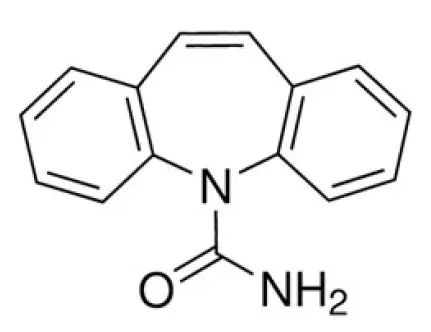
Carbamazepine (CBZ) is a synthetic anticonvulsant that was discovered in 1953 by the Novartis Group and has been commercially available since 1962 (Figure 1). The pure substance is a white, crystalline, and polymorphic powder (forms I–IV, dihydrate) with a melting range of 191–192°C (form I) and a molar mass of 236.27 g/mol. The mechanism of action of CBZ is based on the inhibition of voltage-gated Na+ channels. Its primary pharmaceutical use is in the treatment of epilepsy, trigeminal neuralgia, and bipolar disorders. However, CBZ can also be used during alcohol withdrawal or to treat neuropathic pain [7,8].
In this study, we applied the van’t Hoff plot to determine the amount of impurities in two carbamazepine analytical standards with different HPLC-determined purities. Following the ASTM E928 standard, we evaluated the applicability and reliability of the DSC method to Identify small differences in the purity of such reference materials.
Experimental
For Purity Determination by DSC, two different (secondary) analytical standards of the same active pharmaceutical ingredient, carbamazepine (CBZ) were selected. Both products were manufactured by Sigma-Aldrich (Merck KGaA) and met the manufacturer’s specifications shown in table 1.
Table 1: Comparison of the manufacturers' specifications for the two grades of carbamazepine [1,2]
| Parameter | Carbamazepine (CBZ-I) | Carbamazepine (CBZ-II) |
|---|---|---|
| Product number | 94496 | C4024 |
| Batch | BCCM1539 | MKCT3831 |
| HPCL Purity | 99.9% (Spec: ≥ 99.0%) | 99% (Spec: ≥ 98.0%) |
| Appearance | White powder | White powder |
| Melting Temperatures and EnthalpiesThe enthalpy of fusion of a substance, also known as latent heat, is a measure of the energy input, typically heat, which is necessary to convert a substance from solid to liquid state. The melting point of a substance is the temperature at which it changes state from solid (crystalline) to liquid (isotropic melt).Melting Point | 191 to 192°C | 191 to 192°C |
The manufacturer's HPLC analysis revealed a difference of 0.9% in purity between the two CBZ samples.
This difference in purity can be thermally validated using Differential Scanning Calorimetry (DSC) measurements (NETZSCH DSC 300 Caliris®Supreme ) and the Purity Determination feature of the NETZSCH Proteus® 9 software.
The NETZSCH DSC 300 Caliris®Supreme and Proteus® software enables ASTM-conformant DSC purity screening as a rapid test, particularly valuable for monitoring analytical reference standards for quality control.
Measurement Protocol
Prior to analysis with the NETZSCH DSC 300 Caliris®Supreme , aluminum Concavus® pans were cleaned in isopropanol and thermally conditioned at 425°C for one minute. Samples (~1.5 mg) were then filled into cleaned crucibles and hermetically sealed.
The temperature program was designed to initiate well below the expected melting onset to account for impurity-induced Melting Temperatures and EnthalpiesThe enthalpy of fusion of a substance, also known as latent heat, is a measure of the energy input, typically heat, which is necessary to convert a substance from solid to liquid state. The melting point of a substance is the temperature at which it changes state from solid (crystalline) to liquid (isotropic melt).melting point depression. The protocol employed a two-stage heating profile: initial rapid heating, 20°C to 160°C at 20 K/min; followed by a slow-rate temperature increase of 0.7 K/min, from 160°C to 200°C. The measurement was performed under nitrogen gas at a purging flow of 40 ml/min to maintain an inert atmosphere in the cell throughout the experiment.
Measurement Results
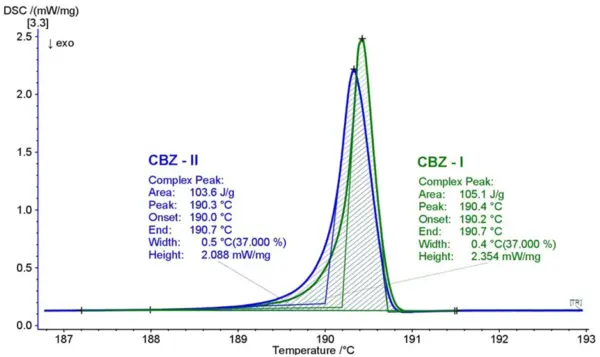
Figure 2 shows the DSC curves for the first heating cycle of CBZ-l and CBZ-ll. The extrapolated onset temperatures at 190°C for CBZ-l: 190.2°C / CBZ-ll: 190°C are consistent with the literature values for CBZ, 190.2°C according to Lide, D.R [9] but in the case of CBZ-l, it is 0.2°C higher than that of CBZ-ll.
As stated before, the impurity of the sample will lower the Melting Temperatures and EnthalpiesThe enthalpy of fusion of a substance, also known as latent heat, is a measure of the energy input, typically heat, which is necessary to convert a substance from solid to liquid state. The melting point of a substance is the temperature at which it changes state from solid (crystalline) to liquid (isotropic melt).melting point, broadening the DSC curve. From the DSC curve, the purity software feature calculates the van't Hoff plot and provides a graphical representation of the DSC purity analysis data; see Figure 3. It plots the Melting Temperatures and EnthalpiesThe enthalpy of fusion of a substance, also known as latent heat, is a measure of the energy input, typically heat, which is necessary to convert a substance from solid to liquid state. The melting point of a substance is the temperature at which it changes state from solid (crystalline) to liquid (isotropic melt).melting temperature against the reciprocal of the melted fraction (1/F), where F represents the portion of the total melting peak area.
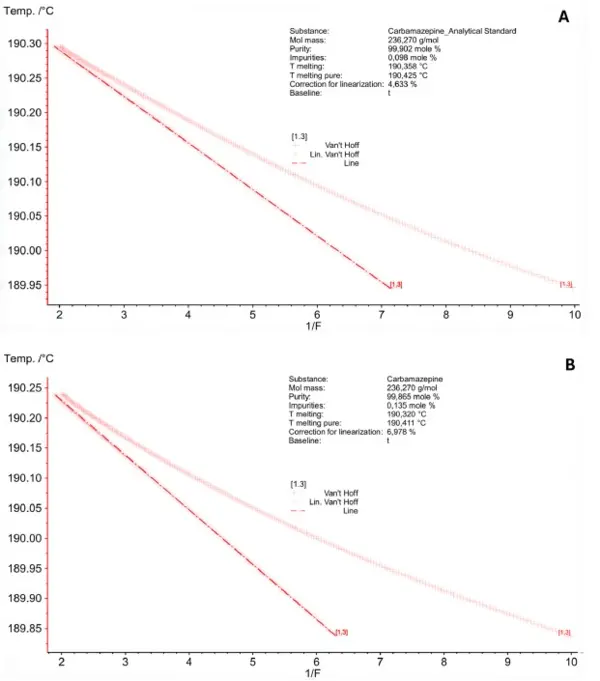
The plot is typically not linear, with greater non-linearity indicating a higher amount of impurity. This deviation arises from pre-melting effects that cannot be detected by DSC. Additionally, the measurement program and data analysis can also influence the plot linearity. For example, starting the low-rate temperature increasing segment too close to the melting onset will yield a wrong Melting Temperatures and EnthalpiesThe enthalpy of fusion of a substance, also known as latent heat, is a measure of the energy input, typically heat, which is necessary to convert a substance from solid to liquid state. The melting point of a substance is the temperature at which it changes state from solid (crystalline) to liquid (isotropic melt).melting temperature,TS. However, if you have well selected the temperature range, setting the peak area incorrectly will interfere with the peak integration boundaries, influencing the calculated heat of fusion,Hf. Both situations will exacerbate plot non-linearity.
To achieve linearity, the analysis software applies a correction factor, c, which is added proportionally to both the total peak area and each fractional area, F. This iterative adjustment yields a corrected F-value that produces a straight-line relationship in theTS = f(1/F)
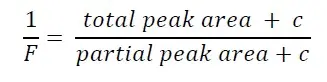
In addition to the acquired DSC curve, the Purity Determination software feature requires the molecular weight of the pure substance to provide results in mole%. The final purity is determined from the slope of the linearized data, while extrapolation to 1/F = 0 provides the theoretical Melting Temperatures and EnthalpiesThe enthalpy of fusion of a substance, also known as latent heat, is a measure of the energy input, typically heat, which is necessary to convert a substance from solid to liquid state. The melting point of a substance is the temperature at which it changes state from solid (crystalline) to liquid (isotropic melt).melting temperature of the 100% pure material. The results are only reliable when the adjusted data shows linearity, the purity level is higher than 98.5%, and the correction factor, c, is lower than 20% [4].
The theoretical Melting Temperatures and EnthalpiesThe enthalpy of fusion of a substance, also known as latent heat, is a measure of the energy input, typically heat, which is necessary to convert a substance from solid to liquid state. The melting point of a substance is the temperature at which it changes state from solid (crystalline) to liquid (isotropic melt).melting point of 100% pure CBZ amounts to 190.425°C for CBZ-l and to 190.411°C for CBZ-ll, compared to the Melting Temperatures and EnthalpiesThe enthalpy of fusion of a substance, also known as latent heat, is a measure of the energy input, typically heat, which is necessary to convert a substance from solid to liquid state. The melting point of a substance is the temperature at which it changes state from solid (crystalline) to liquid (isotropic melt).melting temperature of 190.358°C and 190.320°C, respectively. The calculated impurity content of the measured CBZ-l sample was 0.098 mole% and for CBZ-ll 0.135 mole%. The correction factor for both samples is less than 10%, 4.633% for CBZ-l and 6.978% for CBZ-ll, which demonstrates the high quality of the data and compliance with the ASTM standard. After the measurement, the sample was weighed again, and no mass loss was detected. This confirms that neither Decomposition reactionA decomposition reaction is a thermally induced reaction of a chemical compound forming solid and/or gaseous products. decomposition of the sample nor volatilization occurred during the measurement, which also complies with the maximum weight loss of 1% specified in the ASTM standard.
The purity of CBZ-l (99.9% HPLC) is 99.902 mol%, while that of CBZ-ll (99% HPLC) is 99.865 mol%. The difference of 0.037% is considered marginal but statistically significant according to a two-tailed t-test, although the limited number of replicates should be considered (Figure 4). The lower c-value of CBZ-l (4.8% versus 6.2%) suggests less pre-melting, which may be due to a higher purity degree [6].
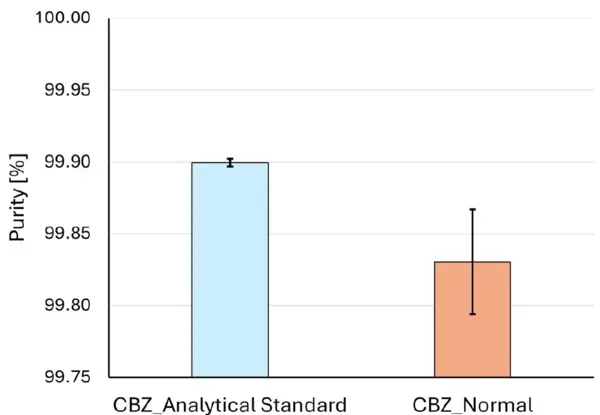
The present results reflect the manufacturer’s specifications and thus support the sensitivity and reliability of this thermoanalytical method. The difference in the DSC-determined purity of 0.037% (CBZ-l vs. CBZ-ll) reflects only eutectic impurities, which is the kind of impurity that DSC can detect. The detected impurity falls within the ASTM method range, < 1.5 mol%, and exceeds the quantitative detection limit of 0.001 mol%.
Conclusion
This study concludes that the NETZSCH DSC 300 Caliris®Supreme , in combination with the Purity Determination software feature of NETZSCH Proteus® for DSC, is ideally suited for screening impurities that influence the melting process and, consequently, for determining the purity of numerous pharmaceuticals, including the differentiation between purity grades of different analytical standards.
Acknowledgement
A big thank-you to Gabriele Kaiser and Dr. Stefan Schmölzer for their valuable contributions to the technical evaluation and interpretation of the results.