Introduction
Melt fracture refers to the phenomenon where polymer melts undergo surface instability during extrusion molding when shear rates exceed a critical threshold. This causes the surface of the extruded material to become rough, exhibiting deformations such as shark skin, unevenness, bamboo-like patterns, or spiral distortions. Melt fracture can severely impact product quality and production efficiency.
As a classic rheological testing instrument, the capillary rheometer enables the investigation of melt fracture phenomena across a wide range of shear rates and temperatures for various materials.
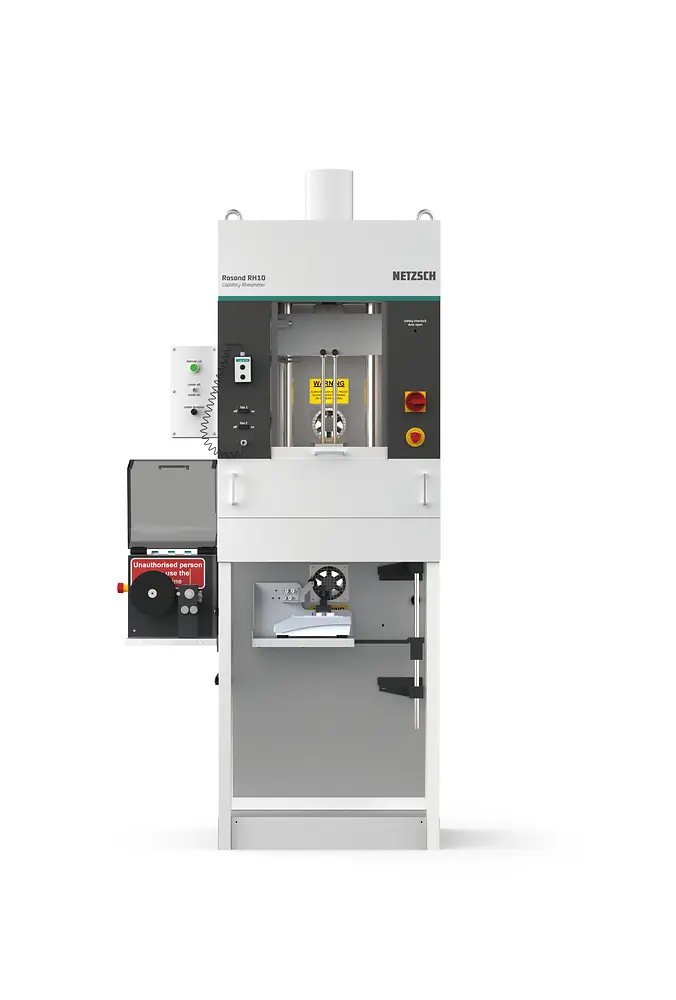
Therefore, in this study, a NETZSCH Rosand RH10 capillary rheometer (figure 1) was used to systematically investigate temperature effects, the inlet angle of the die, and the length-to-diameter ratio of the die on melt fracture in polyethylene (PE) materials. This research aims to guide PE processing techniques in actual production, prevent melt fracture occurrence, and thereby enhance production efficiency and quality of PE products.
Measurement Conditions and Test Method
The measurement conditions are summarized in table 1.
Table 1: Measurement conditions
| Instrument | NETZSCH Rosand RH10 |
| Samples | Polyethylene |
| Pressure transducer | 10000 psi |
| Test temperature | 180°C/220°C/250°C |
| Shear rate range | 50 to 1000/s |
Die specification | |
Die length, diameter and entry angle |
|
After installing the dies below the left barrel, and waiting for the temperature to be stabilized, PE pellets were slowly added to the barrel, pre-pressurized to 1 MPa, and then preheated at a constant temperature for 5 min. Subsequently, the instrument automatically conducted the test according to the set table of shear rates and recorded the information of the melt pressure, shear viscosity, and temperature.
Test Results and Discussion
Influence of Processing Temperature on the Melt Fracture Phenomenon of PE
Figure 2 presents the curves of the apparent shearviscosity1 versus the apparent shearrate2 for PE samples at different temperatures. As illustrated, the apparent shear viscosity of the PE samples decreases gradually with increasing shear rate under all temperature conditions, exhibiting typical Shear ThinningThe most common type of non-Newtonian behavior is shear thinning or pseudoplastic flow, where the fluid viscosity decreases with increasing shear.shear-thinning behavior. This is due to the fact that shear forces within the capillary die disrupt the entanglements between PE molecular chains, reducing intermolecular interactions and consequently leading to a decline in the apparent shear viscosity. Moreover, as the temperature increases, the free volume of the PE melt expands, enhancing the mobility of chain segments and weakening the intermolecular forces. As a result, the fluidity of the PE melt increases. Therefore, for the same apparent shear rate, the apparent shear viscosity of the PE samples decreases with rising temperature.
1Theapparent shear viscosity is the directly calculated shear viscosity without correction for the flow field or inlet effects.
2Theapparent shear rate is the directly calculated shear rate without correction for the flow field.
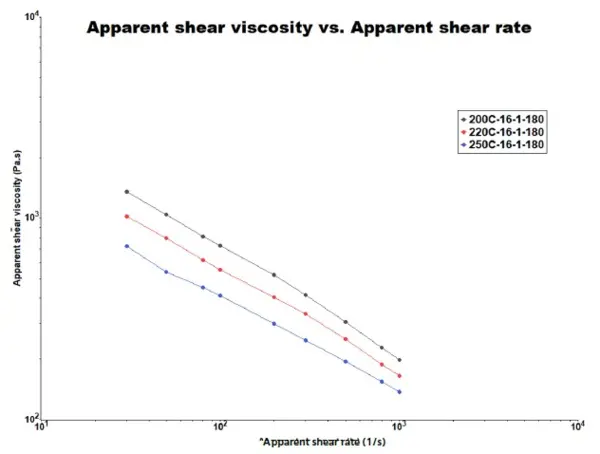
Figure 3 shows photographs of the surface morphology of PE melts extruded through a capillary die at different temperatures and shear rates. As can be observed from the figure, at relatively low shear rates (not exceeding 300 s-¹), the surfaces of the PE extrudates remain relatively smooth. However, as the shear rate increases, irregular fluctuations begin to appear on the surface of the extrudates. Specifically at 200°C, melt fracture occurs in the PE extrudate at a shear rate of 300 s-¹. When the temperature is increased to 220°C, the critical apparent shear rate for the onset of melt fracture rises to 500 s-¹. A further increase in temperature to 250°C delays the melt fracture until an apparent shear rate of 800 s-¹ is reached.
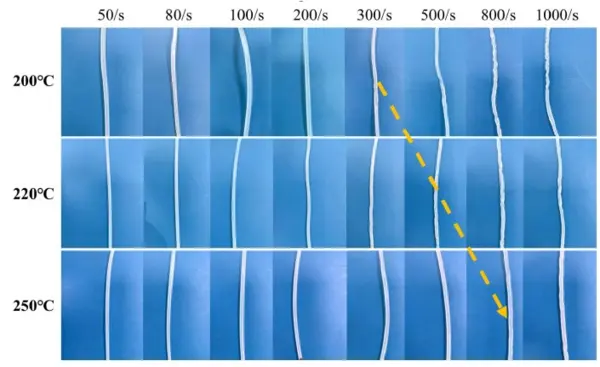
This behavior can be attributed to the enhanced thermal motion of molecular chains at higher temperatures, which counteracts the orienting and disentangling effects imposed by external shear forces. As temperature increases, the intensified motion of the molecular chains raises the critical shear rate required for melt fracture to occur. Therefore, provided that sufficient melt strength is maintained, increasing the processing temperature during extrusion can effectively improve the surface quality of PE products.
Influence of the Die Entrance Angle on the Melt Fracture Phenomon of PE Products
Figure 4 presents the surface morphology of PE melts extruded through capillary dies with different entrance angles at 220°C with various shear rates. As shown in the figure, the extrudate surfaces remain relatively smooth at low apparent shear rates (not exceeding 500 s-1). However, as the shear rate increases, irregular fluctuations begin to appear on the surface. Specifically, when the die entrance angle is 180°, melt fracture occurs at an apparent shear rate of 500 s-1.
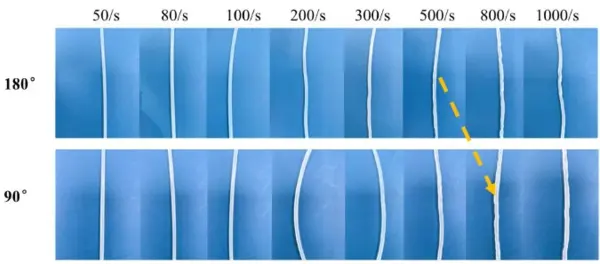
In contrast, when a die with an entrance angle of 90° is used, the critical apparent shear rate for the onset of melt fracture increases to 800 s-¹. This phenomenon can be attributed to the abrupt contraction of melt streamlines as the polymer flows from the barrel into a die with a smaller entrance angle, introducing a significant elongational flow component. Under high-speed elongation, PE molecular chains become highly oriented, leading to enhanced elastic recovery after exiting the die. This results in increased die swell. Simultaneously, the concentration of tensile stresses may easily initiate melt fracture. Therefore, reducing the die entrance angle can contribute to obtain smoother PE products.
Influence of the Die Length-to-Diameter Ration on the Melt Fracture Phenomon of PE Contribute to Obtaining Smoother PE Products
Figure 5 shows photographs of the surface morphology of PE melts extruded through capillary dies with different length-to-diameter (L/D) ratios with various apparent shear rates. As can be observed, at relatively low apparent shear rates (not exceeding 300 s-1), the surfaces of the PE extrudates remain smooth. However, as the shear rate increases, irregular fluctuations begin to appear. Specifically, when the L/D ratio is 8:1, melt fracture occurs at an apparent shear rate of 300 s-1. In contrast, when L/D ratios of 16:1 or 32:1 are used, the critical shear rate for the onset of melt fracture increases to 500 s-1.
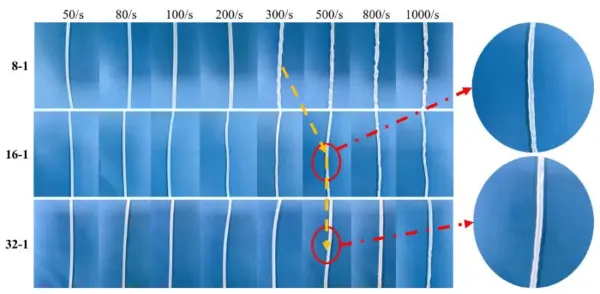
However, when examining the magnified images of the extrudate morphology at a shear rate of 500 s-1, it can be seen that the surface of the extrudate produced with an L/D ratio of 32:1 is smoother than that produced with a ratio of 16:1. This behavior is attributed to the fact that a smaller die L/D ratio results in a shorter RelaxationWhen a constant strain is applied to a rubber compound, the force necessary to maintain that strain is not constant but decreases with time; this behavior is known as stress relaxation. The process responsible for stress relaxation can be physical or chemical, and under normal conditions, both will occur at the same time. relaxation time for PE molecular chains within the capillary. As a consequence, the elastic energy stored during flow cannot be fully released, making the melt more prone to fracture. Therefore, adjusting the die L/D ratio can also be an effective method of improving the surface quality of PE products.
Conclusion
In this work, the morphological changes of polyethylene (PE) extrudates with various shear rates at different temperatures, die entrance angles, and die length-to-diameter ratios were investigated using a NETZSCH Rosand RH10 capillary rheometer. Below a certain critical shear rate threshold, the extrudates exhibited smooth surfaces. When the shear rate exceeded this critical value, the surface of the PE extrudates became rough and melt fracture occurred. It was observed that increasing the processing temperature, reducing the die entrance angle, and using a larger die length-to-diameter ratio all contributed to suppressing the melt fracture phenomenon. Furthermore, since the surface morphology of the PE extrudates was only examined with discrete shear rate values, a more detailed investigation using the Melt Fracture Test mode is recommended to accurately determine the critical shear rate for the onset of melt fracture.