Introduction
Recycled polyolefin blends consisting mainly of polyethylene and polypropylene are important feedstocks in mechanical plastics recycling. They are used for reprocessing into new molded parts, extrusion products, films, packaging-related components and technical plastic applications where the composition of the recyclate strongly influences processing behavior and the performance of the final material. Since PE and PP have different melting ranges, Crystallinity / Degree of CrystallinityCrystallinity refers to the degree of structural order of a solid. In a crystal, the arrangement of atoms or molecules is consistent and repetitive. Many materials such as glass ceramics and some polymers can be prepared in such a way as to produce a mixture of crystalline and amorphous regions.crystallinity, processing windows and Thermal StabilityA material is thermally stable if it does not decompose under the influence of temperature. One way to determine the thermal stability of a substance is to use a TGA (thermogravimetric analyzer). thermal stability, the thermal characterization of such blends is essential for assessing material identity, recyclate quality and suitability for further processing.
Simultaneous thermogravimetry and differential scanning calorimetry provide information on both mass loss and thermal transitions in one measurement, making the technique especially useful for complex recycled polymer mixtures.
Measurement Conditions
Table 1: Measurement conditions
| Instrument | STA Jupiter® |
|---|---|
| Temperature range | 30°C to 600°C |
| Heating rate | 20 K/min |
| Atmosphere | Nitrogen |
| Gas flow rate | 70 ml/min |
| Sample mass | 13.9 mg |
| Crucible | 85 µl Pt/Rh with pierced lid |
Results and Discussion
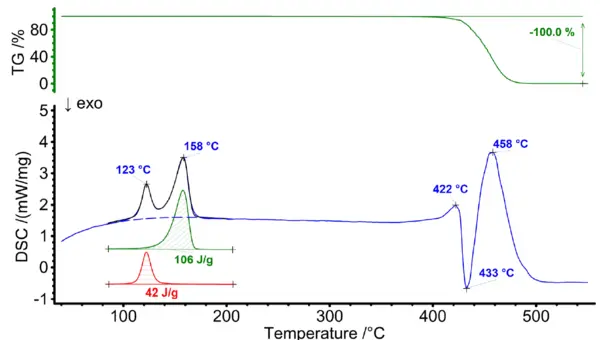
The simultaneous TGA-DSC measurement on the recycled PE-PP blend (Figure 1) shows several characteristic thermal effects. In the lower temperature range, two superimposed EndothermicA sample transition or a reaction is endothermic if heat is needed for the conversion.endothermic melting effects are visible in the DSC signal. The first melting contribution appears at approximately 123°C and can be assigned to the polyethylene fraction, while the second melting contribution at approximately 158°C is characteristic of polypropylene. Because recycled polymer streams often contain partially overlapping material fractions, additives or polymer grades with broad melting behavior, these signals are not completely isolated in the raw DSC curve.
The use of the NETZSCH Peak Separation software is therefore advantageous. It allows the overlapping melting effects to be mathematically separated and individually evaluated. In this measurement, the separated peak areas provide individual melting enthalpies of approximately 42 J/g for the PE-related contribution and 106 J/g for the PP-related contribution. This improves the interpretation of the blend composition and makes it easier to compare different recyclate batches or to monitor changes in material quality. Without Peak Separation, the overlapping EndothermicA sample transition or a reaction is endothermic if heat is needed for the conversion.endothermic effects would only be available as a combined thermal response, reducing the precision of component-specific evaluation.
At higher temperatures, the DSC curve shows additional thermal effects in the region above 400°C, while the TGA curve records the corresponding mass loss caused by pyrolytic Decomposition reactionA decomposition reaction is a thermally induced reaction of a chemical compound forming solid and/or gaseous products. decomposition of the polymer blend under nitrogen. The main Decomposition reactionA decomposition reaction is a thermally induced reaction of a chemical compound forming solid and/or gaseous products. decomposition occurs above approximately 400°C and results in a complete mass loss. The simultaneous acquisition of both signals also improves confidence in the interpretation of complex recyclates. The melting peaks occur while the TGA signal remains stable, confirming that these effects are Phase TransitionsThe term phase transition (or phase change) is most commonly used to describe transitions between the solid, liquid and gaseous states.phase transitions rather than degradation processes. In contrast, the high-temperature DSC effects fit with the TGA mass loss and can therefore be associated with Decomposition reactionA decomposition reaction is a thermally induced reaction of a chemical compound forming solid and/or gaseous products. decomposition. This combined information is valuable for recyclers and material processors because it provides insight into both polymer identification and Thermal StabilityA material is thermally stable if it does not decompose under the influence of temperature. One way to determine the thermal stability of a substance is to use a TGA (thermogravimetric analyzer). thermal stability within a single experiment without the influence of sample preparation or different measurement conditions.
Summary
The simultaneous TGA-DSC analysis provides a compact and informative characterization of a recycled PE-PP blend. The NETZSCH Peak Separation software enhances the evaluation by resolving overlapping melting peaks and enabling a more specific assessment of the individual polymer contributions. This makes the method well suited for quality control, material identification and process-relevant characterization of recycled polyolefin blends.