Introduction
Neodymium iron boron (dFeB) magnets are among the most powerful permanent magnets and are widely used in electric motors, generators, sensors, actuators, and advanced components for the automotive, energy, and electronics sectors [1]. Their performance is closely tied to their Thermal StabilityA material is thermally stable if it does not decompose under the influence of temperature. One way to determine the thermal stability of a substance is to use a TGA (thermogravimetric analyzer). thermal stability and to phase transformations occurring at elevated temperatures, which makes reliable thermal characterization essential for material development, quality assurance, and process optimization.
A major advantage of simultaneous thermal analysis (STA) is that it combines thermogravimetry (TGA) and differential scanning calorimetry (DSC) in a single experiment under identical conditions. This allows mass changes and thermal effects to be evaluated directly against each other, which is especially valuable for complex materials such as NdFeB magnet powders. In practice, this means that processes related to melting, Phase TransitionsThe term phase transition (or phase change) is most commonly used to describe transitions between the solid, liquid and gaseous states.phase transitions, Decomposition reactionA decomposition reaction is a thermally induced reaction of a chemical compound forming solid and/or gaseous products. decomposition phenomena, and OxidationOxidation can describe different processes in the context of thermal analysis.oxidation-related effects can be distinguished more confidently. For industrial users, this translates into faster and more reliable material assessment, fewer uncertainties in data interpretation, and a stronger basis for application-specific qualification.
Experimental
The NdFeB sample was analyzed using a NETZSCH STA Jupiter® Series instrument. Measurements were baseline-corrected and calibrated for temperature and heat flow. The measurement parameters are listed in table 1.
Table 1: Measurement parameter of the STA measurement
| Sample mass: | ~ 15 mg |
| Crucible: | Pt/Rh, 85 µl withAl2O3 liner and pierced lid |
| Sample carrier: | TG-DSCSpecific Heat Capacity (cp)Heat capacity is a material-specific physical quantity, determined by the amount of heat supplied to specimen, divided by the resulting temperature increase. The specific heat capacity is related to a unit mass of the specimen.cp, type S |
| Temperature program: | RT to 1500°C, 20 K/min |
| Atmosphere: | Argon, 70 ml/min |
Results and Discussion
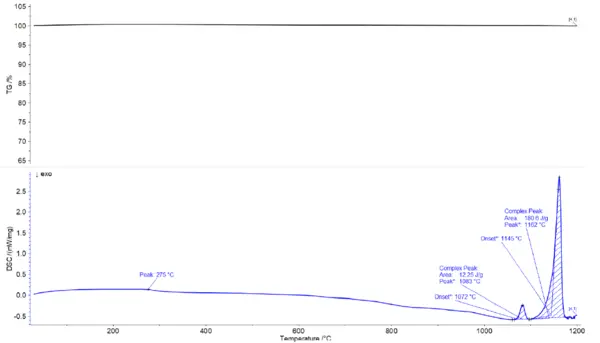
The result of the TGA-DSC measurement is shown in Figure 1. The NdFeB sample mass remains constant over the investigated temperature range, indicating that there is no relevant mass loss under argon. This is an important result because it demonstrates that the thermal events observed in the DSC signal are not associated with measurable material degradation but instead reflect intrinsic changes within the sample.
At higher temperatures, the DSC curve exhibits two endothermal effects. The first appears as a relatively small peak with an onset at 1072°C, a peak maximum at 1083°C, and a reaction enthalpy of 12.25 J/g. A second, larger peak starts at 1145°C and reaches its maximum at 1162°C, with a reaction enthalpy of 180.6 J/g.
The STA results indicate that the smaller thermal effect is most likely associated with an early transformation of a minor constituent or a low-melting secondary phase. In contrast, the larger peak suggests a major high-temperature transformation, potentially related to the melting or partial melting of phases within the NdFeB system. This behavior is consistent with the multiphase microstructure of technical NdFeB magnets, which typically contain the hard magneticNd2Fe14Bphase, Nd-rich intergranular phases, and additional secondary constituents depending on the composition of the alloy and its processing history [2].
Since these effects are not accompanied by a detectable mass loss, the data supports the interpretation that they are phase-related thermal events rather than Decomposition reactionA decomposition reaction is a thermally induced reaction of a chemical compound forming solid and/or gaseous products. decomposition reactions. At the same time, a precise phase assignment cannot be made from STA data alone. For a definitive identification of the underlying transformations, complementary techniques such as high-temperature X-ray diffraction, metallographic analysis after defined heat treatment, or correlation with alloy-specific phase diagram data are recommended.
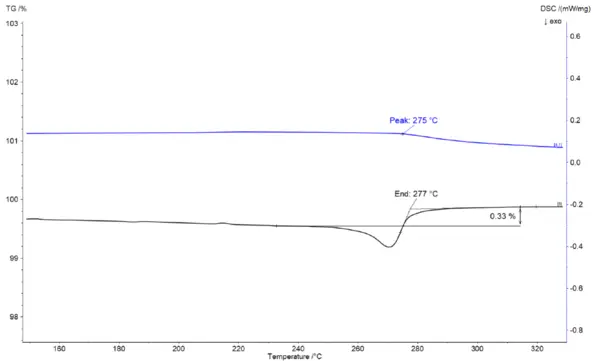
The faint EndothermicA sample transition or a reaction is endothermic if heat is needed for the conversion.endothermic effect at 275°C can be attributed to the Curie transition. Although the signal is weak, this effect can still be resolved by DSC. In addition, an external magnetic field accessory can be attached to the STA for verification; the ferromagnetic to paramagnetic transition will be detected in the form of an apparent mass change signal (see Figure 2).
Summary
For the thermal characterization of NdFeB magnet powders, the NETZSCH STA Jupiter® Series offers clear analytical advantages: it enables the simultaneous detection of possible mass changes and thermal effects in one measurement, allowing users to distinguish between degradation processes and true phase transformations with high confidence. This makes the system particularly valuable for materials development, batch comparison, quality control, failure analysis, and optimization of thermal processing conditions.
Additionally, the Curie transition can be detected in both the DSC and TGA signals using external magnets. These magnets are not included in the standard package, but are available to purchase as optional accessories.
The STA Jupiter® Series helps customers generate reliable, application-relevant thermal data faster and with greater interpretive certainty, supporting better material decisions and more robust process design for advanced NdFeB magnet powder applications.