Introduction
Gallium (Ga)-based liquid metals are emerging as key materials in the field of high-power electronic cooling due to their exceptional Electrical Conductivity (SBA)Electrical conductivity is a physical property indicating a material's ability to allow the transport of an electric charge.electrical conductivity, Thermal ConductivityThermal conductivity (λ with the unit W/(m•K)) describes the transport of energy – in the form of heat – through a body of mass as the result of a temperature gradient (see fig. 1). According to the second law of thermodynamics, heat always flows in the direction of the lower temperature.thermal conductivity, and flow properties. In thermal management, Ga and Ga-indium (In) alloys can serve as thermal interface materials, filling the gaps between chips and heat sinks to efficiently dissipate heat generated by core components such as CPUs and GPUs. This significantly reduces operating temperatures and ensures stable device operation. Their thermal dissipation efficiency far exceeds that of thermal grease and thermal pads. Furthermore, Ga and Ga-based alloys possess an extremely wide liquid temperature range (from sub-zero temperatures to over 2000°C) and a Thermal ConductivityThermal conductivity (λ with the unit W/(m•K)) describes the transport of energy – in the form of heat – through a body of mass as the result of a temperature gradient (see fig. 1). According to the second law of thermodynamics, heat always flows in the direction of the lower temperature.thermal conductivity far superior to that of water, making them highly promising convective cooling media for high-power-DensityThe mass density is defined as the ratio between mass and volume. density chips, aerospace applications, and other fields.
Accurate testing of the Thermal ConductivityThermal conductivity (λ with the unit W/(m•K)) describes the transport of energy – in the form of heat – through a body of mass as the result of a temperature gradient (see fig. 1). According to the second law of thermodynamics, heat always flows in the direction of the lower temperature.thermal conductivity of Ga and Ga-In alloys is essential to ensure their safe and efficient operation in critical thermal management applications. Laser/Light Flash Analysis (LFA) not only measures the Thermal ConductivityThermal conductivity (λ with the unit W/(m•K)) describes the transport of energy – in the form of heat – through a body of mass as the result of a temperature gradient (see fig. 1). According to the second law of thermodynamics, heat always flows in the direction of the lower temperature.thermal conductivity of conventional solid samples and – when using appropriate sample holders and selecting suitable calculation models – can also measure the Thermal DiffusivityThermal diffusivity (a with the unit mm2/s) is a material-specific property for characterizing unsteady heat conduction. This value describes how quickly a material reacts to a change in temperature.thermal diffusivity of special samples such as liquids, pastes, and powders, and thereby calculate their Thermal ConductivityThermal conductivity (λ with the unit W/(m•K)) describes the transport of energy – in the form of heat – through a body of mass as the result of a temperature gradient (see fig. 1). According to the second law of thermodynamics, heat always flows in the direction of the lower temperature.thermal conductivity. This Application Note focuses on the method used by the NETZSCH LFA 717 HyperFlash® to determine the thermal conductivity of pure Ga and Ga-In alloy samples using a PEEK liquid sample holder.
Table 1: Measurement conditions
| Sample | Pure Ga GaIn (Ga75In25) GaInSn (Ga68,5In21,5Sn10) |
| Temperature | 30°C, 60°C, 90°C, 120°C |
| Sample holder | PEEK sample holder for liquids |
| Specific Heat Capacity (cp)Heat capacity is a material-specific physical quantity, determined by the amount of heat supplied to specimen, divided by the resulting temperature increase. The specific heat capacity is related to a unit mass of the specimen.Specific heat capacity | DSC 300 Caliris® Select |
| Atmosphere | N2 |
| Model | 3 layers + pulse correction |
Measurement Results
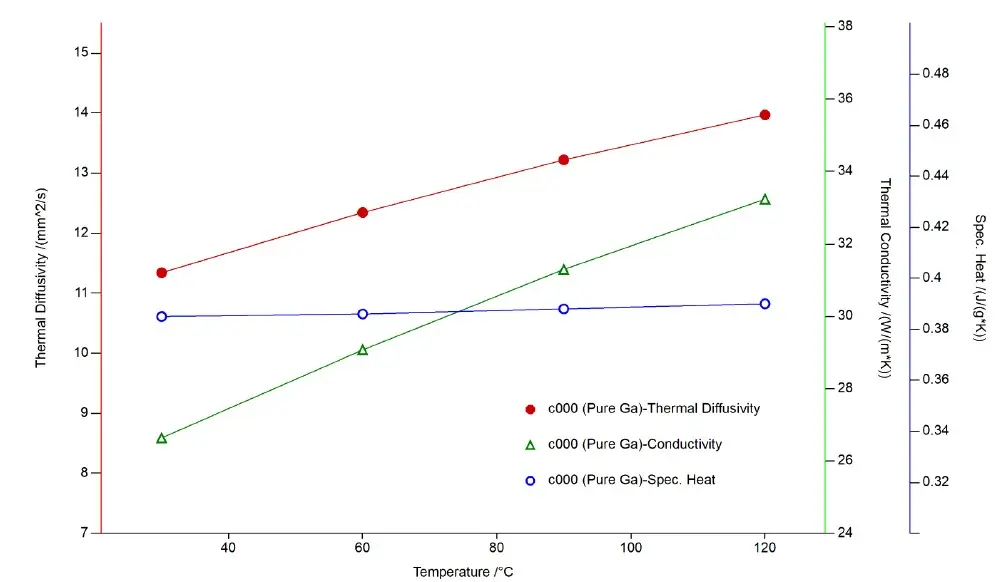
Figure 1 shows the results for the Thermal DiffusivityThermal diffusivity (a with the unit mm2/s) is a material-specific property for characterizing unsteady heat conduction. This value describes how quickly a material reacts to a change in temperature.thermal diffusivity, Specific Heat Capacity (cp)Heat capacity is a material-specific physical quantity, determined by the amount of heat supplied to specimen, divided by the resulting temperature increase. The specific heat capacity is related to a unit mass of the specimen.specific heat capacity (Specific Heat Capacity (cp)Heat capacity is a material-specific physical quantity, determined by the amount of heat supplied to specimen, divided by the resulting temperature increase. The specific heat capacity is related to a unit mass of the specimen.cp), and thermal conductivity of a pure Ga sample, measured over a temperature range of 30°C to 120°C. At 30°C, the sample’s Thermal DiffusivityThermal diffusivity (a with the unit mm2/s) is a material-specific property for characterizing unsteady heat conduction. This value describes how quickly a material reacts to a change in temperature.thermal diffusivity and thermal conductivity amounted to 11.4 mm²/s and 26.6 W/(m·K), respectively, which is consistent with values reported in the literature [1]. Both the Thermal DiffusivityThermal diffusivity (a with the unit mm2/s) is a material-specific property for characterizing unsteady heat conduction. This value describes how quickly a material reacts to a change in temperature.thermal diffusivity and thermal conductivity increase with rising temperature. The Specific Heat Capacity (cp)Heat capacity is a material-specific physical quantity, determined by the amount of heat supplied to specimen, divided by the resulting temperature increase. The specific heat capacity is related to a unit mass of the specimen.specific heat capacity (Specific Heat Capacity (cp)Heat capacity is a material-specific physical quantity, determined by the amount of heat supplied to specimen, divided by the resulting temperature increase. The specific heat capacity is related to a unit mass of the specimen.cp) was measured using a NETZSCH DSC 300 Caliris® Select . It should be noted that, due to the aggressive reaction between Ga and aluminum (Al), a platinum (Pt) crucible lined with Al₂O₃ was used for the measurement.
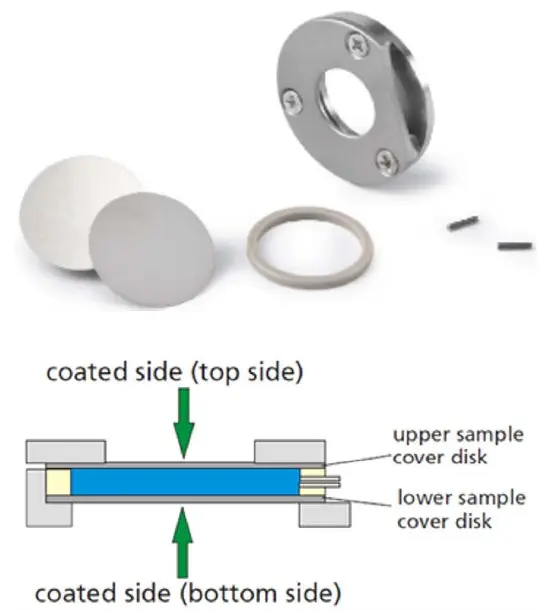
The PEEK liquid sample holder is based on a three-layer model. After assembly, liquid samples can be loaded into the container – composed of upper and lower stainless-steel disks and a PEEK ring – via injection, droplet addition, or smearing (see Figure 2). This special sample holder can be used to test samples such as liquids, liquid metals, and pastes.
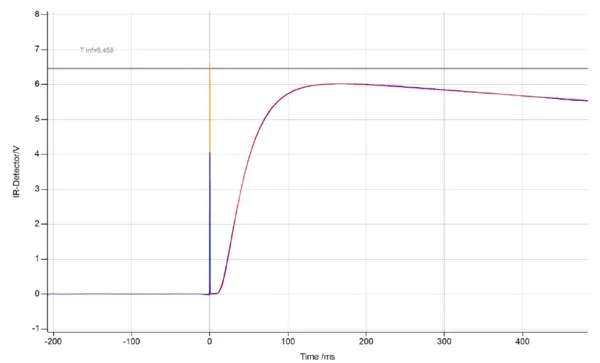
When using this holder, a three-layer model is employed to calculate the Thermal DiffusivityThermal diffusivity (a with the unit mm2/s) is a material-specific property for characterizing unsteady heat conduction. This value describes how quickly a material reacts to a change in temperature.thermal diffusivity. Figure 3 shows the temperature rise curve of the pure Ga sample at 30°C. It can be seen that the measured curve (blue) matches the model-fitted curve (red) very well, further demonstrating the validity and accuracy of the test results obtained using the PEEK sample holder for liquids.
The Melting Temperatures and EnthalpiesThe enthalpy of fusion of a substance, also known as latent heat, is a measure of the energy input, typically heat, which is necessary to convert a substance from solid to liquid state. The melting point of a substance is the temperature at which it changes state from solid (crystalline) to liquid (isotropic melt).melting point of pure Ga is approximately 29.8°C. It remains in a solid state under typical room temperature conditions and cannot be used directly as a liquid thermal interface material or a flowing working fluid. Adding elements such as In and tin (Sn) to Ga forms eutectic alloys that significantly lower the Melting Temperatures and EnthalpiesThe enthalpy of fusion of a substance, also known as latent heat, is a measure of the energy input, typically heat, which is necessary to convert a substance from solid to liquid state. The melting point of a substance is the temperature at which it changes state from solid (crystalline) to liquid (isotropic melt).melting point. For example, the commercial Ga-In-Sn alloy Galinstan has a Melting Temperatures and EnthalpiesThe enthalpy of fusion of a substance, also known as latent heat, is a measure of the energy input, typically heat, which is necessary to convert a substance from solid to liquid state. The melting point of a substance is the temperature at which it changes state from solid (crystalline) to liquid (isotropic melt).melting point as low as -19°C. This means it remains liquid under most natural environmental conditions, greatly expanding its range of applications.
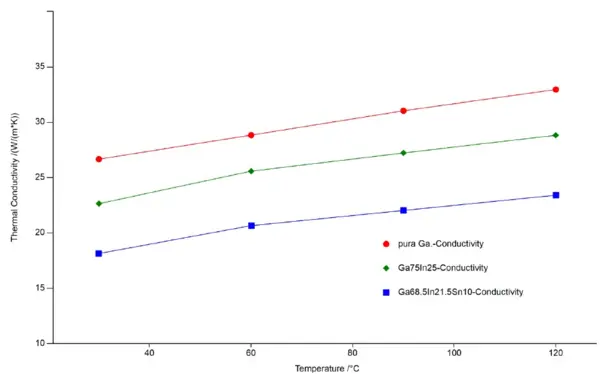
Figure 4 shows the thermal conductivity results for pure Ga and the GaIn (Ga75In25) and GaInSn (Ga68.5In21.5Sn10) alloys, tested using the PEEK liquid sample holder from 30°C to 120°C. It is evident that alloying Ga with In and Sn leads to a decrease in thermal conductivity. The addition of In and Sn introduces extra free-electron scattering centers in liquid Ga, shortening the electron’s mean free path and lowering the thermal conductivity as heat transport in gallium liquid metals is dominated by free electrons [2]. An alloy composition (including In and Sn contents) significantly affects thermal conductivity, and accurate measurement of thermal conductivity provides a basis for the screening and formulation optimization of gallium-based liquid metals.
Summary
Liquid metals based on gallium can flow like water while possessing excellent thermal conductivity and stability, demonstrating extraordinary potential in the field of heat dissipation. The NETZSCH LFA 717 HyperFlash® , paired with the special PEEK sample holder for liquids and using a dedicated three-layer calculation model, can accurately measure the thermal conductivity of gallium-based liquid metals. This is very important for accurately evaluating the heat dissipation capability of liquid metals and further providing efficient and reliable thermal management solutions.