Introduction
Neodymium alloys are key materials for modern highperformance applications. In particular, they are used as a basis for high-performance permanent magnets in electric motors, generators, wind turbines, sensors and hard drives. Along with the magnetic properties, the thermophysical characteristics of neodymium alloys also play a decisive role. At high power densities and rising operating temperatures, the Thermal DiffusivityThermal diffusivity (a with the unit mm2/s) is a material-specific property for characterizing unsteady heat conduction. This value describes how quickly a material reacts to a change in temperature.thermal diffusivity, Specific Heat Capacity (cp)Heat capacity is a material-specific physical quantity, determined by the amount of heat supplied to specimen, divided by the resulting temperature increase. The specific heat capacity is related to a unit mass of the specimen.specific heat capacity and Thermal ConductivityThermal conductivity (λ with the unit W/(m•K)) describes the transport of energy – in the form of heat – through a body of mass as the result of a temperature gradient (see fig. 1). According to the second law of thermodynamics, heat always flows in the direction of the lower temperature.thermal conductivity have significant influence on the thermal behaviour of a material. These properties are essential for efficient thermal management, avoiding local overheating and ensuring longterm material and functional stability.
Knowledge of Thermal DiffusivityThermal diffusivity (a with the unit mm2/s) is a material-specific property for characterizing unsteady heat conduction. This value describes how quickly a material reacts to a change in temperature.thermal diffusivity is of particular importance here, as it describes how quickly a temperature change propagates within the material. In combination with the DensityThe mass density is defined as the ratio between mass and volume. density and Specific Heat Capacity (cp)Heat capacity is a material-specific physical quantity, determined by the amount of heat supplied to specimen, divided by the resulting temperature increase. The specific heat capacity is related to a unit mass of the specimen.specific heat capacity, the Thermal ConductivityThermal conductivity (λ with the unit W/(m•K)) describes the transport of energy – in the form of heat – through a body of mass as the result of a temperature gradient (see fig. 1). According to the second law of thermodynamics, heat always flows in the direction of the lower temperature.thermal conductivity can be determined from this – a central parameter for designing thermally loaded components.
Method and Measurement Conditions
The thermophysical properties of the neodymium alloy were determined with the LFA 717 HyperFlash® HT. Laser flash analysis is one of the most well-established methods for measuring Thermal ConductivityThermal conductivity (λ with the unit W/(m•K)) describes the transport of energy – in the form of heat – through a body of mass as the result of a temperature gradient (see fig. 1). According to the second law of thermodynamics, heat always flows in the direction of the lower temperature.thermal conductivity, is characterized by high precision and short measurement times. During the measurement, the front surface of the sample is excited by a short energy pulse, and the resulting temperature increase on the back surface is recorded without being in contact with an infrared detector. Based on a mathematical curve fit, the Thermal DiffusivityThermal diffusivity (a with the unit mm2/s) is a material-specific property for characterizing unsteady heat conduction. This value describes how quickly a material reacts to a change in temperature.thermal diffusivity is determined from the measured signal.
In addition to the Thermal DiffusivityThermal diffusivity (a with the unit mm2/s) is a material-specific property for characterizing unsteady heat conduction. This value describes how quickly a material reacts to a change in temperature.thermal diffusivity, the Specific Heat Capacity (cp)Heat capacity is a material-specific physical quantity, determined by the amount of heat supplied to specimen, divided by the resulting temperature increase. The specific heat capacity is related to a unit mass of the specimen.specific heat capacity was also determined by LFA according to the comparison method. For this purpose, a copper reference with known thermophysical properties was used. On the basis of the Thermal DiffusivityThermal diffusivity (a with the unit mm2/s) is a material-specific property for characterizing unsteady heat conduction. This value describes how quickly a material reacts to a change in temperature.thermal diffusivity, Specific Heat Capacity (cp)Heat capacity is a material-specific physical quantity, determined by the amount of heat supplied to specimen, divided by the resulting temperature increase. The specific heat capacity is related to a unit mass of the specimen.specific heat capacity and DensityThe mass density is defined as the ratio between mass and volume. density, the Thermal ConductivityThermal conductivity (λ with the unit W/(m•K)) describes the transport of energy – in the form of heat – through a body of mass as the result of a temperature gradient (see fig. 1). According to the second law of thermodynamics, heat always flows in the direction of the lower temperature.thermal conductivity was then calculated. The exact measurement conditions can be found in Table 1.
Table 1: Measurement conditions
| Material | Neodym alloy |
| Sample carrier | Ø 8 mm , SiC |
| Temperature program | RT to 800°C; 50 K intervals |
| Sample dimensions | Ø 8 mm , thickness: 2.8 mm |
| Coating | Graphite |
| Reference forSpecific Heat Capacity (cp)Heat capacity is a material-specific physical quantity, determined by the amount of heat supplied to specimen, divided by the resulting temperature increase. The specific heat capacity is related to a unit mass of the specimen.cp | Pure Cu |
| Atmosphere | Argon |
| Heating rate | 10 K/min |
| Pulse energy | 250 V / 600 μs |
Results and Discussion
Figure 1 shows the Thermal DiffusivityThermal diffusivity (a with the unit mm2/s) is a material-specific property for characterizing unsteady heat conduction. This value describes how quickly a material reacts to a change in temperature.thermal diffusivity, Specific Heat Capacity (cp)Heat capacity is a material-specific physical quantity, determined by the amount of heat supplied to specimen, divided by the resulting temperature increase. The specific heat capacity is related to a unit mass of the specimen.specific heat capacity and Thermal ConductivityThermal conductivity (λ with the unit W/(m•K)) describes the transport of energy – in the form of heat – through a body of mass as the result of a temperature gradient (see fig. 1). According to the second law of thermodynamics, heat always flows in the direction of the lower temperature.thermal conductivity of the investigated neodymium alloy from RT to 800°C. As the temperature rises, all thermophysical characteristics tend to increase. In the range of about 300°C to 350°C, however, the Specific Heat Capacity (cp)Heat capacity is a material-specific physical quantity, determined by the amount of heat supplied to specimen, divided by the resulting temperature increase. The specific heat capacity is related to a unit mass of the specimen.specific heat capacity shows a clear maximum, while the Thermal DiffusivityThermal diffusivity (a with the unit mm2/s) is a material-specific property for characterizing unsteady heat conduction. This value describes how quickly a material reacts to a change in temperature.thermal diffusivity forms a local minimum at the same time. This correlated behaviour indicates a transition that is related to the Curie transformation of the alloy.
Both properties are sensitive to structural or magnetic changes in the material and allow for clear identification of the relevant temperature range.
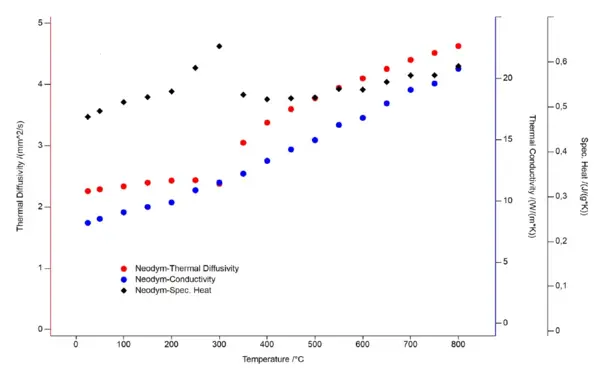
The calculated Thermal ConductivityThermal conductivity (λ with the unit W/(m•K)) describes the transport of energy – in the form of heat – through a body of mass as the result of a temperature gradient (see fig. 1). According to the second law of thermodynamics, heat always flows in the direction of the lower temperature.thermal conductivity, however, does not show a pronounced transition peak, but increases almost continuously over the entire measuring range. This behaviour is due to the fact that the opposing effects of the increased Specific Heat Capacity (cp)Heat capacity is a material-specific physical quantity, determined by the amount of heat supplied to specimen, divided by the resulting temperature increase. The specific heat capacity is related to a unit mass of the specimen.specific heat capacity and the reduced Thermal DiffusivityThermal diffusivity (a with the unit mm2/s) is a material-specific property for characterizing unsteady heat conduction. This value describes how quickly a material reacts to a change in temperature.thermal diffusivity largely compensate for each other in calculating the Thermal ConductivityThermal conductivity (λ with the unit W/(m•K)) describes the transport of energy – in the form of heat – through a body of mass as the result of a temperature gradient (see fig. 1). According to the second law of thermodynamics, heat always flows in the direction of the lower temperature.thermal conductivity. The influence of the transition is therefore much less pronounced in the Thermal ConductivityThermal conductivity (λ with the unit W/(m•K)) describes the transport of energy – in the form of heat – through a body of mass as the result of a temperature gradient (see fig. 1). According to the second law of thermodynamics, heat always flows in the direction of the lower temperature.thermal conductivity than in the directly measured individual parameters.
The results show that the combined determination of the Thermal DiffusivityThermal diffusivity (a with the unit mm2/s) is a material-specific property for characterizing unsteady heat conduction. This value describes how quickly a material reacts to a change in temperature.thermal diffusivity and Specific Heat Capacity (cp)Heat capacity is a material-specific physical quantity, determined by the amount of heat supplied to specimen, divided by the resulting temperature increase. The specific heat capacity is related to a unit mass of the specimen.specific heat capacity using LFA, the thermophysical behaviour of materials can be assessed more accurately. In particular, temperature-dependent anomalies, such as those that can occur close to the Curie transformation, can be reliably detected and interpreted on the basis of the individual parameters.
Summary
The LFA 717 HyperFlash® HT enables precise characterization of the thermal properties at high temperatures, especially through the non-contact laser flash method for determining Thermal DiffusivityThermal diffusivity (a with the unit mm2/s) is a material-specific property for characterizing unsteady heat conduction. This value describes how quickly a material reacts to a change in temperature.thermal diffusivity. In combination with reference samples and DensityThe mass density is defined as the ratio between mass and volume. Density Determination, the Specific Heat Capacity (cp)Heat capacity is a material-specific physical quantity, determined by the amount of heat supplied to specimen, divided by the resulting temperature increase. The specific heat capacity is related to a unit mass of the specimen.specific heat capacity and Thermal ConductivityThermal conductivity (λ with the unit W/(m•K)) describes the transport of energy – in the form of heat – through a body of mass as the result of a temperature gradient (see fig. 1). According to the second law of thermodynamics, heat always flows in the direction of the lower temperature.thermal conductivity can also be reliably determined.