Introduction
Lactose monohydrate is one of the most widely used excipients in the pharmaceutical industry. Thanks to its good availability, favourable processing properties, compressibility, and flowability, it is commonly used as a filler or diluent in tablets and capsules. To ensure consistent product quality, it is essential to reliably detect any possible changes to the material during storage and processing.
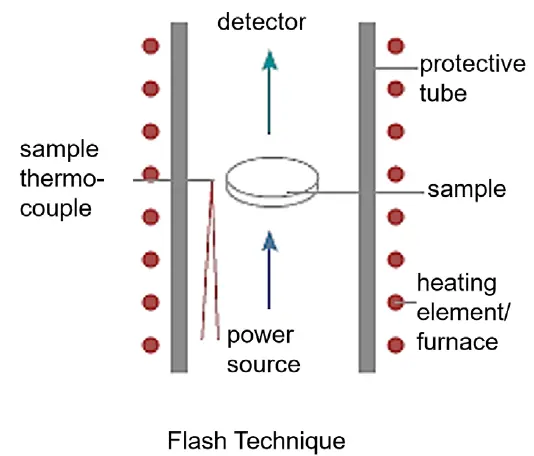
Storage, moisture uptake, or structural changes can influence the physical properties of powdered pharmaceutical raw materials. In addition to established methods for thermal characterization, Light Flash Analysis (LFA, schematic in Figure 1) is a fast, contact-free, and non-destructive technique for determining the Thermal DiffusivityThermal diffusivity (a with the unit mm2/s) is a material-specific property for characterizing unsteady heat conduction. This value describes how quickly a material reacts to a change in temperature.thermal diffusivity of materials. In this method, the front surface of a plane-parallel sample is heated by a short energy pulse; the resulting temperature increase on the rear surface is recorded by an infrared detector and used to determine the Thermal DiffusivityThermal diffusivity (a with the unit mm2/s) is a material-specific property for characterizing unsteady heat conduction. This value describes how quickly a material reacts to a change in temperature.thermal diffusivity.
Making Storage Effects Visible: Fresh versus Expired Lactose
Two lactose monohydrate powders were investigated: a fresh sample and an expired sample. Both powders were pressed into pellets under identical conditions (at 20 kN for 20 min) in order to achieve comparable sample geometries and contact conditions. The aim of the study was to reveal possible differences in the Thermal DiffusivityThermal diffusivity (a with the unit mm2/s) is a material-specific property for characterizing unsteady heat conduction. This value describes how quickly a material reacts to a change in temperature.thermal diffusivity of the two materials in the low-temperature range from room temperature to 80°C.
Precise LFA Measurements with the LFA 717 HyperFlash®
The measurements were carried out using the LFA 717 HyperFlash®. This instrument is designed for highly accurate and rapid measurements of Thermal DiffusivityThermal diffusivity (a with the unit mm2/s) is a material-specific property for characterizing unsteady heat conduction. This value describes how quickly a material reacts to a change in temperature.thermal diffusivity on a wide range of materials and enables analyses under defined atmospheres. In this measurement series, the analysis was performed under an argon atmosphere on cylindrical pellets with a diameter of 12.6 mm and a height of 3 mm.
Clear Differences Reliably Detected
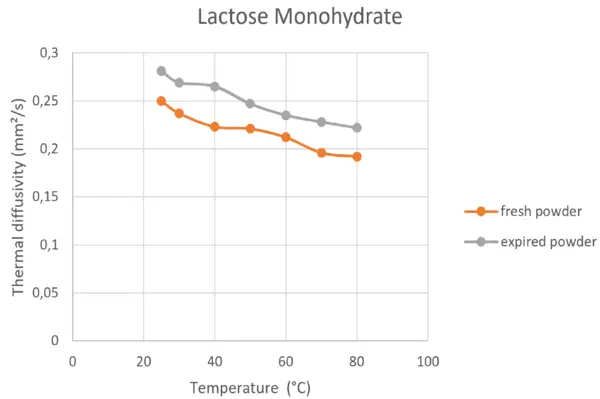
Figure 2 shows the Thermal DiffusivityThermal diffusivity (a with the unit mm2/s) is a material-specific property for characterizing unsteady heat conduction. This value describes how quickly a material reacts to a change in temperature.thermal diffusivity of both lactose monohydrate pellets as a function of temperature in the range from 25 °C to 80°C. For both samples, a decrease in thermal diffusivity with increasing temperature can be observed. This behavior corresponds to the typical trend found in many materials, where increasing phonon-phonon interactions at higher temperatures affect heat transport.
The fresh lactose sample exhibits lower values than the expired sample across the entire temperature range investigated. The deviation amounts to up to approximately 16%. This difference may be attributed to a higher proportion of amorphous components in the fresh sample. Amorphous regions can impede heat transport within the pellet more strongly than crystalline structures, resulting in lower thermal diffusivity.
LFA as a Valuable Tool for Assessing Pharmaceutical Quality
The study demonstrates that the LFA 717 HyperFlash® is sensitive to material-related differences between lactose monohydrate samples. Even in the moderate temperature range between 25°C and 80°C, clear differences in thermal diffusivity between fresh and expired lactose could be detected. Light Flash Analysis therefore represents a valuable method for characterizing pharmaceutical excipients and assessing storage-related changes.
Measurement Data at a Glance
| Parameter | Setting |
|---|---|
| Sample | Lactose monohydrate, fresh and expired |
| Instrument | LFA 717 HyperFlash® |
| Detector | MCT |
| Sample holder | Ø 12.7 mm, Standard |
| Atmosphere | Argon |
| Heating rate | 10 K/min |
| Temperature range | 25°C to 80°C |
| Sample dimensions | Ø 12.6 mm, Höhe 3 mm |
| Evaluation model | Standard |
| Sample preparation | Pressed at 20 kN for 20 min |
Conclusion
Thermal DiffusivityThermal diffusivity (a with the unit mm2/s) is a material-specific property for characterizing unsteady heat conduction. This value describes how quickly a material reacts to a change in temperature.Thermal diffusivity determines how quickly heat spreads within a lactose powder. It indirectly influences the stability of lactose as it determines the temperature profile and thus the thermal StressStress is defined as a level of force applied on a sample with a well-defined cross section. (Stress = force/area). Samples having a circular or rectangular cross section can be compressed or stretched. Elastic materials like rubber can be stretched up to 5 to 10 times their original length.stress on the powder. High thermal diffusivity results in faster and more uniform heating or cooling while low thermal diffusivity can lead to temperature gradients, causing different areas of the powder to be exposed to thermal StressStress is defined as a level of force applied on a sample with a well-defined cross section. (Stress = force/area). Samples having a circular or rectangular cross section can be compressed or stretched. Elastic materials like rubber can be stretched up to 5 to 10 times their original length.stress for varying lengths of time.
In addition to thermal diffusivity, temperature, exposure time and moisture content are also crucial factors affecting stability. At elevated temperatures and humidity, Maillard reactions*, discoloration and changes to the lactose crystal structure or crystal water content may occur.
*The Maillard reaction is a chemical reaction between reducing sugars and the amino groups of proteins or amino acids. It is primarily accelerated by higher temperatures and often by moisture too. Typical consequences include the formation of brown and yellowish pigments, as well as other possible reaction products, which can alter the product's properties.