Introduction
Coal is the main fuel used in cement production in China, and one of the key indicators of the consumption of raw fuel in cement production. Coal quality affects not only the yield and quality of cement clinker production, but also its costs as high-quality coal with a higher calorific value can enable higher process temperatures or reduce coal consumption at the same process temperature, thereby lowering fuel costs. Advanced testing means and strengthening the quality management of coal are the important parts to ensure the reduction of coal consumption and the improvement of the quality of cement products.
The combustion behavior of coal in the cement industry is complex. Traditional industrial analytical evaluation methods [1] are no longer applicable. One example is the AdiabaticAdiabatic describes a system or measurement mode without any heat exchange with the surroundings. This mode can be realized using a calorimeter device according to the method of accelerating rate calorimetry (ARC®). The main purpose of such a device is to study scenarios and thermal runaway reactions. A short description of the adiabatic mode is “no heat in – no heat out”.adiabatic calorimeter method where the coal is placed in an AdiabaticAdiabatic describes a system or measurement mode without any heat exchange with the surroundings. This mode can be realized using a calorimeter device according to the method of accelerating rate calorimetry (ARC®). The main purpose of such a device is to study scenarios and thermal runaway reactions. A short description of the adiabatic mode is “no heat in – no heat out”.adiabatic container, and its heat content is calculated by measuring the temperature change inside the container. While this method uses simple equipment, the measurement results are relatively inaccurate.
In this work, the material characterization of coal is carried out using a NETZSCH STA Jupiter® simultaneous thermal analyzer. Thermogravimetric (TGA) and differential scanning calorimetry (DSC) curves were used to determine key combustion parameters, including the ExothermicA sample transition or a reaction is exothermic if heat is generated.exothermic onset and end temperatures (Tonset, Tend), initial mass-loss temperature (Ti), maximum mass-loss rate (Vmax), total ExothermicA sample transition or a reaction is exothermic if heat is generated.exothermic heat (q), and average combustion rate (v). Based on these parameters, three evaluation indices,
- combustion intensity (I),
- average heat-release intensity (Q) and
- the combustion characteristic index (S)
were calculated. These indices provide a quantitative basis for assessing the performance of coal combustion. In the cement industry, coal with optimal combustion behavior is characterized by low combustion intensity (I), high average heat-release intensity (Q), and a high combustion characteristic index (S), reflecting a favorable balance between ignition behavior, heat output, and overall reactivity.
Measurement Method
For the experimental series, two coal specimens − coal A and coal B − were selected. Each specimen had a mass of approximately 10 mg. The applied temperature program extended from ambient temperature (RT) to 1000°C. Heating was conducted at a constant rate of 10 K/min under an air atmosphere. Table 1 shows all important parameters of the TGA and DSC curves along with the corresponding symbol, unit and definition.
Establishment of Evaluation Index Parameters
Using the basic parameters of the thermal analysis curve, the following three evaluation index parameters can be defined [2] (see table 1 for abbreviations).
a) Burning Intensity (I)
The burning intensity of coal indicates the intensity of the instantaneous heat release in the ExothermicA sample transition or a reaction is exothermic if heat is generated.exothermic process. It is defined as:
b) Average Heat Release Intensity (Q)
The average ExothermicA sample transition or a reaction is exothermic if heat is generated.exothermic intensity of coal expresses the amount of heat released per unit mass of coal per unit temperature during the period from the beginning to the end of the coal's ExothermicA sample transition or a reaction is exothermic if heat is generated.exothermic activity. It is defined as:
c) Combustion Characteristic Index (S)
The combustion characteristics of coal are a comprehensive index of coal, including the flammability of coal, the ignition point of coal, the burning intensity of coal and the burning time of coal. From these perspectives, combined with the corresponding literature [3-4], it can be
Table 1: Important parameters of the TGA and DSC curves with symbol, unit and definition.
| Parameter | Unit | Definition | |
|---|---|---|---|
Thermogravimetry (TGA) | |||
| Onset temperature of the mass loss | Ti | °C | The temperature at which the coal begins to lose weight (ignition temperature). |
| Burnout time | t98% | min | The time required to burn 98% of the fuel. |
| Burnout temperature | T98% | °C | The temperature corresponding to burning 98% of the fuel. |
| Average combustion rate | V | %/min | Total weight-loss percentage divided by the burnout time. |
Differential Thermogravimetry (DTG) | |||
| Maximum mass-loss rate | Vmax | %/min | The maximum mass-loss rate. |
Heat Flow (DSC) | |||
| Onset temperature of the ExothermicA sample transition or a reaction is exothermic if heat is generated.exothermal peak | Tonset | °C | Temperature of the coal at the beginning of the ExothermicA sample transition or a reaction is exothermic if heat is generated.exothermal effect |
| End temperature of the ExothermicA sample transition or a reaction is exothermic if heat is generated.exothermal peak | Tend | °C | Temperature at the end of the ExothermicA sample transition or a reaction is exothermic if heat is generated.exothermal effect |
| Area of the ExothermicA sample transition or a reaction is exothermic if heat is generated.exothermal peak | q | J/g | Exothermal capacity of coal |
| Peak height of the exotherm | H | Height of the ExothermicA sample transition or a reaction is exothermic if heat is generated.exothermal peak relative to the DSC baseline | |
| Half-peak width of the ExothermicA sample transition or a reaction is exothermic if heat is generated.exothermal peak (width) | W | min | Time corresponding to the peak width at half of the ExothermicA sample transition or a reaction is exothermic if heat is generated.exothermal peak height. |
Results and Discussion
The STA curves of coal A and coal B are shown in figures 1 and 2, respectively. As you can see, both samples show two mass-loss steps. The first up to 150°C which is due to the release of moisture. The corresponding mass losses for coal A and coal B are 1.8% and 1.6%, respectively, indicating comparable moisture contents. The second, substantially larger mass-loss step corresponds to the thermal Decomposition reactionA decomposition reaction is a thermally induced reaction of a chemical compound forming solid and/or gaseous products. decomposition and combustion of the coal samples.
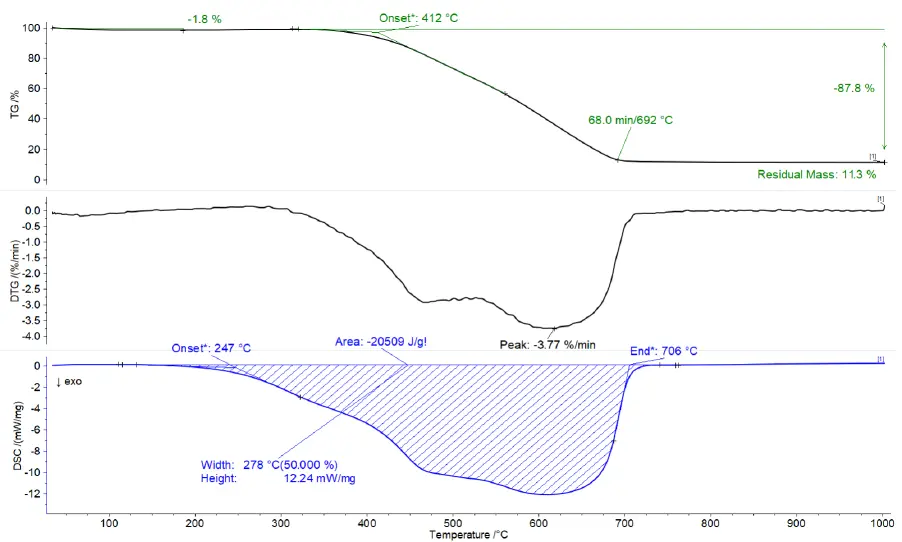
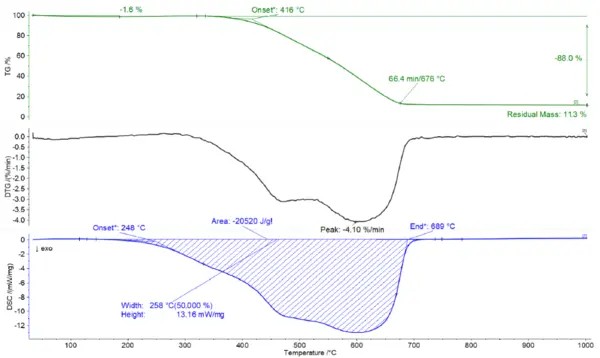
From the STA curves, the basic parameters of the thermal characteristics of the two kinds of coal can be obtained, which are listed in table 1.
As can be seen in table 1, the ignition temperatures of the two kinds of coal in decreasing order is as follows: coal B > coal A. The ignition temperature reflects the degree of difficulty of the coal ignition. The lower the ignition temperature, the easier it is to ignite the coal. The ExothermicA sample transition or a reaction is exothermic if heat is generated. exothermic capacity of the two coals in decreasing order is as follows: coal B > coal A; the higher the ExothermicA sample transition or a reaction is exothermic if heat is generated. exothermic capacity, the better the coal quality. The burnout time of the two coal samples in descending order is as follows: coal A > coal B. In general, the longer the burnout time, the worse is the burning out performance.
The three evaluation index parameters of the two kinds of coal are listed in table 2. For the cement industry, the larger the combustion characteristic index (S), the better the combustion performance of the coal and the better the coal quality. However, the comprehensive combustion performance of coal cannot be determined by this single index. We should also consider the size of the burning intensity (I) and the average heat release intensity (Q). Only coal with a low burning intensity (I), a high average heat release intensity (Q) and a high combustion characteristic index (S), features superior comprehensive performance.
As can be seen in table 3, coal B has a higher burning intensity and average heat release intensity than coal A. However, its combustion characteristic index (5.35 ×10⁻⁹) is lower than that of coal A (5.46 ×10⁻⁹). In general, coal A possesses superior comprehensive combustion performance.
Table 2: Measurement results of the TGA and DSC measurements on coal A and B.
| Parameter | Unit | Coal A | Coal B |
|---|---|---|---|
| °C | 412 | 416 | |
| Ti | m/W/mg | 12.24 | 13.16 |
| H | v | 27.80 | 25.80 |
| W | J/g | 20509 | 20520 |
| q | °C | 247 | 248 |
| Tonset | °C | 706 | 689 |
| t98% | min | 26.8 | 24.8 |
| T98% | °C | 692 | 676 |
Ti: Ignition time; H: Height of the ExothermicA sample transition or a reaction is exothermic if heat is generated. exothermic peak; W: Half-peak width of the ExothermicA sample transition or a reaction is exothermic if heat is generated. exothermic peak; q: Area of the ExothermicA sample transition or a reaction is exothermic if heat is generated. exothermic peak;Tonset: Onset temperature of the ExothermicA sample transition or a reaction is exothermic if heat is generated.exothermic peak;Tend: End temperature of the ExothermicA sample transition or a reaction is exothermic if heat is generated.exothermal peak;t98%: Burnout time;T98%: Burnout time; v: average combustion rate;Vmax: Maximum mass-loss rate
Table 3: Three evaluation index parameters of coal A and B.
| Parameter | Unit | Coal A | Coal B |
|---|---|---|---|
| Burning intensity, I | mW/mg·min | 0.440 | 0.525 |
| Average heat release intensity, Q | J/g·°C | 44.721 | 46.594 |
| Combusion characteristic index, S | 5.46 x 10⁻⁹ | 5.35 x 10⁻⁹ |
Conclusion
The combustion characteristics of coal samples can be studied by the NETZSCH STA Jupiter®. The basic parameters of coal samples during the heating process can be obtained from the TGA, DTG, and DSC curves, such as ignition temperature, heat release, and burnout time.
Based on the derived thermal parameters, additional comprehensive indices − i.e., burning intensity, average heat-release intensity, and combustion characteristic index − can be calculated. These evaluation indicators provide an integrated description of the combustion behavior of coal and allow for a more reliable comparison between different coal samples, thereby supporting the selection of the most suitable coal for a given application.
Introduction
Coal is the main fuel for cement production in China and represents one of the most important indicators for raw-fuel consumption in cement production. Coal quality influences not only the yield and quality of cement clinker production, but also its costs, since high-quality coal with a higher calorific value enables higher process temperatures or, at constant process temperature, reduces coal demand, thereby saving fuel costs. Modern testing methods and improvement of coal quality are important factors for ensuring a reduction in coal consumption and an improvement in the quality of cement products.
The combustion behavior of coal in the cement industry is complex. Conventional industrial analytical evaluation methods [1] are no longer applicable. One example is AdiabaticAdiabatic describes a system or measurement mode without any heat exchange with the surroundings. This mode can be realized using a calorimeter device according to the method of accelerating rate calorimetry (ARC®). The main purpose of such a device is to study scenarios and thermal runaway reactions. A short description of the adiabatic mode is “no heat in – no heat out”.adiabatic calorimetry, in which coal is placed in an AdiabaticAdiabatic describes a system or measurement mode without any heat exchange with the surroundings. This mode can be realized using a calorimeter device according to the method of accelerating rate calorimetry (ARC®). The main purpose of such a device is to study scenarios and thermal runaway reactions. A short description of the adiabatic mode is “no heat in – no heat out”.adiabatic vessel and the heat content of the coal is calculated by measuring the temperature change inside the vessel. Although this method requires only simple equipment, the measurement results are relatively inaccurate.
In this work, material characterization of two coal types is carried out by simultaneous thermal analysis using a NETZSCH STA Jupiter® instrument. Based on thermogravimetric (TG) and differential calorimetry (DSC) results, important combustion parameters were determined, including the onset and end temperatures (Tonset,Tend) of the exotherm, the temperature of initial mass loss (Ti), the maximum mass-loss rate (Vmax), the total ExothermicA sample transition or a reaction is exothermic if heat is generated.exothermic heat (q), and the average combustion rate (v).
Based on these parameters, the evaluation indices
- combustion intensity (I),
- average heat-release intensity (Q), and
- the combustion characteristic index (S)
were calculated. These indices provide a quantitative basis for evaluating the combustion performance of coal. The requirements for coal use in the cement industry are optimum combustion behavior through low combustion intensity, high average heat-release intensity, and a high combustion characteristic index. This reflects a favorable balance between ignition behavior, heat release, and overall reactivity.
Method and Measurement Parameters
Two different coal samples (coal A and B, mass approximately 10 mg) were heated from room temperature to 1000 °C at a heating rate of 10 K/min in air. Table 1 shows all important parameters of the TG and DSC curves, together with their symbols, units, and definitions.
Combustion indices:
The individual measured values are subsequently used to determine combustion intensity, average heat-release intensity, and the combustion characteristic index [2] (see table 1 for abbreviations).
a) Combustion intensity (I)
The combustion intensity of coal indicates the intensity of instantaneous heat release in this ExothermicA sample transition or a reaction is exothermic if heat is generated.exothermic process and is defined as:
b) Average heat-release intensity (Q)
The average ExothermicA sample transition or a reaction is exothermic if heat is generated.exothermic intensity of coal indicates the amount of heat released per unit mass of coal and per unit temperature during the period from the beginning to the end of the coal's ExothermicA sample transition or a reaction is exothermic if heat is generated.exothermic activity and is defined as:
c) Combustion characteristic index (S)
The combustion characteristics of coal are comprehensive indicators of its quality, including flammability, ignition point, combustion intensity, and combustion duration. From these aspects and taking the relevant literature into account
Table 1: Important parameters of the TG and DSC curves with symbol, unit, and definition.
| Parameter | Symbol | Unit | Definition |
|---|---|---|---|
| Thermogravimetry (TG) | |||
| Onset temperature of mass loss | Ti | °C | The temperature at which the sample begins to lose mass (ignition temperature). |
| Combustion time | t98% | min | Time required to burn 98% of the fuel. |
| Combustion temperature | T98% | °C | Temperature at which 98% of the fuel has been burned. |
| Average combustion rate | V | %/min | Total mass loss divided by combustion time. |
| Differential thermogravimetry (DTG) | |||
| Maximum mass-loss rate | Vmax | %/min | The maximum mass-loss rate. |
| Differential scanning calorimetry (DSC) | |||
| Onset temperature of the ExothermicA sample transition or a reaction is exothermic if heat is generated. exothermic peak | Tonset | °C | Temperature at the beginning of the ExothermicA sample transition or a reaction is exothermic if heat is generated. exothermic effect. |
| End temperature of the ExothermicA sample transition or a reaction is exothermic if heat is generated. exothermic peak | Tend | °C | Temperature at the end of the ExothermicA sample transition or a reaction is exothermic if heat is generated. exothermic effect. |
| Area of the ExothermicA sample transition or a reaction is exothermic if heat is generated. exothermic peak | q | J/g | Combustion enthalpy of the sample. |
| Peak height of the exotherm | H | mW/mg | Height of the exothermic peak relative to the DSC baseline. |
| Half-width of the exothermic peak | W | min | Time corresponding to the half-width of the exotherm. |
Results and Discussion
The TG and DSC curves of coal A and coal B are shown in figures 1 and 2. Both samples show two mass-loss steps. The first, up to approximately 150 °C, can presumably be attributed to the release of moisture. In comparison, coal A and B show similar moisture contents here (1.8% and 1.6%, respectively). The second, considerably larger mass-loss step corresponds to thermal Decomposition reactionA decomposition reaction is a thermally induced reaction of a chemical compound forming solid and/or gaseous products. decomposition and combustion of the coal samples.
The curves provide the basic parameters of the thermal properties of the two coal types. Table 2 lists the results for the individual samples.
The ignition temperatures of coal sample A (412 °C) and coal sample B (416 °C) show similar values, with the temperature of coal sample B slightly higher. The higher the ignition temperature, the more difficult it is to ignite the coal. The combustion enthalpy of coal B is also higher than that of coal A. The higher the combustion enthalpy, the better the quality of the coal. Another important parameter when using coal is combustion time: the longer the duration, the poorer the combustion performance. A comparison of both samples shows that coal sample A, at almost 28 minutes, is slightly above coal sample B (approximately 26 minutes).
The three evaluation parameters for the two coal types are listed in table 3. For the cement industry, the higher the combustion characteristic index (S), the better the combustion performance of the coal and the better its quality. However, the overall combustion performance of coal cannot be determined from this index alone. Combustion intensity (I) and average heat-release intensity (Q) must also be considered. The coal used should therefore have low combustion intensity (I), high average heat-release intensity (Q), and a high combustion characteristic index (S) to be suitable for use in the cement industry.
Under this consideration and with reference to table 3, it can be seen that coal A has better combustion performance than coal B due to its lower combustion intensity and higher combustion characteristic index.
Table 2: Measurement results of the TG and DSC measurements of coal samples A and B.
| Parameter | Unit | Coal A | Coal B |
|---|---|---|---|
| Ti | °C | 412 | 416 |
| H | mW/mg | 12.24 | 13.16 |
| W | min | 27.80 | 25.80 |
| q | J/g | 20509 | 20520 |
| Tonset | °C | 247 | 248 |
| Tend | °C | 706 | 689 |
| t98% | min | 26.8 | 24.8 |
| T98% | °C | 692 | 676 |
| V | %/min | 3.150 | 3.394 |
Ti: ignition temperature; H: height of the exothermic peak; W: half-width of the exothermic peak; q: combustion enthalpy;Tonset: onset temperature of the exothermic peak;Tend: end temperature of the exothermic peak;t98%: combustion time;T98%: combustion temperature; V: average combustion rate;Vmax: maximum mass-loss rate
Table 3: Calculated combustion parameters of coal samples A and B.
| Parameter | Unit | Coal A | Coal B |
|---|---|---|---|
| Combustion intensity I | mW/mg·min | 0.440 | 0.525 |
| Average heat-release intensity Q | J/g·°C | 44.721 | 46.594 |
| Combustion characteristic index S | 5.46 x 10⁻⁹ | 5.35 x 10⁻⁹ |
Summary
The combustion characteristics of different coal samples can be investigated using the NETZSCH STA Jupiter®. Fundamental parameters of the coal samples during the combustion process can be determined from TG, DTG, and DSC measurement results, for example ignition temperature, heat release, and combustion time.
Based on these measured values, comprehensive indices such as combustion intensity, average heat-release intensity, and the combustion characteristic index can additionally be calculated. These evaluation indices provide an integrated description of the combustion behavior of coal and enable a more reliable comparison between different coal samples, supporting selection of the coal best suited to a particular application.