はじめに
中国におけるセメント生産では、石炭が主要な燃料として使用されており、セメント生産における原料燃料の消費量の重要な指標の一つとなっています。 石炭の品質は、セメントクリンカーの生産量や品質に影響を与えるだけでなく、そのコストにも影響を及ぼします。これは、発熱量の高い高品質な石炭を使用することで、プロセス温度を高く設定できるほか、同じプロセス温度でも石炭消費量を削減できるため、燃料コストの低減につながるからです。 高度な試験手段の導入と石炭の品質管理の強化は、石炭消費量の削減とセメント製品の品質向上を確保するための重要な要素です。
セメント産業における石炭の燃焼挙動は複雑です。 従来の工業用分析評価法 [1] は、もはや適用できません。その一例が断熱熱量計法であり、石炭を断熱容器に入れ、容器内の温度変化を測定することでその発熱量を算出します。この方法は単純な装置を使用しますが、測定結果は比較的精度が低くなります。
本研究では、NETZSCH 社製のSTA Jupiter® 同時熱分析装置を用いて、石炭の材料特性評価を行いました。 熱重量分析(TGA)および示差走査熱量測定(DSC)曲線を用いて、発熱(発熱性)反応の開始温度および終了温度(Tonset、Tend)、初期質量減少温度(Ti)、最大質量減少率(Vmax)、 総発熱量(q)、および平均燃焼速度(v)を決定しました。これらのパラメータに基づき、3つの評価指標、
- 燃焼強度(I)、
- 平均発熱強度(Q)、および
- 燃焼特性指数(S)
が算出されました。これらの指標は、石炭燃焼の性能を評価するための定量的根拠となります。 セメント産業において、最適な燃焼挙動を示す石炭は、低い燃焼強度(I)、高い平均発熱強度(Q)、および高い燃焼特性指数(S)を特徴としており、これらは着火挙動、発熱量、および全体的な反応性の間の良好なバランスを反映しています。
測定方法
一連の実験では、2つの石炭試料(石炭Aおよび石炭B)が選定されました。各試料の質量は約10 mgでした。適用された温度プログラムは、室温(RT)から1000°Cまででした。加熱は、空気雰囲気下で10 K/minの一定速度で行われました。 表1には、TGAおよびDSC曲線の重要なパラメータすべてと、それに対応する記号、単位、定義が示されています。
評価指標パラメータの策定
熱分析曲線の基本パラメータを用いて、以下の3つの評価指標パラメータを定義することができます[2](略語については表1を参照してください)。
a) 燃焼強度(I)
石炭の燃焼強度は、発熱(発熱性)過程における瞬間的な放熱の強度を示します。これは次のように定義されます:
b) 平均発熱強度(Q)
石炭の平均発熱(発熱性)強度は、石炭の発熱活動の開始から終了までの期間において、石炭の単位質量あたり、単位温度あたりに放出される熱量を表します。その定義は次のとおりです:
c) 燃焼特性指数(S)
石炭の燃焼特性とは、石炭の可燃性、着火点、燃焼強度、燃焼時間などを含む、石炭の総合的な指標です。これらの観点から、関連する文献[3-4]と併せて考察すると、次のように言えます。
表1:TGAおよびDSC曲線の重要なパラメータ(記号、単位、定義付き)。
| パラメータ | 単位 | 定義 | |
|---|---|---|---|
熱重量分析(TGA) | |||
| 質量減少の開始温度 | Ti | °C | 石炭が重量を失い始める温度(着火温度)。 |
| 燃焼完了時間 | t98% | 分 | 燃料の98%が燃焼するのに必要な時間です。 |
| 燃焼完了温度 | T98% | °C | 燃料の98%が燃焼した時点に対応する温度です。 |
| 平均燃焼速度 | V | %/分 | 総減量率を燃焼完了時間で見積もった値です。 |
示差熱重量分析法(DTG) | |||
| 最大質量減少率 | Vmax | %/分 | 最大質量減少率。 |
熱流(DSC) | |||
| 発熱ピークの開始温度 | Tonset | °C | 発熱(発熱性)現象が始まる時点での石炭の温度 |
| 発熱(発熱性)ピークの終了温度 | Tend | °C | 発熱(発熱性)作用の終了時の温度 |
| 発熱ピークの面積 | q | J/g | 石炭の発熱容量 |
| 発熱ピークの高さ | H | DSCベースラインに対する発熱(発熱性)ピークの高さ | |
| 発熱ピークの半値幅(幅) | W | 分 | 発熱ピークの高さの半分に相当するピーク幅に対応する時間。 |
結果と考察
石炭Aおよび石炭BのSTA曲線は、それぞれ図1および図2に示されています。ご覧のとおり、両試料とも2段階の質量減少が見られます。 最初の段階は150°Cまでで、これは水分放出によるものです。石炭Aと石炭Bの対応する質量減少率は、それぞれ1.8%と1.6%であり、これらは両者の水分含有量が同程度であることを示しています。2番目の、はるかに大きな質量減少段階は、石炭試料の熱分解および燃焼に起因するものです。
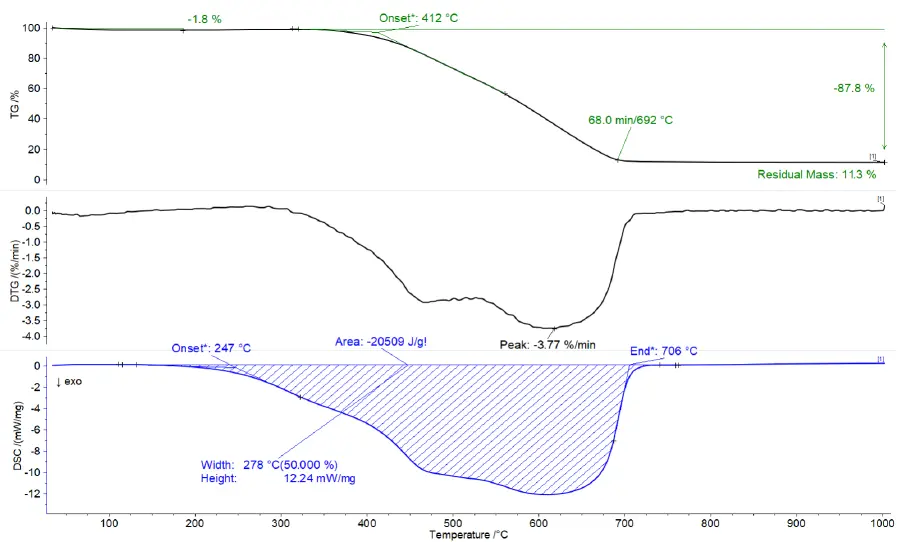
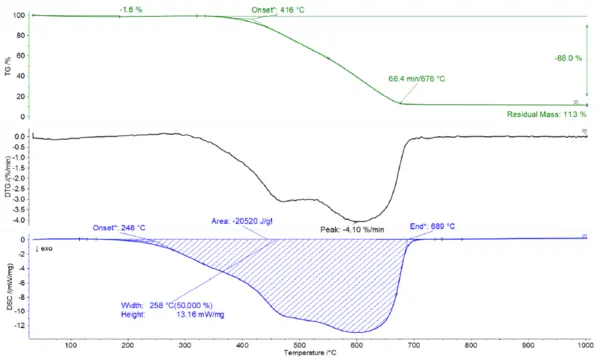
STA曲線から、2種類の石炭の熱特性に関する基本パラメータを導き出すことができ、それらは表1に示されています。
表1からわかるように、2種類の石炭の発火温度は高い順に、石炭B > 石炭Aとなっています。発火温度は、石炭の発火の難しさの程度を表しています。発火温度が低いほど、石炭は発火しやすくなります。 2種類の石炭の発熱(発熱性)は、高い順に「石炭B > 石炭A」となります。発熱(発熱性)が高いほど、石炭の品質は良好です。 2種類の石炭試料の燃焼時間は、高い順に次のようになります:石炭A > 石炭B。一般的に、燃焼時間が長いほど、燃焼性能は劣ります。
2種類の石炭に関する3つの評価指標パラメータを表2に示します。セメント業界において、燃焼特性指数(S)が大きいほど、石炭の燃焼性能が高く、石炭の品質も優れています。ただし、石炭の総合的な燃焼性能は、この単一の指標だけで判断することはできません。 燃焼強度(I)および平均発熱強度(Q)の大きさも考慮する必要があります。燃焼強度(I)が低く、平均発熱強度(Q)が高く、かつ燃焼特性指数(S)が高い石炭のみが、優れた総合性能を備えています。
表3からわかるように、石炭Bは石炭Aよりも燃焼強度と平均発熱強度が高いです。しかし、その燃焼特性指数(5.35×10⁻⁹)は、石炭A(5.46×10⁻⁹)よりも低くなっています。一般的に、石炭Aの方が優れた総合的な燃焼性能を有しています。
表2:石炭AおよびBのTGAおよびDSC測定結果。
| パラメータ | 単位 | 石炭A | 石炭B |
|---|---|---|---|
| °C | 412 | 416 | |
| Ti | m/W/mg | 12.24 | 13.16 |
| H | v | 27.80 | 25.80 |
| W | J/g | 20509 | 20520 |
| q | °C | 247 | 248 |
| 融点 | °C | 706 | 689 |
| t98% | 分 | 26.8 | 24.8 |
| T98% | °C | 692 | 676 |
Ti:着火時間;H:発熱(発熱性)ピークの高さ;W:発熱(発熱性)ピークの半値幅;q:発熱(発熱性)ピークの面積;Tonset:発熱(発熱性)ピークの開始温度;Tend:発熱(発熱性)ピークの終端温度;t98%:燃焼完了時間;T98%:燃焼完了温度;v:平均燃焼速度;Vmax:最大質量損失率
表3:石炭AおよびBの3つの評価指標パラメータ。
| パラメータ | 単位 | 石炭A | 石炭B |
|---|---|---|---|
| 燃焼強度、I | mW/mg·min | 0.440 | 0.525 |
| 平均発熱強度、Q | J/g·°C | 44.721 | 46.594 |
| 燃焼特性指数、S | 5.46 × 10⁻⁹ | 5.35 × 10⁻⁹ |
結論
石炭試料の燃焼特性は、NETZSCH のSTA(Jupiter® )を用いて調査することができます。加熱過程における石炭試料の基本パラメータ(着火温度、発熱量、燃焼完了時間など)は、TGA、DTG、およびDSC曲線から得ることができます。
導出された熱パラメータに基づき、燃焼強度、平均発熱強度、燃焼特性指数といった追加の総合指標を算出することができます。これらの評価指標は、石炭の燃焼挙動を包括的に記述するものであり、異なる石炭試料間のより信頼性の高い比較を可能にし、それによって特定の用途に最適な石炭の選定を支援します。
Introduction
Coal is the main fuel for cement production in China and represents one of the most important indicators for raw-fuel consumption in cement production. Coal quality influences not only the yield and quality of cement clinker production, but also its costs, since high-quality coal with a higher calorific value enables higher process temperatures or, at constant process temperature, reduces coal demand, thereby saving fuel costs. Modern testing methods and improvement of coal quality are important factors for ensuring a reduction in coal consumption and an improvement in the quality of cement products.
The combustion behavior of coal in the cement industry is complex. Conventional industrial analytical evaluation methods [1] are no longer applicable. One example is adiabatic calorimetry, in which coal is placed in an adiabatic vessel and the heat content of the coal is calculated by measuring the temperature change inside the vessel. Although this method requires only simple equipment, the measurement results are relatively inaccurate.
In this work, material characterization of two coal types is carried out by simultaneous thermal analysis using a NETZSCH STA Jupiter® instrument. Based on thermogravimetric (TG) and differential calorimetry (DSC) results, important combustion parameters were determined, including the onset and end temperatures (Tonset, Tend) of the exotherm, the temperature of initial mass loss (Ti), the maximum mass-loss rate (Vmax), the total exothermic heat (q), and the average combustion rate (v).
Based on these parameters, the evaluation indices
- combustion intensity (I),
- average heat-release intensity (Q), and
- the combustion characteristic index (S)
were calculated. These indices provide a quantitative basis for evaluating the combustion performance of coal. The requirements for coal use in the cement industry are optimum combustion behavior through low combustion intensity, high average heat-release intensity, and a high combustion characteristic index. This reflects a favorable balance between ignition behavior, heat release, and overall reactivity.
Method and Measurement Parameters
Two different coal samples (coal A and B, mass approximately 10 mg) were heated from room temperature to 1000 °C at a heating rate of 10 K/min in air. Table 1 shows all important parameters of the TG and DSC curves, together with their symbols, units, and definitions.
Combustion indices:
The individual measured values are subsequently used to determine combustion intensity, average heat-release intensity, and the combustion characteristic index [2] (see table 1 for abbreviations).
a) Combustion intensity (I)
The combustion intensity of coal indicates the intensity of instantaneous heat release in this exothermic process and is defined as:
b) Average heat-release intensity (Q)
The average exothermic intensity of coal indicates the amount of heat released per unit mass of coal and per unit temperature during the period from the beginning to the end of the coal's exothermic activity and is defined as:
c) Combustion characteristic index (S)
The combustion characteristics of coal are comprehensive indicators of its quality, including flammability, ignition point, combustion intensity, and combustion duration. From these aspects and taking the relevant literature into account
Table 1: Important parameters of the TG and DSC curves with symbol, unit, and definition.
| Parameter | Symbol | Unit | Definition |
|---|---|---|---|
| Thermogravimetry (TG) | |||
| Onset temperature of mass loss | Ti | °C | The temperature at which the sample begins to lose mass (ignition temperature). |
| Combustion time | t98% | min | Time required to burn 98% of the fuel. |
| Combustion temperature | T98% | °C | Temperature at which 98% of the fuel has been burned. |
| Average combustion rate | V | %/min | Total mass loss divided by combustion time. |
| Differential thermogravimetry (DTG) | |||
| Maximum mass-loss rate | Vmax | %/min | The maximum mass-loss rate. |
| Differential scanning calorimetry (DSC) | |||
| Onset temperature of the exothermic peak | Tonset | °C | Temperature at the beginning of the exothermic effect. |
| End temperature of the exothermic peak | Tend | °C | Temperature at the end of the exothermic effect. |
| Area of the exothermic peak | q | J/g | Combustion enthalpy of the sample. |
| Peak height of the exotherm | H | mW/mg | Height of the exothermic peak relative to the DSC baseline. |
| Half-width of the exothermic peak | W | min | Time corresponding to the half-width of the exotherm. |
Results and Discussion
The TG and DSC curves of coal A and coal B are shown in figures 1 and 2. Both samples show two mass-loss steps. The first, up to approximately 150 °C, can presumably be attributed to the release of moisture. In comparison, coal A and B show similar moisture contents here (1.8% and 1.6%, respectively). The second, considerably larger mass-loss step corresponds to thermal decomposition and combustion of the coal samples.
The curves provide the basic parameters of the thermal properties of the two coal types. Table 2 lists the results for the individual samples.
The ignition temperatures of coal sample A (412 °C) and coal sample B (416 °C) show similar values, with the temperature of coal sample B slightly higher. The higher the ignition temperature, the more difficult it is to ignite the coal. The combustion enthalpy of coal B is also higher than that of coal A. The higher the combustion enthalpy, the better the quality of the coal. Another important parameter when using coal is combustion time: the longer the duration, the poorer the combustion performance. A comparison of both samples shows that coal sample A, at almost 28 minutes, is slightly above coal sample B (approximately 26 minutes).
The three evaluation parameters for the two coal types are listed in table 3. For the cement industry, the higher the combustion characteristic index (S), the better the combustion performance of the coal and the better its quality. However, the overall combustion performance of coal cannot be determined from this index alone. Combustion intensity (I) and average heat-release intensity (Q) must also be considered. The coal used should therefore have low combustion intensity (I), high average heat-release intensity (Q), and a high combustion characteristic index (S) to be suitable for use in the cement industry.
Under this consideration and with reference to table 3, it can be seen that coal A has better combustion performance than coal B due to its lower combustion intensity and higher combustion characteristic index.
Table 2: Measurement results of the TG and DSC measurements of coal samples A and B.
| Parameter | Unit | Coal A | Coal B |
|---|---|---|---|
| Ti | °C | 412 | 416 |
| H | mW/mg | 12.24 | 13.16 |
| W | min | 27.80 | 25.80 |
| q | J/g | 20509 | 20520 |
| Tonset | °C | 247 | 248 |
| Tend | °C | 706 | 689 |
| t98% | min | 26.8 | 24.8 |
| T98% | °C | 692 | 676 |
| V | %/min | 3.150 | 3.394 |
Ti: ignition temperature; H: height of the exothermic peak; W: half-width of the exothermic peak; q: combustion enthalpy; Tonset: onset temperature of the exothermic peak; Tend: end temperature of the exothermic peak; t98%: combustion time; T98%: combustion temperature; V: average combustion rate; Vmax: maximum mass-loss rate
Table 3: Calculated combustion parameters of coal samples A and B.
| Parameter | Unit | Coal A | Coal B |
|---|---|---|---|
| Combustion intensity I | mW/mg·min | 0.440 | 0.525 |
| Average heat-release intensity Q | J/g·°C | 44.721 | 46.594 |
| Combustion characteristic index S | 5.46 x 10⁻⁹ | 5.35 x 10⁻⁹ |
概要
NETZSCH (STA)Jupiter® を使用することで、さまざまな石炭試料の燃焼特性を調査することができます。燃焼過程における石炭試料の基本パラメータ(例えば、着火温度、発熱量、燃焼時間など)は、TG、DTG、およびDSCの測定結果から決定することができます。
これらの測定値に基づき、燃焼強度、平均発熱強度、燃焼特性指数などの包括的な指標をさらに算出することができます。これらの評価指標は、石炭の燃焼挙動を統合的に記述するものであり、異なる石炭試料間のより信頼性の高い比較を可能にし、特定の用途に最適な石炭の選定を支援します。