Introduction
Powder Bed Fusion (PBF), often called Selective Laser SinteringSintering is a production process for forming a mechanically strong body out of a ceramic or metallic powder. Sintering (SLS), is one of the most frequently used Additive Manufacturing technologies for producing structural plastic parts. It does not require molds or support structures. Furthermore, it is capable of producing complex geometries, internal structures and thin walls with mechanical properties comparable to injection-molded parts. This shortens the development cycle and makes it an alternative for many work pieces and even whole assemblies [1].
In the PBF process, a thin layer of powder is applied on the build platform and heated to just below the Melting Temperatures and EnthalpiesThe enthalpy of fusion of a substance, also known as latent heat, is a measure of the energy input, typically heat, which is necessary to convert a substance from solid to liquid state. The melting point of a substance is the temperature at which it changes state from solid (crystalline) to liquid (isotropic melt).melting temperature of the material. Next, a laser traces the cross-section of the part geometry of the first layer, providing enough energy to locally melt the material. The surrounding powder stays solid and keeps the shape of the molten geometry. Now, the build platform is lowered by one layer height making room for the next layer. A sweeper moves across the surface and deposits new and colder powder on top of the build platform to create the next layer. These process steps of powder coating and laser melting are repeated over and over until the whole part is built. Only then is the build envelope cooled down, which initiates CrystallizationCrystallization is the physical process of hardening during the formation and growth of crystals. During this process, heat of crystallization is released.crystallization and thus solidification process of the part. After the part is cooled completely, it is unpacked. The entire process can be up to 12 hours without subsequent cooling; IsothermalTests at controlled and constant temperature are called isothermal.isothermal CrystallizationCrystallization is the physical process of hardening during the formation and growth of crystals. During this process, heat of crystallization is released.crystallization can occur after some time. Therefore, IsothermalTests at controlled and constant temperature are called isothermal.isothermal CrystallizationCrystallization is the physical process of hardening during the formation and growth of crystals. During this process, heat of crystallization is released.crystallization studies are needed to evaluate this behavior for the selected polymer powders and thus qualify them for PBF [2].
Material
The first material used in this process was Polyamide 12 (PA12) due to its good mechanical performance and the capability of generating powders by precipitation. This yields a powder with close to perfect spherical shape, which is necessary to create a uniform layer during coating.
Experimental
A typical protocol for the IsothermalTests at controlled and constant temperature are called isothermal.isothermal CrystallizationCrystallization is the physical process of hardening during the formation and growth of crystals. During this process, heat of crystallization is released.crystallization of PA12 measurements is given here:
- Step 1: The sample was heated from room temperature to above melting at 200°C at 20 K/min. It was kept there for one minute to erase the sample history.
- Step 2: It was then rapidly cooled to the IsothermalTests at controlled and constant temperature are called isothermal.isothermal temperature step (168°C, 167°C, 166°C, 165°C, 164°C, 163°C, 162°C) using a high cooling rate of 125 K/min to prevent reorganization processes that occur with PA12 at slow cooling rates. Both the capability of achieving a fast cooling rate with regular sample sizes and the capability of precisely controlling the temperature are features of the NETZSCH DSC 300 Caliris® with P-Module that are extremely valuable for this analysis.
- Step 3: Next, the sample was kept at the IsothermalTests at controlled and constant temperature are called isothermal.isothermal temperature for 30 minutes to study the CrystallizationCrystallization is the physical process of hardening during the formation and growth of crystals. During this process, heat of crystallization is released.crystallization process.
- Step 4: The sample can then be cooled down or the sample can be heated back up to 200°C at 10 K/min (as was done here) to get the full picture and observe the melting behavior after the IsothermalTests at controlled and constant temperature are called isothermal.isothermal CrystallizationCrystallization is the physical process of hardening during the formation and growth of crystals. During this process, heat of crystallization is released. crystallization step.
All other measurement conditions are summarized in Table 1.
Table 1: Measurement conditions
| Pan | Concavus® Al, unpierced |
|---|---|
| Sample weight | 5 mg |
| Atmosphere | N2 |
| Gas flow rate | 250 ml/min |
| Temperature steps | 25°C →200°C (20 K/min), constant for 1 min, 200°C → 165°C (125 K/min), constant for 30 min, 165°C → 200°C (10 K/min), cool down |
Figure 1 shows the IsothermalTests at controlled and constant temperature are called isothermal.isothermal CrystallizationCrystallization is the physical process of hardening during the formation and growth of crystals. During this process, heat of crystallization is released. crystallization behavior at different temperatures from 162°C to 168°C right below the build envelope temperature. The CrystallizationCrystallization is the physical process of hardening during the formation and growth of crystals. During this process, heat of crystallization is released. crystallization peak temperature,tmax, is analyzed in the Proteus® software as the peak of the curve from the start of the IsothermalTests at controlled and constant temperature are called isothermal.isothermal step.
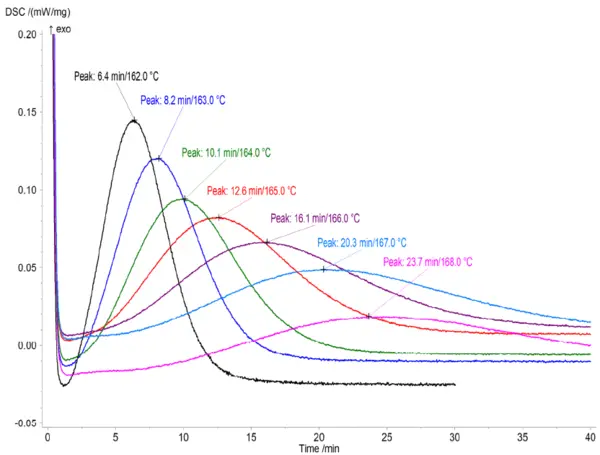
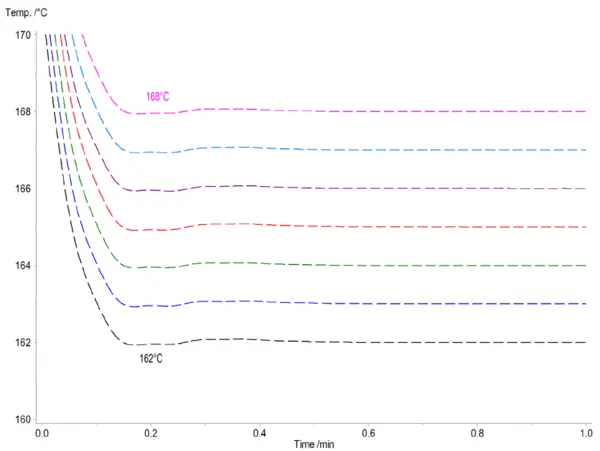
Figure 2 shows the corresponding normalized temperature profile of the IsothermalTests at controlled and constant temperature are called isothermal.isothermal segment. The IsothermalTests at controlled and constant temperature are called isothermal.isothermal temperatures were reached about 0.2 minutes after the segment start. Even at these high cooling rates of 125 K/min, the temperature only overshoots by ± 0.1 K in less than 30 s.
These results highlight that even at the typical build envelope temperature of 168°C for PA12, CrystallizationCrystallization is the physical process of hardening during the formation and growth of crystals. During this process, heat of crystallization is released. crystallization starts after about 1 minute from the beginning of the isothermal segment (Figure 1) and reaches its peak after 23.7 minutes. While the top layers will be reheated closer to the Melting Temperatures and EnthalpiesThe enthalpy of fusion of a substance, also known as latent heat, is a measure of the energy input, typically heat, which is necessary to convert a substance from solid to liquid state. The melting point of a substance is the temperature at which it changes state from solid (crystalline) to liquid (isotropic melt).melting temperature with each additional layer, it becomes obvious that lower layers will eventually stay at 168°C or could even cool further. Thus, given the long build durations of typically several hours, crystallization will occur and has to be taken into account.
To further understand the crystallization rate as a function of time and temperature as well as to model the process – for example, to determine warpage or residual StressStress is defined as a level of force applied on a sample with a well-defined cross section. (Stress = force/area). Samples having a circular or rectangular cross section can be compressed or stretched. Elastic materials like rubber can be stretched up to 5 to 10 times their original length.stress build-up – the crystallization kinetics can be studied. The kinetic modelling of the crystallization rate is based on these isothermal DSC data.
Kinetic Analysis
The kinetic analysis was performed using the NETZSCH Kinetics Neo software [5]. It provided one kinetic model depending on time and temperature, which can describe all experimental curves at different temperatures. This model calculates the crystallization rate by the kinetic equation:
Where
f(α) is the dependence of the crystallization rate on the current crystallization degree, α
K(T) is the dependence of the crystallization rate on temperature.
In isothermal analysis of crystallization, the first dependence is typically represented by the Avrami equation, which represents the crystallization nucleation rate.
The extended version of the Avrami equation is the Sestak-Berggren equation. This extended equation is used in the current analysis because it provides a better fit for the experimental data:
The expression K(T) in Eq. 1 is a formal Arrhenius dependence as the function of temperature with pre-exponent, A, and apparent activation energy, E:
This kinetic model (Eqs. 1, 3, 4) presents the dependence of the current crystallization rate on the temperature and current degree of crystallization. The equations contain unknown kinetic parameters, which are found by the software in order to determine the best fit for the experimental curves.
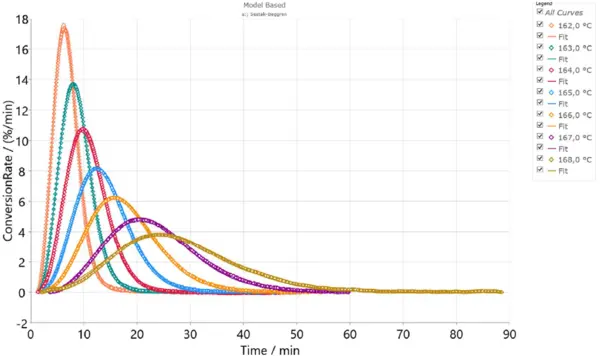
When this kinetic analysis is performed simultaneously under different temperature conditions of all isothermal experiments with optimal parameters, then there will be very good agreement between the experiment and simulation withR2 = 0.998. In Figure 3, the points represent the experimental data and the solid lines show the simulation according to Eqs. 1,3,4.
The rate of crystallization differs from chemical reactions by its temperature dependence. Chemical reactions will be faster at higher temperatures. However, increasing the temperature for crystallization results in lower supercooling and therefore a slower crystallization rate. Figure 3 presents the slowest crystallization at the highest temperature of 168°C and fastest crystallization at the lowest temperature of 162°C.
This inverse temperature direction for crystallization provides negatives apparent activation energy in the kinetic models for isothermal crystallization, which is published in literature and also in ASTM standards [4]. The kinetic parameters for the Sestak-Berggren model with negative apparent activation energy are presented in Table 2.
Table 2: Kinetic parameters of crystallilzation of PA 12 for the Sestak-Berggren model conditions
| Activation Energy | -406.549 kJ/mol |
|---|---|
| Log (PreExp) | -50.900 Log (1/s) |
| ReactOrder n | 0.942 |
| AutocatOrder | 0.528 |
| LogOrder q | 0.133 |
Simulations of PA12 Crystallization in PBF Processes
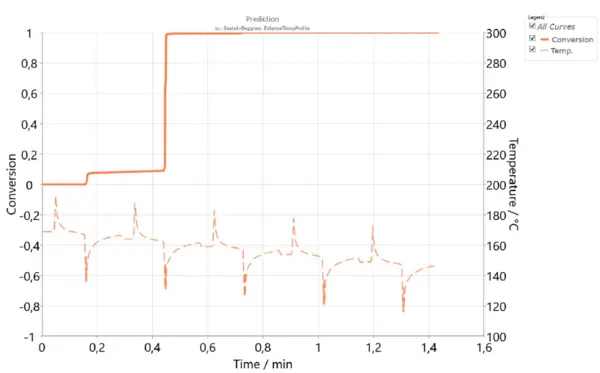
This single model now works for different temperatures between 162 and 168°C. Therefore, it can be used for simulation of crystallization in the PBF process in the process window of temperatures. The temperature profile of the powder surface was measured over the duration of the cycle. We can then run a simulation of the crystallization process for this powder layer. It can be assumed that each lower layer has a similar temperature profile, but with slightly reduced temperatures due to the powder application for each layer. Thus, the crystallization process of a single layer during several laser cycles can be simulated. Figure 4 presents the simulation of the crystallization degree over 5 cycles where for each new cycle, the temperature of the current layer was reduced by 2 K because its position shifts towards a lower level.
We see that one layer cannot completely crystallize during the time constraints of one cycle, when this layer is on top of the powder bed. However, crystallization continues throughout the PBF process, as each cycle produces further layers. CrystallizationCrystallization is the physical process of hardening during the formation and growth of crystals. During this process, heat of crystallization is released.Crystallization during several cycles is one of the advantages of PBF, when the resulting 3D object has very strong layer adhesion and isotropic mechanical properties in all directions like hardness, tensile strength and elongation [3].
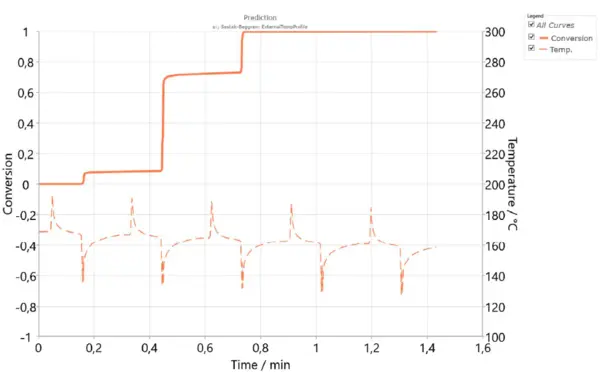
However, if the thickness of the powder layer is increased, then the temperature difference between layers will be higher. This can happen during high-speed SinteringSintering is a production process for forming a mechanically strong body out of a ceramic or metallic powder. sintering. The simulation over 5 cycles with a temperature difference of 5 K (Figure 5) shows that the main crystallization is already finished during the second cycle, while the third layer is already solid. This asynchronous crystallization could be the reason for the mechanical stresses, warpage or curling in the sample because of its shrinkage during the PBF process. Additionally, using thick powder layers could decrease the isotropy of the final material.
Conclusion
The combination of NETZSCH Kinetics Neo and a NETZSCH DSC instrument is an effective method for studying the crystallization rate of polymers and simulates their behavior for such complex industrial processes such as 3D-printing by PBF technology. This is extremely valuable in searching optimal temperature conditions for the new materials which will be used in Additive Manufacturing processes by Powder Bed Fusion.