Introduction
Successful polymer processing requires thorough understanding of material behavior under real manufacturing conditions. While shear viscosity is commonly measured and used for process optimization, extensional viscosity often provides the missing information needed to understand issues such as flow instability, film defects, die swell, neck-in, or poor product quality.
The Rosand high-pressure capillary rheometer enables the determination of both shear and extensional viscosity in a single measurement, providing valuable insight into material performance during extrusion, blow molding, and other elongational flow processes.
Extensional Viscosity: When Shear Viscosity Is Not Enough
Materials can exhibit nearly identical shear viscosity behavior while performing very differently during processing. In such cases, extensional viscosity often reveals differences because, compared to shear measurement, is highly sensitive to molecular architecture and molecular weight distribution.
For processors and material developers relying solely on shear viscosity may result in incomplete material characterization and unexpected production challenges.
The Challenge: Avoid Material Sticking in the Conventional Orifice Dies Exit Region
Extensional viscosity in the Rosand rheometer is determined by measuring the pressure drop at the die entrance. Using conventional zero-length (orifice) dies, the material can stick and accumulate at the die exit, particularly when testing highly elastic polymer melts.
This can result in:
- Overestimated entrance pressure drop (Pen) extensional viscosity values
- Poor Repeatability
- Misinterpretation of material properties
- Failure to identify important effects such as StrainStrain describes a deformation of a material, which is loaded mechanically by an external force or stress. Rubber compounds show creep properties, if a static load is applied.strain hardening
The Solution: The FreeFlow Die Technology
To overcome these limitations, NETZSCH has developed the innovative FreeFlow die (Figure 1) in collaboration with Prof. Martin Zatloukal at TBU Zlín. Its optimized geometry prevents material from sticking in the downstream region. As a result, the entrance pressure drop can be accurately and reproducibly measured.
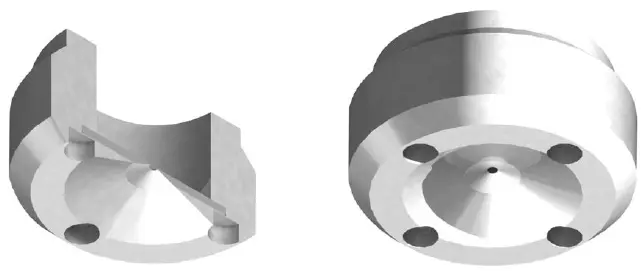
The benefits are straightforward:
- Accurate extension viscosity measurements
- Improved reproducibility
- Reliable detection of StrainStrain describes a deformation of a material, which is loaded mechanically by an external force or stress. Rubber compounds show creep properties, if a static load is applied.strain-hardening and softening behavior
- Enhanced confidence in rheological data
Designed for Real Processing Applications
FreeFlow dies are available in both circular and rectangular geometries. This allows users to investigate shear viscosity as well as:
- Uniaxial extensional viscosity for applications such as blow molding and fiber spinning
- Planar extensional viscosity for cast-film extrusion and evaluation of neck-in effects
This results in a more comprehensive understanding of material behavior under process-relevant deformation conditions.
Your Benefits at a Glance
- No material sticking at the downstream region after the die exit
- High reliability of rheogical measurements
- Precise determination of extensional viscosity
- Reliabile detection of StrainStrain describes a deformation of a material, which is loaded mechanically by an external force or stress. Rubber compounds show creep properties, if a static load is applied.strain hardening and softening
- Material characterization under realistic processing conditions
- Efficient material development and process optimization
Conclusion
The FreeFlow die expands the capabilities of the Rosand high-pressure capillary rheometer by enabling highly reliable shear and extensional viscosity measurements. By eliminating sticking of the material at the downstream region after the die exit and minimizing measurement errors, it provides the accurate rheological information required for efficient product development, improved process control, and enhanced manufacturing performance.