Rapid Viscoelastic Characterization with Chirps Rheometry
Oscillatory frequency sweeps are a fundamental rheological technique for characterizing the linear viscoelastic behavior of polymer melts, providing information on molecular structure and material response across different timescales. In a conventional frequency sweep, individual frequencies are applied sequentially, meaning that acquisition of a complete data set can take tens of minutes or, depending on the frequency range and measurement conditions, even hours.
Chirps rheometry provides a significantly faster approach. Rather than applying individual frequencies sequentially, a chirp uses a continuously varying oscillatory frequency within a single waveform, enabling a spectrum of linear viscoelastic information to be acquired in a fraction of the time required for a conventional frequency sweep. Where a conventional frequency sweep may require tens of minutes or longer to generate a viscoelastic spectrum, a chirps measurement can capture comparable information across the selected frequency range in a matter of seconds.
Optimally Windowed Chirps (OWCh) further refine the technique through careful waveform design and windowing, reducing spectral leakage and improving the quality of the resulting viscoelastic data. In addition to increasing measurement speed, shorter measurement times can reduce the time a polymer melt spends at elevated temperature during testing. This can be particularly advantageous for thermally sensitive or degradable polymers, where prolonged thermal exposure may alter the material during the measurement itself.
Rapid Quality Assessment of Recycled Polymers
The increasing use of recycled polymers creates new challenges for material characterization and quality control. Unlike virgin polymers produced under tightly controlled conditions, recyclate streams can exhibit greater variability in composition, molecular structure, thermal history and degradation state. Contamination or the presence of different polymer grades can introduce further variability, potentially affecting both processing behavior and final product performance.
Rheological measurements are particularly sensitive to changes in polymer molecular structure and can therefore provide valuable information when comparing recyclate streams, batches or processing histories. However, conventional rheological characterization can be too time-consuming for routine screening when large numbers of samples need to be assessed.
Chirps Measurement of Polymer Recyclate Melts
The HDPE and PP based recyclate samples were measured at 180 C using a 40 mm, parallel plate geometry, a 1 mm gap, and an active hood configuration. To determine whether thermal degradation was occurring over the testing times with the recyclate samples, a single frequency measurement was performed at 1% StrainStrain describes a deformation of a material, which is loaded mechanically by an external force or stress. Rubber compounds show creep properties, if a static load is applied.strain and 1 Hz over 30 minutes, the results of which are shown in Figure 1. From the complex viscosity of either sample, there is a not a significant change in either of the recyclates over the test duration.
The goal of this project was to compare the data obtained from traditional frequency sweeps of polymer recyclates with data obtained using much faster chirps measurements. Fresh samples were loaded and trimmed before being subjected to three consecutive measurements on the same sample: an initial logistic chirps measurement, followed by a traditional frequency sweep, and then a second logistic chirps measurement. This measurement sequence enabled direct comparison between the chirps and traditional frequency sweep data, while comparison of the initial and final chirps measurements allowed any changes in the sample occurring over the duration of the experiment to be assessed.
Chirps measurements were completed using logistic frequency between 0.05 to 25 Hz (duration 21 seconds). The frequency sweeps were completed using a StrainStrain describes a deformation of a material, which is loaded mechanically by an external force or stress. Rubber compounds show creep properties, if a static load is applied.strain of 1%, and a logarithmic progression from 0.01 to 100 Hz (duration 23 minutes).
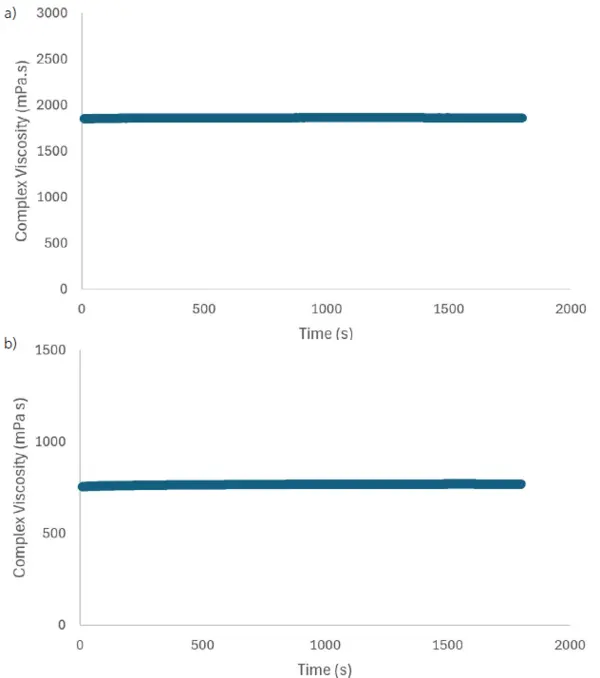
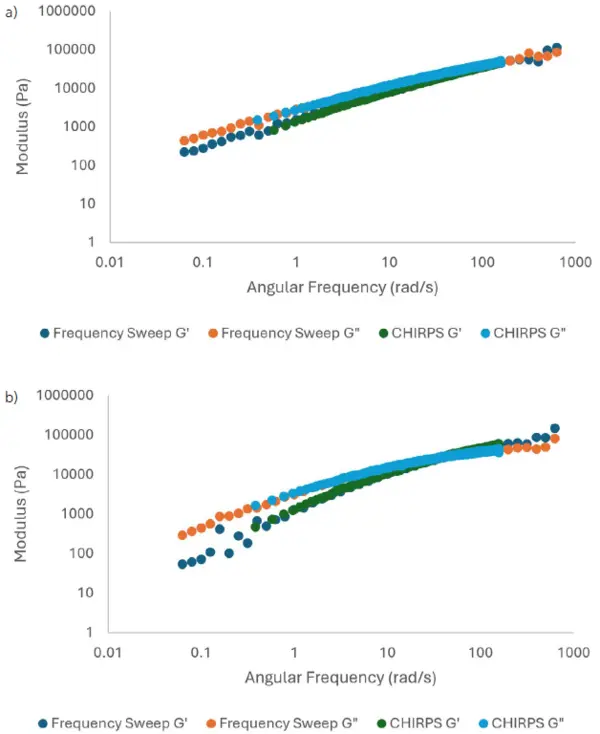
Figure 2 shows the comparison between initial chirps measurements and frequency sweeps completed on the same recyclate melt. From Figure 2, both HDPE and PP polymer melt samples had very similar results whether measured by chirps or a traditional frequency sweep. However, the chirps measurement took 1.5% of the time that did the frequency sweep.
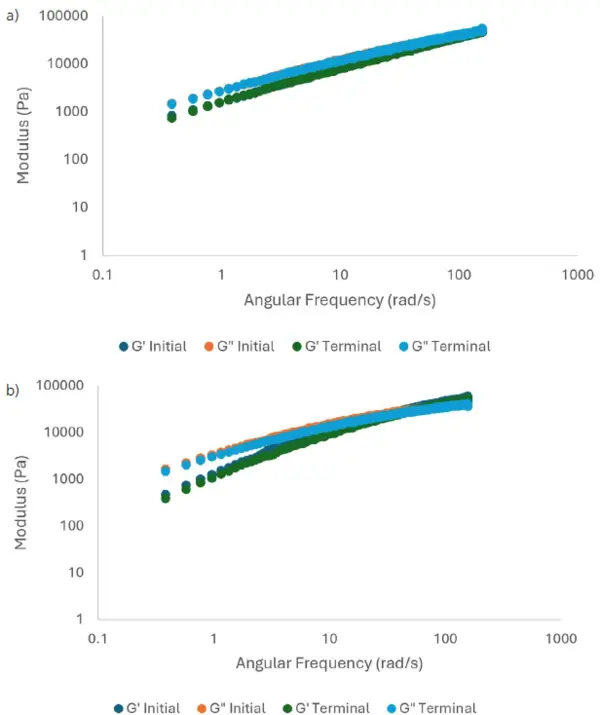
Finally, Figure 3 compares the chirps measurements that were completed on the same sample, but 23 minutes apart. This test is important to see how material properties may change as a function of time or thermal degradation. Using individual ‘snapshots’ of chirps, a greater understanding can be produced for performance of complex mixture like recyclates or how thermal degradation occurs over discrete time intervals. From Figure 3, neither the HDPE nor PP samples showed a change in material properties at 180°C over 25 minutes indicating thermal degradation was not a factor and corroborating the results shown in Figure 1.
Conclusion
In this study, we compared the frequency-dependent properties of two different plastic recyclates using traditional frequency sweeps and chirps measurements. Chirps measurements, directly available in the rSpace software, produce a full frequency analysis in a fraction of the time. Even with complex samples such as recyclates, precise data could be captured by a chirps measurement in under 30 seconds compared to the traditional frequency sweep taking over 23 minutes. This measurement type, now standard in the software, is particularly important for materials which undergo rapid rheological transitions, or which are thermally unstable.
Acknowledgements
We would like to thank Prof. Dr. Henning Winter for providing the materials.