Introduction
Protein powders are a main stay in the world of nutrition helping individuals gain muscle, lose weight, or simply fill gaps int their diet. The most common protein source in the industry is whey, a byproduct of dairy manufacturing. However, with dietary restrictions (lactose intolerance), ethical concerns, and research into maximizing nutritional benefit, many other sources for protein powder have been investigated as well.
There are many commercial protein powders which are fully derived from plant sources or even from insect sources. NETZSCH Grinding & Dispersing offers tailored systems with high throughput and low energy consumption for processing whole insects, dried larvae, or intermediate products. However, both plant and insect derived protein powders traditionally suffer an issue of poor solubility when compared to traditional whey. Plant based protein powders tend to be composed of more hydrophobic amino acids and lack the natural chemical emulsifiers in whey, and insect-based protein powder tend to contain natural fibers from the exoskeleton (chitin) which are naturally poorly water soluble. To overcome these solubility problems, blending different sources with different amino acid and emulsifier profiles is a common strategy.
In this study we sought to compare the dry powder properties of differently sourced protein powders as well as to measure their dissolution profiles and even explore their mouthfeel. To achieve this, we utilized the NETZSCH Kinexus Prime series of rheometers which can characterize a broad range of complex fluids and semi-solids due to their sensitivity, low volume requirement, modular geometries, and advanced software capabilities. In particular, the modular nature of the instrument allowed quick and easy adjustment to measure the samples as powders, during dissolution, and for tribology.
Four different samples were characterized; a whey protein which was further reinforced with additional amino acids, a whey protein isolate (whey which is further processed to filter lactose and fat), a plant-based blend (pea, pumpkin, and chia protein), and an insect-based blend (cricket and pea protein).
Dry Powder Properties
For measurement of the dry powders themselves, a similar protocol was utilized as previously reported for the measurement of dry lactose [1]. The measurement parameters are detailed in table 1.
Table 1: Measurement setup
| Instrument | Kinexus prime ultra+ |
|---|---|
| Samples | Dry protein power (15 g each) |
| Cylinder | Cylindrical cup (Φ 34 mm) |
| Paddle | 2-bladed starch paddle |
| Temperature range | RT |
| Shear viscosity | 10 to 1000 1/s |
Each sample was subjected to a fluidization step consisting of a shear viscosity ramp between 10 to 1000 1/s followed by a 5-minute rest. During this step, interactions between the particles are reduced [2] and the influence of the sample history is deleted (compression by handling, etc). Viscosity as a function of shear rate for each powder is shown in Figure 1.
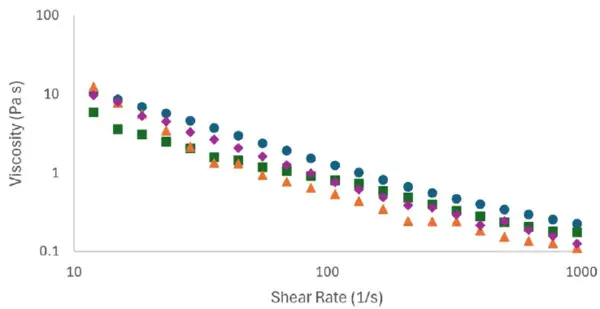
Even during the fluidizing step to erase sample history there is a clear distinction in viscosity of the samples with the reinforced whey having the highest viscosity and the insect blend the lowest. Numerous parameters such as particle size and charge will dictate the viscosity of the dry powders under shear.
With the processing history of the samples erased by fluidization, an amplitude sweep was conducted on the samples to determine the viscoelastic properties (G’ describing elastic behavior and G” viscous behavior) of the powders. The measurement was completed using the starch paddle at room temperature and 1 Hz from 0.01 Pa to 50 Pa. The results of the amplitude sweeps are shown in Figure 2.
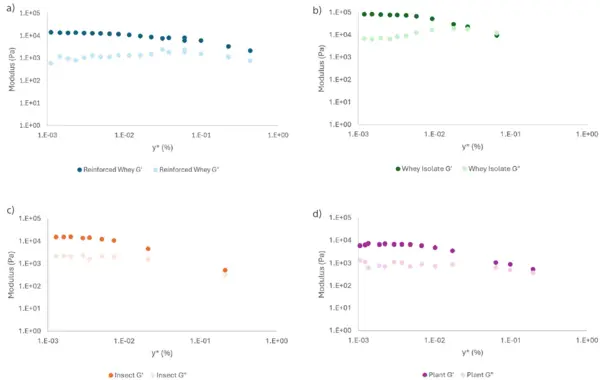
The measured viscoelastic properties of the dry powders give us insight into the networks formed by particle-particle interaction (electrostatics, friction, etc.). Understanding these properties is not only important with processing and flowability, but in understanding how strong these networks are when it comes to dissolution. The whey protein isolate has the highest initial modulus values suggesting it forms the stiffest powder network, but it also displays the lowest region of linear viscoelasticity (the region in which G’ and G” display linear response with increasing StrainStrain describes a deformation of a material, which is loaded mechanically by an external force or stress. Rubber compounds show creep properties, if a static load is applied.strain) demonstrating that although the network is stiff it requires little shear StrainStrain describes a deformation of a material, which is loaded mechanically by an external force or stress. Rubber compounds show creep properties, if a static load is applied.strain to break the particles apart. In contrast, the reinforced whey protein has the largest region of linear viscoelasticity suggesting that the network created by the particles is robust to shear or process VibrationA mechanic process of oscillation is called vibration. Vibration is a mechanical phenomenon whereby oscillations occur about an equilibrium point. In many cases, vibration is undesirable, wasting energy and creating unwanted sound. For example, the vibrational motions of engines, electric motors, or any mechanical device in operation are typically unwanted. Such vibrations could be caused by imbalances in the rotating parts, uneven friction, or the meshing of gear teeth. Careful designs usually minimize unwanted vibrations.vibration.
It is important to note, besides the physical/mechanical differences observed between the differently sourced protein powders, it would also be expected that they display different thermal properties as well [2].
Viscoelastic properties of the a) reinforced whey, b) whey protein isolate, c) insect blend, and d) plant blend protein powders as measured by an amplitude sweep at 1 Hz from a shear StrainStrain describes a deformation of a material, which is loaded mechanically by an external force or stress. Rubber compounds show creep properties, if a static load is applied.strain of 0.001 to 1%.
Dissolution
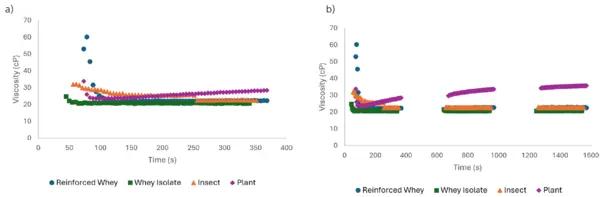
A standard recipe for protein powder smoothies is to add one scoop (25-35 g) to 1-1.5 cups of water. Our goal in this study was not only to measure the time it took the various protein powders to dissolve, but also how well they remained dissolved versus sedimenting. We also wanted to determine dissolution and viscosity as these samples would be mixed, either industrially or at home with a blender. To that end, shear rates in a model mixer were found to range from 0-400 1/s (dependent on size, propeller, etc.) [3]. For measurement, 35 g of water was added to a 34 mm diameter cup. 4.4 g of each protein powder was then poured on top of the water before the starch paddle was lowered to a set gap of 5 mm. Each sample was then mixed at 300 1/s for 5 minutes. After initial mixing, the sample was allowed to sediment for 5 minutes before being mixed again at 300 1/s for 5 minutes. This pattern of pausing and mixing was completed for an additional cycle for each sample (total measurement time of 25 minutes).
The results of the dissolution study are shown in Figure 3. Looking Figure 3a) which shows viscosity as a function of mixing at 300 1/s for 5 minutes, is it obvious that the whey protein isolate dissolves the fastest and has the lowest viscosity of all the mixtures. The reinforced whey takes just under two minutes to reach a stable measured while the insect blend takes over 4 minutes. Importantly, the plant-based blend never reaches a stable viscosity but continues to increase, suggesting that more of the protein is being hydrated and going into solution. From Figure 3b), we see that over the entire 25-minute testing window and with three separate mixing steps the plant-based blend still increases in viscosity and has not reached a steady value. In comparison, the other three protein powders reached a stable measurement after the first mix. Not only does the plant-based blend continue to hydrate even after 25 minutes in solution, but its final viscosity is nearly double that of the whey protein solate at the same concentration.
Tribology Measurements
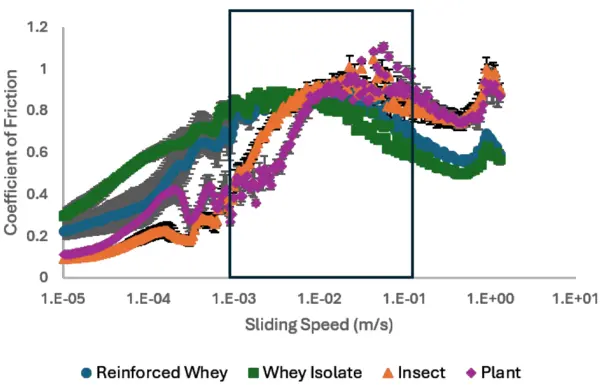
We have shown previously how tribology (the study of friction and lubrication) assessment with the Kinexus Prime ultra+ can be utilized by the food science industry to correlate food structure with sensory perceptions such as mouthfeel [4]. We took the protein shakes produced during the dissolution studies and tested them using a ball-on-three-pins tribology cell. The upper geometry utilized a borosilicate glass ball (12.7 mm in diameter), and the lower geometry three elastomeric pins (Sylgard 184) to best simulate the soft oral tongue-palate tribopair. It has been reported that the average speed of tongue movement over the palate during the five stages of liquid swallowing is 10.3 mm/s [5]. Samples were measured in triplicate at room temperature over a sliding speed of 5e-7 to 1.3 m/s.
The extended Stribeck curves of the four protein smoothies are shown in Figure 4. Traditionally, a low coefficient of friction is defined as < 0.3 while a high coefficient of friction is > 0.6. The region of 1 mm/s to 100 mm/s is highlighted to encompass the range of speeds in which the tongue moves over the palate while drinking. Both the reinforced whey and whey protein isolate have similar profiles while the insect blend and plant blend both have initially coefficients of friction which increase as a function of sliding speed. This would suggest that during the action of swallowing, both the insect blend and the plant blend would have an increasingly grainy texture caused by particle agglomeration, thus resulting in a higher coefficient of friction. This data is pivotal in understanding the age-old question ‘how smooth is your smoothie?’
Summary
In this study, we explored the properties of differently sourced protein powders from differently processed wheys, to full plant blends, to insect blends. Using the Kinexus Prime ultra+ we were able to address the dry powder properties to dissolution characteristics and even understand how the final solutions might feel in the mouth while drinking them. The development of plant-based and insect-based protein products is a major area of research in the food and beverage industry. Understanding variables such as flowability and dissolution is critical for both manufacturing and the enjoyment of the end user.