Introduction
With the growing global population and ever-increasing demand for proteins, some alternative protein sources have recently attracted rising interest, such as plantbased proteins, cultured or cultivated meat proteins, fermentation-derived proteins, edible insect proteins and algae [1]. The gelling property is among the most important functions of alternative proteins, contributing to the texture and taste of food products. Gelation occurs during processing and manufacturing of food products. Heating is one of the most frequently used methods to form gels with alternative proteins. After denaturation and unfolding of protein molecules by heating and enveloping water, they will be aggregated to form a three-dimensional network structure, i.e., the gel structure.
In practice, a rotational rheometer is suitable to study heat-induced gelling properties of alternative proteins, such as the gelling temperature, gel stability and gel strength.
Materials and Measurement Conditions
The protein powders were dispersed in demineralized water at defined protein concentrations (pea protein concentrate: 10 wt% and 7 wt%, insect proteins: 10 wt%). The protein suspensions were agitated with a magnetic stirrer at room temperature for 2 hours. Beside the whole egg sample, an egg white sample was prepared by removing the egg yolk and vigorous whisking at room temperature for a few minutes to get a homogeneous solution.
A NETZSCH Kinexus Prime pro+ Rheometer, equipped with a plate-plate system (diameter: 40 mm, gap: 0.5 mm) was used to perform the measurements on the pea protein concentrate samples, the whole egg and egg white samples. A temperature sweep was carried out by increasing the temperature from 25°C to 95°C at a rate of 5°C/min. After reaching the highest temperature, the heat-induced gels were held for 10 min to study gel stability. The storage modulus (G’) und Viscous modulusThe complex modulus (viscous component), loss modulus, or G’’, is the “imaginary” part of the samples the overall complex modulus. This viscous component indicates the liquid like, or out of phase, response of the sample being measurement. loss modulus (G’’) were recorded during the experiment. The obtained results for plant-based proteins and egg proteins were compared with those for insect proteins [2].
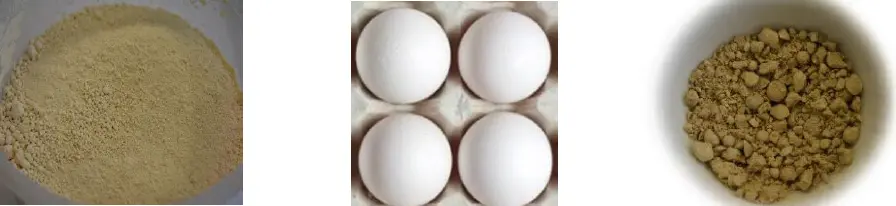
Middle: Fresh eggs (used as animal proteins for comparison): both the whole egg and egg white were analyzed, respectively.
Right: Non-plant-based novel proteins: insect proteins (crude protein content 68.7 g/100 g) extracted from black soldier fly (BSF) pupae insects in a previous study [2]
Measurement Results and Discussion
The gelling properties of different alternative proteins and a typical animal protein source (egg) were studied during and after heating with rotational rheometry.
Figure 2 displays the storage modulus, G’, and Viscous modulusThe complex modulus (viscous component), loss modulus, or G’’, is the “imaginary” part of the samples the overall complex modulus. This viscous component indicates the liquid like, or out of phase, response of the sample being measurement. loss modulus, G’’, of the gel formed with pea protein concentrate during thermal treatment. An increase in G’ and G’’ occurs when the temperature increases up to approx. 55°C. This results from the protein denaturation. After thermal treatment by further increasing the temperature, G’ is higher than G’’ at a protein concentration of 10 wt%, showing a solid-like gel behavior.
In addition, an experiment on the pea protein concentrate at a lower protein concentration of 7 wt%, indicates that G’’ is higher than G’ with increasing the heating temperature, suggesting a weak liquid-like gel behavior.
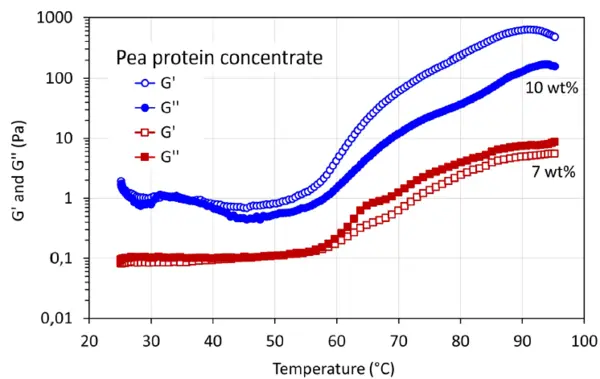
However, the crossover G’ = G’’ was not observed in this study of pea protein concentrate.
In a previous study of the heat-induced gelation with BSF pupae insect proteins [2], it has been found that with increasing the temperature above 50°C, both G’ and G’’ increased, caused by protein denaturation. The sample studied began to form gel, which was indicated by the crossover G’ = G’’ at 60°C, the temperature of gelling point.
The curve progression over the temperature for insect proteins is different from that for pea protein concentrate. Such different gelling behavior can be attributed to different material compositions and individual protein characteristics such as possible different hydrophilic and hydrophobic amino acids and their ratios among various alternative proteins.
The gelation curves of both the whole egg and egg white samples exhibit the typical sol-gel transition during the temperature sweep. As of approx. 60°C, a significant increase in G' and G" can be observed, which be explained, for example, by structural changes or denaturation of the proteins. Figure 3 illustrates G’ and G’’ of the gel formed with the whole egg solution during thermal treatment. G’ displays an apparent increase at about 62°C and a sharp increase at about 75°C, while G’’ shows a dramatic increase at about 75°C. The crossover point occurs at about 74°C. For the egg white sample (Figure 4), both G’ and G’’ display two apparent increases at about 64°C and 75°C, respectively. The crossover point occurs at about 62.5°C. The observed denaturation phenomena can be related to the chemical composition of the whole egg sample (egg white and yolk) and egg white sample.
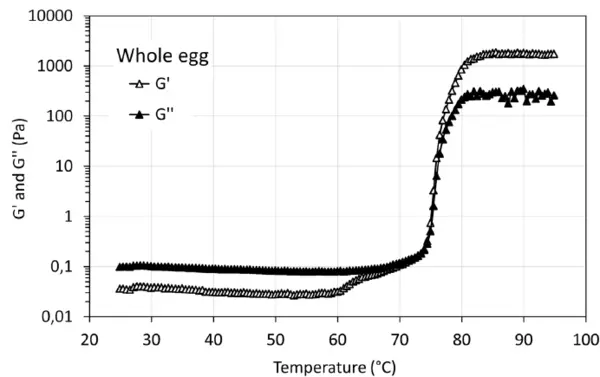
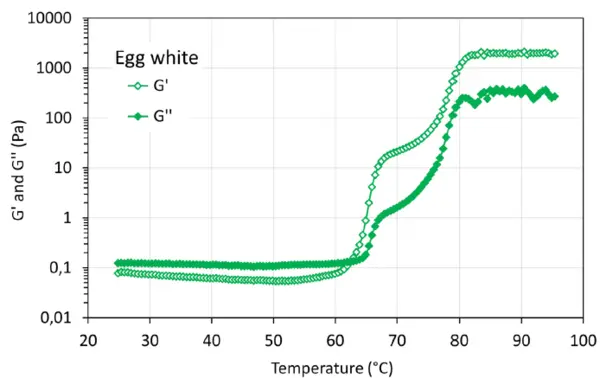
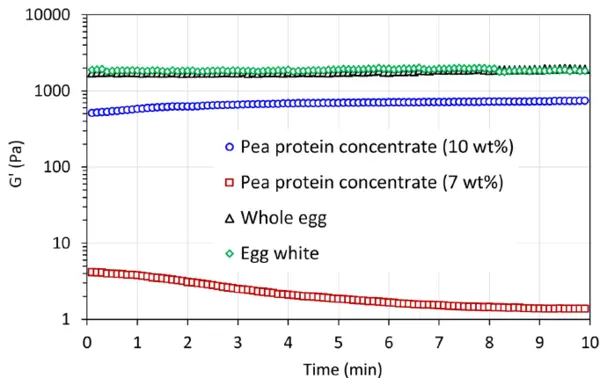
Figure 5 illustrates the gel strength, G’, and stability within 10-min holding time after reaching the highest temperature. The heat-induced gels from egg proteins exhibit the highest strength and are very stable. Such stable gel property has also been observed at a temperature higher than 85°C in figure 3 and figure 4. For the pea protein concentrate sample at 10 wt%, it takes about 4 min to reach the highest gel strength and then the formed gel is stable, whereas the gel strength decreases slightly for the pea protein concentrate sample at 7 wt%. This might be due to the deformation (destruction) of the formed weak gel structure during the measurement. As compared to the strength of the gel formed with insect proteins [2], those gels exhibit different gel strengths, G’, following the order

This might suggest that different alternative proteins have different potential applications. For instance, the heat-induced gels with a lower G’ value or a weak gel network might be interesting and suitable for liquid food formulations like plant-based drinks or alternative milks, whereas the gels with a higher G’ value or a strong gel network would be interesting for dairy and meat analogues and so on.
It is worth mentioning that the gelling properties of alternative proteins are influenced by different factors, such as protein type, protein content, temperature, pH value, Ionic strength and other components.
Conclusion
The heat-induced gelling properties of two alternative protein sources (plant-based proteins and non-plant-based novel proteins) were studied by applying rotational rheometry. The gelation curves of the storage modulus, G’, and loss modulus, G’’, were recorded and interpreted during the temperature sweep. The gelling temperature, gel stability and gel strength of alternative proteins were analyzed and compared with those of animal proteins (egg). Such measurements are fast and require a relatively small amount of representative sample.