09.09.2026 by Aileen Sammler
Introduction to the Rheology of Dispersions – Fundamentals, Influencing Factors and Measurement Methods
Discover the fundamentals of dispersion rheology, key influencing factors, and measurement methods. Download the free NETZSCH white paper.
Rheology of Dispersions
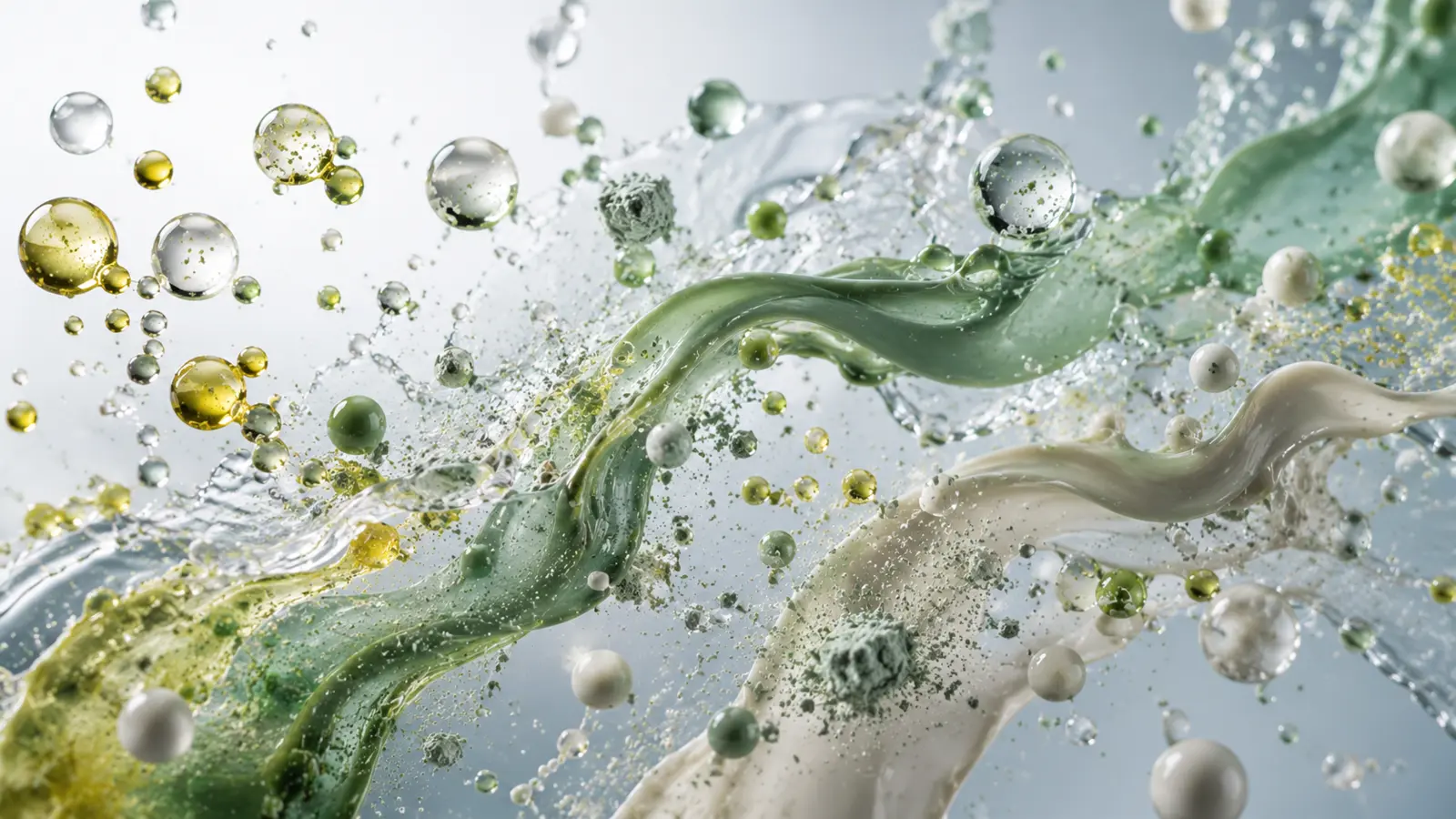
A dispersion designs a system in which one phase (e.g., particles) is distributed into another phase (e.g., a liquid). Dispersions are part of our everyday lives — in foods, paints, cosmetics, and industrial coatings.
What determines how these complex systems behave during the process (, spraying or pumping)? How to ensure that particles present in a dispersion (e.g., herbs in a salad dressing) will not settle? Or when watery and oily phases of a face cream will not separate? The answer lies in rheology, the science of the flow and deformation behavior of materials.
The new White Paper from NETZSCH Analyzing & Testing provides a comprehensive introduction to the rheology of dispersions and explains how to accurately characterize the behavior of such systems.
Rheology Determines the Flow Behavior
Rheology describes how materials flow or deform under external forces. Rheological tests include the determination of the flow behavior, i.e., the shear viscosity curve.
Materials exhibit different types of flow behavior:
- Ideally viscous materials show a linear relationship between shear StressStress is defined as a level of force applied on a sample with a well-defined cross section. (Stress = force/area). Samples having a circular or rectangular cross section can be compressed or stretched. Elastic materials like rubber can be stretched up to 5 to 10 times their original length.stress and shear rate. Their shear viscosity is independent of the shear rate/shear StressStress is defined as a level of force applied on a sample with a well-defined cross section. (Stress = force/area). Samples having a circular or rectangular cross section can be compressed or stretched. Elastic materials like rubber can be stretched up to 5 to 10 times their original length.stress applied.
- Shear-thinning materials (e.g., paints and sauces) become less viscous when shear is applied.
- Shear-thickening materials (e.g., cornstarch-water mixtures) become more viscous under StressStress is defined as a level of force applied on a sample with a well-defined cross section. (Stress = force/area). Samples having a circular or rectangular cross section can be compressed or stretched. Elastic materials like rubber can be stretched up to 5 to 10 times their original length.stress.
Key Factors Influencing Flow Behavior
The rheological behavior of dispersions depends on multiple parameters. The most important influencing factors include:
- Volume concentration of the dispersed phase
- Particle size, shape, and distribution
- Viscosity of the continuous phase
- Interactions between dispersed particles (e.g., electrostatic or hydrophobic forces)
- Temperature
- Surface-active substances
- Maximum packing DensityThe mass density is defined as the ratio between mass and volume. density
Rheological Measurement Methods
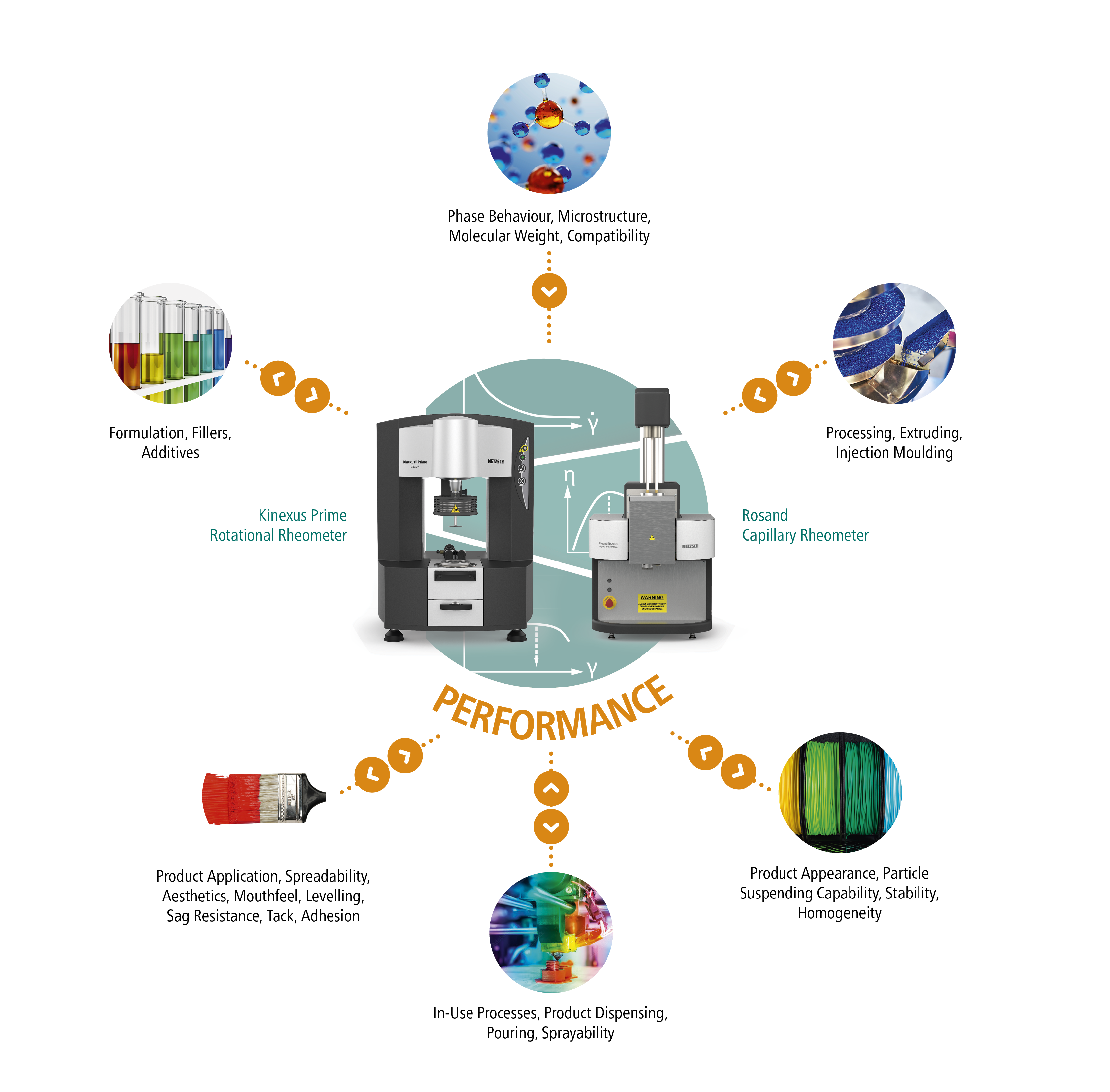
NETZSCH offers a variety of measurement techniques for accurately determining the rheological properties of dispersions:
- Rotational rheometers – ideal for low to medium shear rates
- High-pressure capillary rheometers – suitable for medium to high shear rates, especially in process-related applications
Important aspects to consider during measurements include:
- Avoiding sedimentation
- Detecting and correcting wall slip
- Minimizing shear heating and flow separation
These methods, laboratory measurements can closely replicate real process conditions — from food dispersions like sauces and mayonnaise to technical suspensions such as paints or coatings.


Practical Examples: From Mayonnaise to Wall Paint
The White Paper illustrates how rheological measurements can be applied to optimize product quality and process stability:
- Food industry: Determining the yield point helps ensure desired texture and stability — for example, keeping mayonnaise firm on French fries or preventing sauces from spreading uncontrollably.
- Coatings and paints: Controlling viscosity ensures smooth, uniform application without dripping or sagging.
Such insights enable engineers and product developers to fine-tune formulations for specific performance requirements.
Conclusion: Rheology as the Key to Understanding Complex Systems
Rheology is more than just a measurement discipline — it is a fundamental tool for understanding material behavior across nearly every industry. With the right rheological methods, products can be developed more precisely, processes can be optimized, and consistent quality can be achieved.
The NETZSCH White Paper offers a clear and practical overview — from basic rheological theory to advanced, real-world applications.
➡️ Read the full White Paper here: