Webinar
22.09.2026
AI-Driven Materials Discovery: The Role of Thermal Analysis in Autonomous Research
English
2:00 p.m. - 3:00 p.m. EDT (Eastern USA Time)
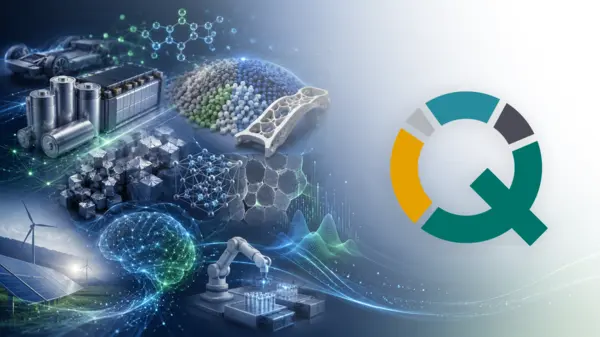
How Thermal Characterization Accelerates AI-Guided Development of Batteries, Polymers, Metals, and Energy Materials
Artificial intelligence is transforming how new materials are discovered, optimized, and commercialized. Yet even the most advanced machine learning models rely on one fundamental requirement: high-quality experimental data.
This webinar explores how thermal analysis techniques including DSC, TGA, STA, DMA, and LFA provide the critical material-property data that powers AI-driven research and materials informatics. Learn how thermal properties such as Glass Transition TemperatureThe glass transition is one of the most important properties of amorphous and semi-crystalline materials, e.g., inorganic glasses, amorphous metals, polymers, pharmaceuticals and food ingredients, etc., and describes the temperature region where the mechanical properties of the materials change from hard and brittle to more soft, deformable or rubbery.glass transition temperature, Crystallinity / Degree of CrystallinityCrystallinity refers to the degree of structural order of a solid. In a crystal, the arrangement of atoms or molecules is consistent and repetitive. Many materials such as glass ceramics and some polymers can be prepared in such a way as to produce a mixture of crystalline and amorphous regions.crystallinity, Thermal StabilityA material is thermally stable if it does not decompose under the influence of temperature. One way to determine the thermal stability of a substance is to use a TGA (thermogravimetric analyzer). thermal stability, Decomposition reactionA decomposition reaction is a thermally induced reaction of a chemical compound forming solid and/or gaseous products. decomposition behavior, mechanical properties, and Thermal ConductivityThermal conductivity (λ with the unit W/(m•K)) describes the transport of energy – in the form of heat – through a body of mass as the result of a temperature gradient (see fig. 1). According to the second law of thermodynamics, heat always flows in the direction of the lower temperature.thermal conductivity are increasingly being used to train predictive models for batteries, polymers, metals, and energy materials.
The presentation will also introduce Proteus® Now Quantify, demonstrating how automated analysis and organization of thermal characterization data can transform large experimental datasets into AI-ready information. By accelerating data extraction, standardizing interpretation, and enabling trend analysis across thousands of experiments, researchers can move more efficiently from measurement to insight.
Real-world examples will show how thermal analysis supports autonomous experimentation, battery safety research, polymer development, and next-generation digital R&D workflows.
Participants will learn:
- How thermal analysis supports AI-driven materials discovery.
- Which thermal properties provide value for machine learning models.
- Examples of AI applications in batteries, polymers, metals, and energy materials.
- How Proteus® Quantify helps generate structured, AI-ready datasets.
- How thermal characterization fits into autonomous and self-driving laboratory environments.
Register for this webinar if you work in materials research or R&D and want to explore how thermal analysis, structured data, and AI can accelerate materials development.
Speaker:
Peter Ralbovsky
Northeast Sales Manager at NETZSCH Instruments North America, LLC
NETZSCH Analyzing & Testing
Register now free of charge!