Introduction
Polyphenylene sulfide (PPS) is a high-performance thermoplastic polymer that is used in demanding technical applications due to its high thermal and chemical resistance as well as its dimensional stability. PPS plays a central role in the manufacture of thermally and mechanically stressed components, particularly in the automotive, electronics and aerospace industries. Comprehensive knowledge of Thermal ConductivityThermal conductivity (λ with the unit W/(m•K)) describes the transport of energy – in the form of heat – through a body of mass as the result of a temperature gradient (see fig. 1). According to the second law of thermodynamics, heat always flows in the direction of the lower temperature.thermal conductivity is crucial for the thermal design and thermal management of such components. It enables precise modeling of heat flows and prevents local overheating, all of which in turn increases the operational safety and service life of the systems.
GHFM Method
The TCT 716 Lambda, which functions according to the GHFM (guarded heat flow meter) method, can carry out a straightforward characterization of polymers thanks to its ability to measure Thermal ConductivityThermal conductivity (λ with the unit W/(m•K)) describes the transport of energy – in the form of heat – through a body of mass as the result of a temperature gradient (see fig. 1). According to the second law of thermodynamics, heat always flows in the direction of the lower temperature.thermal conductivity directly. Even small changes in the chemical composition, due to the addition of fillers, can be detected.
Measurements
Tables 1 and 2 describe both the PPS samples tested and the measurement conditions. Samples of pure and modified PPS (glass fiber + Carbon BlackTemperature and atmosphere (purge gas) affect the mass change results. By changing the atmosphere from, e.g., nitrogen to air during the TGA measurement, separation and quantification of additives, e.g., carbon black, and the bulk polymer can become possible.carbon black) were available. All samples were analyzed using the TCT 716 Lambda.
Table 1: Samples
| Sample | Pure PPS | Filled PPS |
|---|---|---|
| Number | 2 | 2 |
| Thickness | 4 and 5 mm | 4 and 5 mm |
| Diameter | Approx. 51 mm | Approx. 51 mm |
Table 2: Measurement parameters
| Temperature program | 25 - 200°C in 25-K steps |
|---|---|
| Temperature gradient | 30 K |
| Pressure | 175 kPa |
| Calibration material | Vespel Sp1 |
Results and Discussion
Figure 1 provides an overview of the Thermal ConductivityThermal conductivity (λ with the unit W/(m•K)) describes the transport of energy – in the form of heat – through a body of mass as the result of a temperature gradient (see fig. 1). According to the second law of thermodynamics, heat always flows in the direction of the lower temperature.thermal conductivity measurements obtained from both filled and unfilled PPS samples. The orange measurement curves show the results of the Thermal ConductivityThermal conductivity (λ with the unit W/(m•K)) describes the transport of energy – in the form of heat – through a body of mass as the result of a temperature gradient (see fig. 1). According to the second law of thermodynamics, heat always flows in the direction of the lower temperature.thermal conductivity tests for the samples made of pure PPS, while the blue measurement curves represent the results for the filled samples. As expected, the filled samples exhibit a significantly higher Thermal ConductivityThermal conductivity (λ with the unit W/(m•K)) describes the transport of energy – in the form of heat – through a body of mass as the result of a temperature gradient (see fig. 1). According to the second law of thermodynamics, heat always flows in the direction of the lower temperature.thermal conductivity (approx. by a factor of 1.75) than the pure PPS. The results for the filled samples are nearly identical.
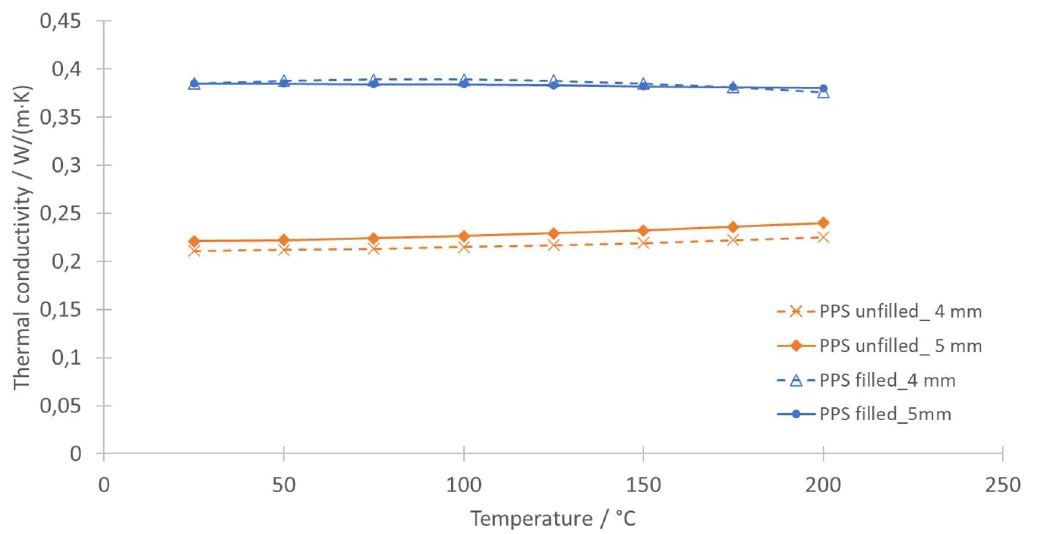
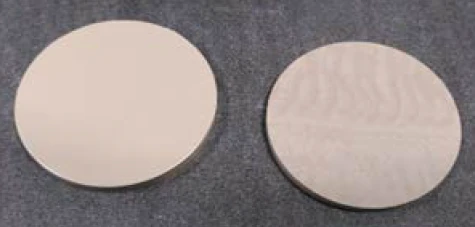
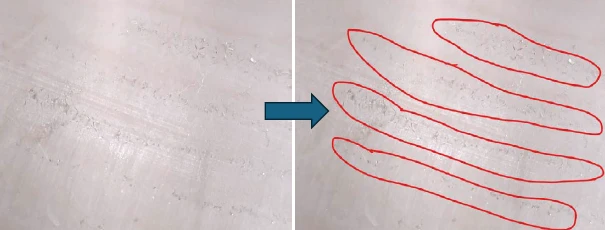
In the case of the samples made of pure PPS, the 4-mm sample has a slightly lower thermal conductivity (difference of approx. 6.3%). This is probably due to structural differences between the two samples. The 4-mm sample appears to have an inhomogeneity (see figure 2) which, on closer inspection, could be linked to pores within certain areas of the material (see figure 3). This structural inhomogeneity probably originates from the manufacturing process. Pores normally lead to a reduction in thermal conductivity, which is confirmed by the results of the TCT measurements.
Summary
The TCT 716 Lambda enables direct measurement of the thermal conductivity of polymers and offers high effectiveness in analyzing thermal property differences between pure polymer matrices and filler-reinforced polymers. It also reliably detects subtle variations caused by structural changes resulting from different manufacturing processes.
In addition, the TCT 716 Lambda features two independent test stacks, allowing for faster data collection and higher throughput – an important advantage for quality control in industrial environments.