Customer SUCCESS STORY
Understanding Melt Fracture in Polymer Processing with NETZSCH Capillary Rheometers
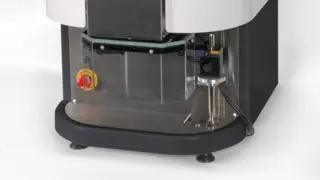
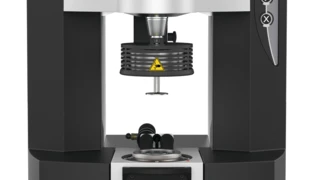
This is a customer success story by Don Fleming. As founder of Fleming Polymer Testing, he has been providing contract testing services to the polymer industry since 1988, using the NETZSCH capillary rheometers RH2000, RH7 and RH10.
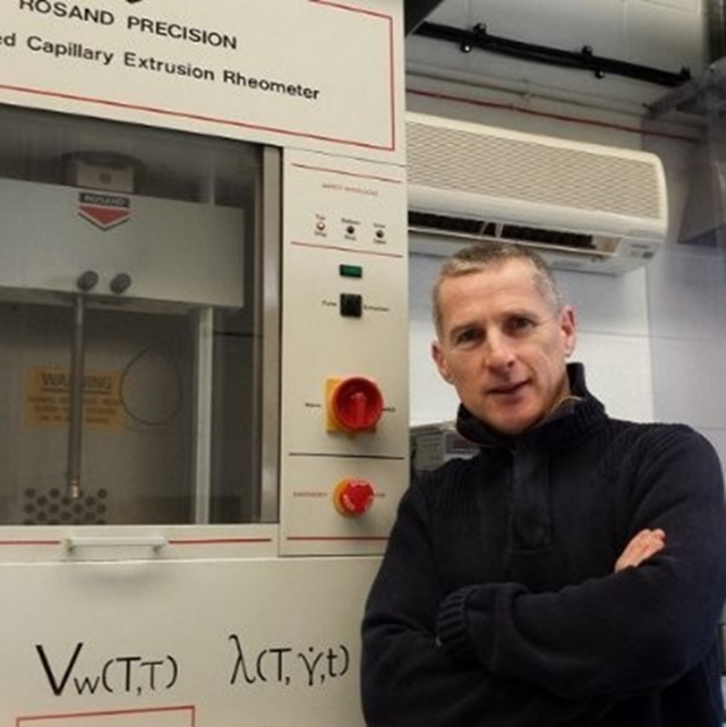
Introduction of Don Fleming
“My name is Don Fleming. I graduated in Mechanical Engineering at Bradford University before undertaking a PhD in the same department. The substantive areas of my research were the reactive extrusion of cross-linked LLDPE and PET foams via twin screw extrusion and the department's capillary rheometer was an essential part of this work, eventually resulting in me working for Rosand in the early 1990’s. I established Fleming Polymer Testing in 1998 using capillary rheometry as the cornerstone of my business providing contract testing work to the polymer industry.
On commencing the business, it was a given that the rheometer was going to be the Rosand twin bore and having seen many other rheometers in the field, there is no question that the Rosand was and continues to be the premier instrument.
The business now has a RH2000, RH7 and RH10. All three instruments have worked on a range of materials, not only polymers, and its flexibility and sensitivity has allowed complex work such as the melt fracture described below to be performed with ease.
The Goal: Solving Real-Life Polymer Process Problems
Since then, the business has expanded and consolidated to encompass distributorship of the Compuplast suite of flow simulation software, which of course relies heavily on data from the rheometer. The business has enabled me to travel to many of the world’s greatest polymer companies to deliver both training and seminars and to bridge the academic aspects of rheometry with the solving of real-life process problems. The routine elements of testing together with the rigors of flow simulation mean that all aspects of the rheometers capability are exercised from die swell to wall slip and melt fracture to extensional viscosity.
Understanding Melt Fracture and Melt Rupture in Polymer Processing
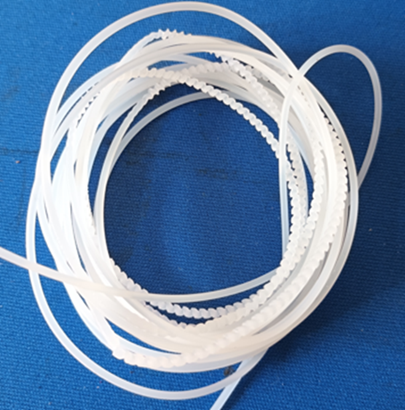
One of the most intriguing and problematic areas of polymer processing is melt fracture. Melt fracture results in the surface of the extruded polymer becoming rough and undulating as shown in figure 1.
This is clearly a serious problem if we need, and in most cases, we do, the surface of our product to be smooth and defect free; no one wants to produce a poor looking cable, profile or pipe! The causes of melt fracture and its sister phenomenon, melt rupture, have been under academic scrutiny for decades, without arguably, much consensus. However, one aspect that is not in contention is that it occurs at a specific, critical StressStress is defined as a level of force applied on a sample with a well-defined cross section. (Stress = force/area). Samples having a circular or rectangular cross section can be compressed or stretched. Elastic materials like rubber can be stretched up to 5 to 10 times their original length.stress and this StressStress is defined as a level of force applied on a sample with a well-defined cross section. (Stress = force/area). Samples having a circular or rectangular cross section can be compressed or stretched. Elastic materials like rubber can be stretched up to 5 to 10 times their original length.stress can be measured only on the capillary rheometer.
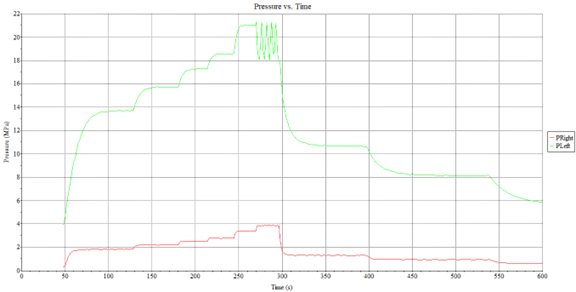
Figure 2 shows the pressure fluctuations experienced by the rheometer on encountering a melt fracturing polymer. Once the surface distortions begin, the long die pressure transducer encounters a cyclic undulation during which pressure equilibrium is not possible; in order to calculate a shear StressStress is defined as a level of force applied on a sample with a well-defined cross section. (Stress = force/area). Samples having a circular or rectangular cross section can be compressed or stretched. Elastic materials like rubber can be stretched up to 5 to 10 times their original length.stress value, the pressure must be in an equilibrium state.
If we are unaware of this phenomenon, we very often produce a shear viscosity function which looks like that of figure 3 where there exists a plateau region. This plateau is not real, but a manifestation of how the rheometer seeks an equilibrium pressure, can’t find one and then moves on to the next shear rate. Although this result is not real, it is indicative of melt fracture and a visual examination of the extrudate will often confirm it. Furthermore, the critical shear StressStress is defined as a level of force applied on a sample with a well-defined cross section. (Stress = force/area). Samples having a circular or rectangular cross section can be compressed or stretched. Elastic materials like rubber can be stretched up to 5 to 10 times their original length.stress can be extracted from figure 3 as that shear StressStress is defined as a level of force applied on a sample with a well-defined cross section. (Stress = force/area). Samples having a circular or rectangular cross section can be compressed or stretched. Elastic materials like rubber can be stretched up to 5 to 10 times their original length.stress where the plateau begins; 500kPa in this case.
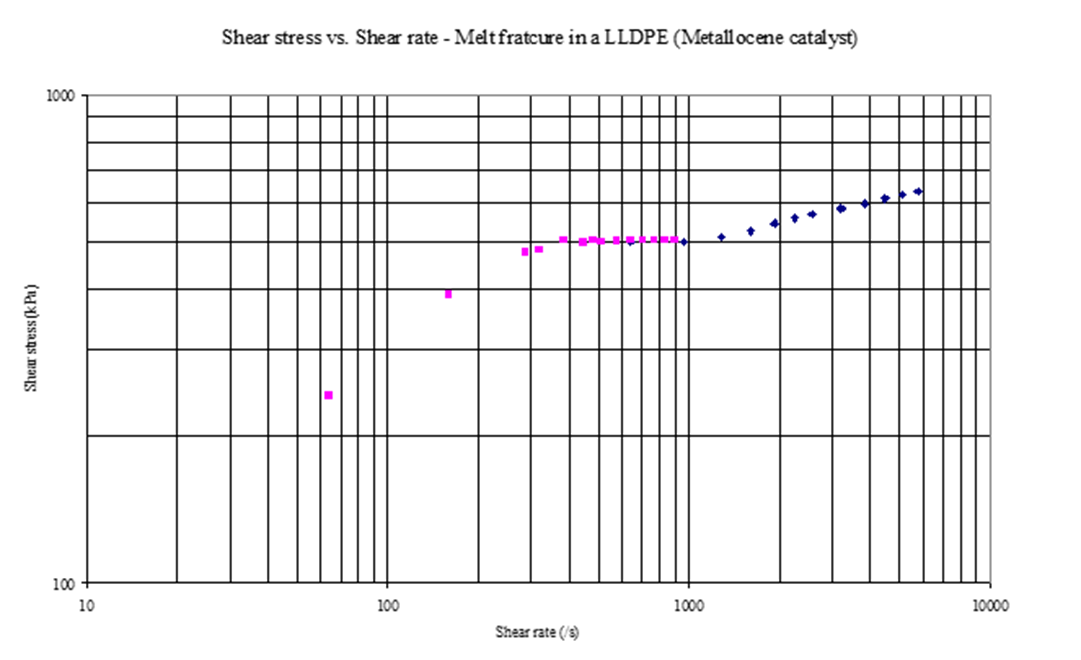
The academic work confirms that the critical StressStress is defined as a level of force applied on a sample with a well-defined cross section. (Stress = force/area). Samples having a circular or rectangular cross section can be compressed or stretched. Elastic materials like rubber can be stretched up to 5 to 10 times their original length.stress is independent of temperature and weight average molecular weight, consequently, it is essentially impossible to irradicate if mass throughput and/or die geometry are retained.
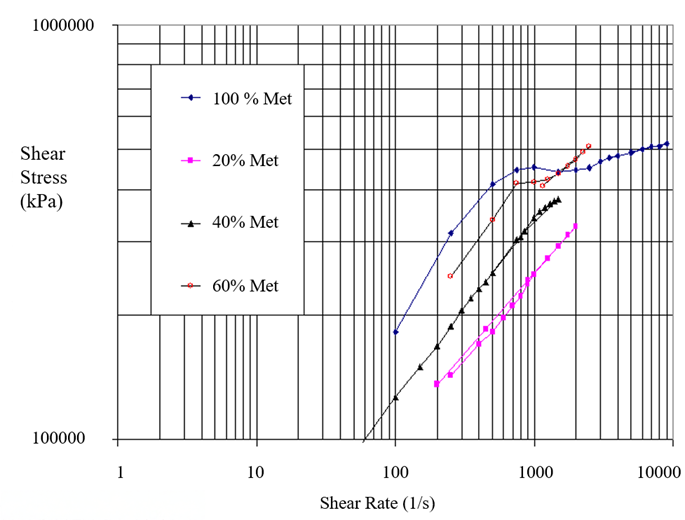
Figure 4 shows melt fracture manifested in a 100% Metallocene catalyzed linear low DensityThe mass density is defined as the ratio between mass and volume. density polyethylene (LLDPE) and it is clear that the critical StressStress is defined as a level of force applied on a sample with a well-defined cross section. (Stress = force/area). Samples having a circular or rectangular cross section can be compressed or stretched. Elastic materials like rubber can be stretched up to 5 to 10 times their original length.stress is around 450kPa. On compounding the Metallocene with increasing proportions of a Zieger Natta catalyzed grade, it is apparent that the critical StressStress is defined as a level of force applied on a sample with a well-defined cross section. (Stress = force/area). Samples having a circular or rectangular cross section can be compressed or stretched. Elastic materials like rubber can be stretched up to 5 to 10 times their original length.stress decreases; on dropping to a 60% metallocene proportion the critical stress reduces to around 410kPa, reducing to around 340kPa at 20%.
This important result provides one of the few methods by which the critical stress can be reduced and how it can only be detected and measured using capillary rheometry.”
Acknowledgement
A big thank you to Don Fleming of Fleming Polymer Testing for sharing his expertise on melt fracture in polymer processing. Don has demonstrated how critical shear stress can be measured and understood — turning complex flow behavior into valuable insights. We're proud to support this important work with our reliable, high-precision rheometers.